
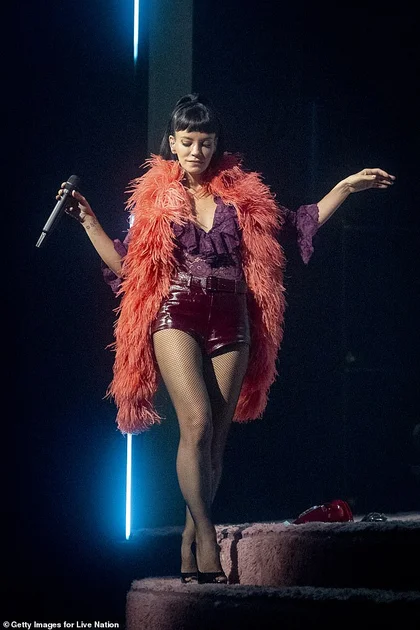
Lily Allen Defends Controversial 50-Minute O2 Arena Performance After Fan Backlash
Lily Allen has directly responded to criticism over her weekend performance at London’s O2 Arena, where fans expressed disappointment over the show’s brief 50-minute runtime, the absence of a traditional support act, and what they perceived as a lack of engagement with the audience. The singer took to social media on Monday to address each complaint, defending her artistic choices while conceding that she is “a bit weird.”
The 41-year-old singer performed her West End Girl show at the O2 Arena on Saturday and Sunday, June 27 and 28, with a third show scheduled for July 7. Audience members quickly took to X (formerly Twitter) to voice their frustration. One user wrote: “Lily Allen at The O2 * No support act * Arrived on stage at 9:10pm * All wrapped up by 10pm * Not one word to the audience * £86 to sit in the gods.” The post, which also noted ticket prices of up to $114 (roughly £86–£90), quickly went viral.
Allen, however, was not willing to let the criticism stand unchallenged. In a series of responses, she clarified that there was indeed a support act — the cello ensemble Dallas Minor Trio, which performs instrumental versions of her older hits before she takes the stage. She also explained that her late start was due to a wardrobe malfunction: “I was a few mins late as my tights were laddered and I had to change them.”
Regarding the show’s length, Allen pointed out that the performance was exactly what had been advertised — a full run-through of her 14-track album West End Girl, which runs approximately 44 minutes. “The show is just over an hour as it’s just the album in its entirety,” she wrote. “The show has always been advertised as ‘Lily Allen performs West End Girl.’”
Most notably, she addressed the criticism over her silence during the performance. “It’s my artistic choice not to talk to the audience, the fourth wall helps with the storytelling. Most people find it to be effective,” she explained, adding that she did not want anyone to feel ripped off and that the entire touring team was “really working very hard to give people the best show we possibly can, and I’m extremely proud of it.”
When the original critic followed up to clarify that he was not critiquing the content of the show, but rather the lack of a simple “thank you,” Allen responded with a self-deprecating quip: “I’d happily concede that I’m a bit weird, though.”
Mixed Reactions from Concertgoers
The singer’s response has drawn a divided reaction online. Some fans defended her, noting that the show was always billed as a theatrical experience rather than a traditional pop concert. “She bowed and waved at the audience and was clearly extremely grateful for us fans who were there. I’ve been to see her …” one attendee commented, though the full post was cut off.
Others remained critical. “It can’t be right to charge that much for an hour, late on Sunday night,” one user wrote. Another added: “I’d also concede that not saying ‘thank you’ at the end of a gig is a d**k move. People in all professions thank customers for providing custom to pay their wages, so why wouldn’t artists appreciate their fans for coming?”
The Concept Behind West End Girl: Theater, Not a Typical Pop Show
To understand the controversy, it is essential to recognize that West End Girl is not a standard concert tour. The album, released in October 2025, is a concept record that chronicles the breakdown of Allen’s five-year marriage to Stranger Things star David Harbour, whom she accuses of multiple affairs. The show was initially conceived as a theatrical piece for smaller venues before being expanded to arenas due to popular demand.
In an earlier interview with Vogue, Allen described the show as “unlike anything I’ve ever done before.” She explained: “On previous tours, the shows have been about my personality and my interaction with the audience. This show can feel more like theater at times.” The performance features an orchestral accompaniment and is designed to maintain a “fourth wall,” a theatrical convention where the performer does not directly acknowledge the audience.
Allen’s decision to remain in character throughout the performance is a deliberate artistic choice aimed at enhancing the storytelling. However, for fans accustomed to her earlier, more conversational tours, the experience may have felt jarring — especially given the premium ticket prices and the large venue setting.
Ticket Prices and Venue Size Add to Discontent
The O2 Arena has a capacity of 20,000, and ticket prices ranged from £50 to £114 (approximately $64 to $145). Some fans felt that the combination of a short set, no traditional support act, and the lack of audience engagement did not justify the cost. The original critic, Rupert Hawksley — an opinion editor for London’s The Spectator — doubled down on his stance, arguing: “it can’t be right to charge that much for an hour, late on Sunday night.”
Allen has faced similar criticism in the past. In 2018, she was criticized for a short set at a festival, and in 2013, she made headlines for walking off stage early. However, this latest backlash is distinct because it stems from the format of the show itself, not from any perceived lack of effort or vocal performance. Multiple sources confirm that Allen’s vocal delivery and the orchestral arrangements were well-received, even by disgruntled attendees. The criticism is centered almost entirely on the structure and presentation.
The Broader Trend: Theatrical Concerts and Fan Expectations
Allen’s West End Girl tour is part of a growing trend among major artists who are blurring the lines between concert and theater. Beyoncé’s Renaissance tour, Taylor Swift’s Eras tour, and Harry Styles’ Love on Tour all incorporate theatrical elements, but they typically balance performance with audience interaction. Allen’s approach — strict adherence to an album tracklist, no encores, no stage banter — is more akin to a Broadway show or a film screening than a rock concert.
This format raises important questions about fan expectations in an era of soaring ticket prices. When the average concertgoer pays over $100 for a ticket, many expect a certain level of engagement and value for money. A 50-minute performance with no intermission and no direct communication can feel inadequate, even if the artistic intent is genuine.
The Role of Social Media in Shaping Artist-Fan Dynamics
The controversy also highlights the intensifying scrutiny artists face through social media. One viral post can shape public perception of an entire tour, and artists are increasingly responding directly to critics in real-time. Allen’s willingness to engage — albeit defensively — is a double-edged sword: it humanizes her but also opens the door for further backlash.
Moreover, the exchange underscores a generational divide. Younger fans, many of whom grew up with Allen’s earlier hits like “Smile,” “LDN,” and “The Fear,” may expect a certain nostalgia-driven experience. Her new work, by contrast, is darker, more introspective, and less immediately accessible. In a cultural landscape where fans often seek connection with artists, the choice to remain silent and in character can feel alienating.
What This Changes: Artist Control vs. Fan Satisfaction
The West End Girl controversy is unlikely to derail Allen’s tour — many dates are sold out — but it does place her at the center of an ongoing debate about artistic integrity versus customer satisfaction. Should artists prioritize their creative vision, even if it means disappointing paying fans? Or does the high cost of live entertainment oblige performers to deliver a more traditional, audience-friendly experience?
Allen has made her position clear. In her response, she wrote: “I don’t want anyone to feel ripped off, Everyone on this tour is really working very hard to give people the best show we possibly can, and I’m extremely proud of it.” She has not announced any changes to the format of the show, suggesting that she will continue to perform West End Girl as conceived.
The Impact on Her Career
For an artist like Allen, whose career has been marked by both critical acclaim and public controversy, this episode reinforces her reputation as an uncompromising creative. However, it also risks alienating the casual fans who fill arena seats. If ticket sales for her additional London dates or upcoming stops in the United States, Australia, and New Zealand begin to dip, the industry may take note.
Some artists, like Cara Delevingne Opens Up About Sobriety, Her Viral 2022 Airport Photos, have rebuilt public trust by being more transparent about their struggles and choices. Others, such as Kash Patel’s UFC Plot Disclosure Sparks Legal and Ethics Concerns, have faced backlash for failing to meet the expectations of their audiences. Allen’s situation is different — it is not about misconduct, but about a mismatch between artistic vision and audience expectation.
Final Verdict: A Show That Divides Opinions
As the dust settles, one thing is clear: Lily Allen’s West End Girl show at the O2 Arena has become a lightning rod for broader conversations about the value and nature of live performance. Whether fans love it or hate it, the show is generating buzz — and for better or worse, that often translates into ticket sales.
For those considering attending future dates, the key takeaway is to understand exactly what they are paying for. This is not a greatest-hits tour. It is a 50-minute theatrical performance of a single album, with no encores, no banter, and no opening act in the traditional sense. For fans who appreciate concept albums and immersive theater, it may be a masterpiece. For those expecting a standard pop concert, it may leave them feeling shortchanged.
As for the West End Girl tour, the next opportunity for audiences to judge the show will be on July 7, when Allen performs her third and final London date at the O2 Arena. Whether she adjusts her approach or continues with the same format remains to be seen. But if the social media response is any guide, the conversation is far from over.
In the meantime, Allen’s own words may serve as the best summary: “I’m a bit weird.” And for many artists, that is exactly the point.
Comments