
Thousands Celebrate as Leeds Pride Expands to Two Days for 20th Anniversary
Leeds Pride 2026 has made history this weekend, drawing an estimated 75,000 visitors to the city centre for its landmark 20th anniversary celebrations. For the first time in its two-decade history, the event is running across two full days, from Saturday, July 18 to Sunday, July 19, with the much-anticipated parade taking place on Sunday.
The expanded format marks a significant milestone for the festival, which began as Leeds Gay Pride in 2006, attracting just 6,500 people. Organisers report that nearly 250 local businesses are supporting this year’s event, underscoring its evolution from a grassroots gathering into one of the largest Pride celebrations in Northern England.
Saturday’s opening day featured live music, tribute acts, and cabaret performances in the Leeds Pride Village on Lower Briggate, including sets from Atomic Kitten’s Natasha Hamilton, Deville, and Disco to Duvet. Attendees travelled from across West Yorkshire and beyond, with some coming from as far as Saltburn-by-the-Sea and Newcastle.
“It makes people feel more comfortable being themselves and who they are,” said Lilly, a 17-year-old attendee from Saltburn-by-the-Sea. “This is a safe space for everyone.”
The weather has been slightly cooler than recent weeks, but brighter skies are expected for Sunday’s parade, which will be led for the first time by Leeds United Football Club.
Leeds United Leads Parade for the First Time
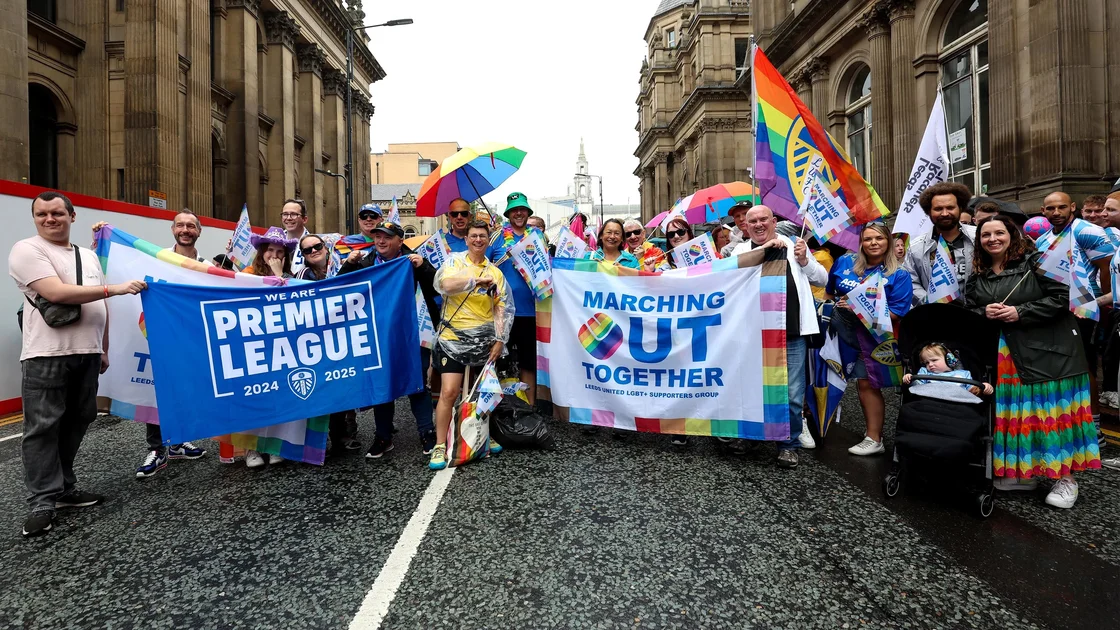
Leeds United, along with its LGBTQ+ supporter group Marching Out Together, is an official sponsor of this year’s Pride and is leading the parade — a historic first for the club in the event’s 20-year history. Former Whites stars Tony Dorigo, Noel Whelan, and Bridie Hannon are marching alongside the club’s mascot, Lucas the Kop Cat, in a show of allyship.
“We’re incredibly proud to once again sponsor Leeds Pride and we are honoured to lead the parade as the event celebrates its 20th anniversary,” said Jade Brown, Leeds United’s Equality, Diversity and Inclusion Lead. “For us, Pride is about more than just attending a single event. It's about demonstrating our ongoing commitment to making Leeds United a place where everyone feels welcome, respected and empowered to be themselves.”
The club has stated it will work across the upcoming season to challenge and eliminate homophobia in football, continuing to promote inclusion regardless of sexual orientation or gender identity.
The inclusion of Leeds United in a leading role reflects a broader trend of professional sports clubs embracing Pride events, even as tensions around LGBTQ+ visibility persist in global sports — notably during the 2026 FIFA World Cup, where a controversial “Pride Match” between Iran and Egypt drew both protests and attention to human rights issues.
‘Pride Is a Protest’: Community Leaders Stress Dual Purpose
While the festival atmosphere dominated the city centre, organisers and community leaders were careful to remind attendees that Pride remains a political act. Lord Mayor of Leeds, Councillor Stephen Holroyd, who made history this year as the first openly gay Lord Mayor alongside his partner Simon Mapals as Consort, emphasised the event’s deeper meaning.
“Pride is a protest,” Councillor Holroyd told the Yorkshire Evening Post. “It shows that we are here and we are not going anywhere. People can come together to be themselves.”
Holroyd, who has attended Leeds Pride regularly since moving to Leeds in 2014, noted that the event has grown from a “small little event” into a massive celebration that brings everyone together, come rain or shine.
This dual identity — protest and party — was echoed by attendees. Michael O’Brian, 60, who travelled from Rochdale, said: “Meeting new people, celebrating everyone’s individuality, and just having a good time really, but also not forgetting that it is a protest and not a party, that’s the main part really. We are all coming together to protest and party.”
Angela Milburn, 61, summed up the spirit succinctly: “It is nice to be inclusive, to include everybody, and to party. Celebrate life.”
The message of protest is particularly resonant this year, as the weekend coincides with ongoing global debates over LGBTQ+ rights. The 2026 World Cup, which concluded recently, featured a designated Pride match between Iran and Egypt — two nations with poor records on LGBTQ+ rights — sparking backlash from both teams’ football federations. FIFA President Gianni Infantino initially stated there would be no official Pride match, but local organisers in Seattle pressed ahead, and FIFA ultimately allowed rainbow flags in stadiums.
Two-Day Format Signals a New Era for Leeds Pride
The decision to expand Leeds Pride to a two-day weekend marks a strategic shift for organisers, who hope to attract even more visitors and grow the event’s economic and cultural impact. Saturday’s programme focused on the Pride Village and cabaret performances, while Sunday centres on the parade — a structure that allows attendees to enjoy both the party atmosphere and the protest march.
“Normally it is on the Sunday, now it is on the Saturday so it opens it up to a lot of other people, which is fabulous,” said O’Brian.
The event has also drawn support from local LGBTQ+ non-profits such as Angels of Freedom, whose founder Rob Wilson described the festival as “epic” in increasing representation of the LGBTQ+ community in the city. The organisation, known for providing volunteering opportunities in the region, is among many community groups taking part.
Leeds Pride’s growth mirrors a national trend: many UK cities are expanding their Pride celebrations as public support for LGBTQ+ rights remains high, even as political debates around trans rights and conversion therapy continue. The festival’s 20-year trajectory — from 6,500 to 75,000 attendees — demonstrates the enduring demand for visible, inclusive community events.
Broader Implications: Pride in a Polarised World
Leeds Pride 2026 takes place against a backdrop of both progress and pushback for LGBTQ+ rights globally. In the UK, the government has faced ongoing pressure to ban conversion therapy and reform the Gender Recognition Act, while trans rights have become a flashpoint in public discourse.
Internationally, the 2026 World Cup highlighted the tensions between sporting events and human rights. The Pride match in Seattle was a rare moment of explicit LGBTQ+ visibility in a tournament hosted by nations with varying records on queer rights — the United States, Mexico, and Canada all have legal protections, but the match itself involved two countries where same-sex activity is criminalised or heavily stigmatised.
Leeds Pride’s leaders are conscious of these wider battles. “Pride is a protest,” Councillor Holroyd repeated, anchoring the celebration in a longer tradition of activism that began with the Stonewall riots in 1969.
For many attendees, the event is both a refuge and a platform. “It makes people feel more comfortable being themselves and who they are,” said Lilly. The sense of a “safe space” is critical, especially for younger attendees who may be navigating their identities in environments that are not always accepting.
The involvement of Leeds United also signals a shift in football culture. English clubs have increasingly embraced Pride events and anti-homophobia campaigns, though incidents of homophobic chanting and abuse in stadiums persist. Leeds United’s pledge to work against homophobia throughout the season will be tested as the new campaign begins.
Looking Ahead: The Future of LGBTQ+ Visibility
As Leeds Pride celebrates its 20th anniversary, its organisers are already looking to the future. The two-day format may become permanent if this year’s event proves successful, and discussions are underway about expanding the parade route and adding more family-friendly zones.
The festival’s growth also brings challenges: managing larger crowds, ensuring safety, and maintaining the grassroots activist spirit amid commercial sponsorship. But for attendees like Mohit Kakodiya, who travelled from Newcastle to mark his 30th birthday at Pride, the event remains a powerful affirmation of identity and community.
“We are all coming together to protest and party,” summed up Michael O’Brian. It’s a message that captures the essence of Leeds Pride 2026 — a celebration of how far the LGBTQ+ community has come, and a reminder of how much further there is to go.
For those enjoying the midsummer weather, the festival also offers a chance to reflect on other natural and cosmic events, such as the Perseid Meteor Shower 2026: New Moon Promises 100 Meteors Per Hour at Peak, which will light up skies later this summer — a fitting metaphor for the brilliance and resilience of the human spirit.
Comments