
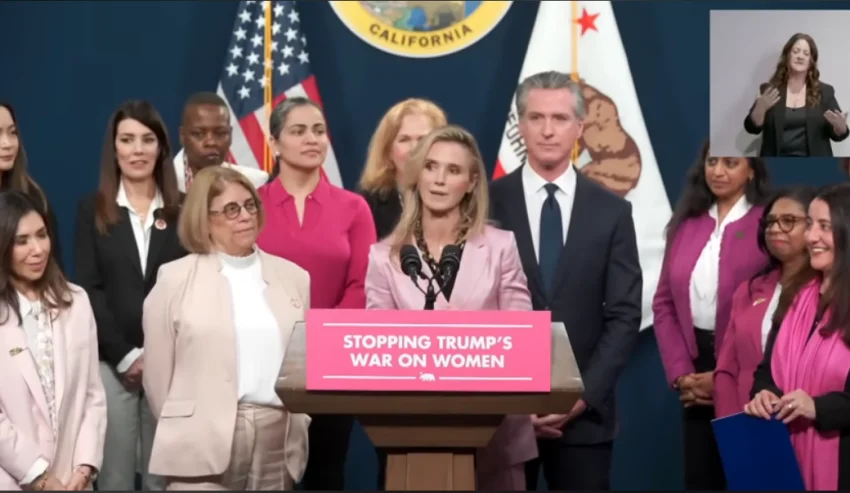
FBI Investigation Targets Jennifer Siebel Newsom in Expanding Federal Probe
California Governor Gavin Newsom has publicly alleged that the FBI is investigating his wife, Jennifer Siebel Newsom, in what he describes as a politically motivated attack orchestrated by President Donald Trump. The Democratic governor, a vocal critic of the former president and a potential 2028 White House contender, stated in a video posted to social media on Monday that federal agents have been knocking on the doors of family, friends, and former employees.
"He's coming after me because I am considering running for president," Newsom said. "If they can't intimidate me, they'll go after the mother of our children. Donald Trump picked the wrong target. We have nothing to hide."
Federal investigators have been examining the finances of both Newsom and his wife for roughly the past year, according to sources familiar with the matter. One line of inquiry focuses on Siebel Newsom's taxes, while another relates to her nonprofit, the California Partners Project (CPP). A separate investigation involves Dana Williamson, Newsom's former chief of staff, who pleaded guilty to federal campaign finance fraud charges in May 2026. The investigations are being handled by the U.S. Attorney's Office for the Eastern District of California, based in Sacramento.
A source familiar with the probe told the BBC that there were "several investigations ongoing" and that they had been active for approximately a year. The source denied Trump's direct involvement, stating that the investigations "all originated out of California, working through whistleblowers and government sources." The White House declined to comment on Newsom's allegations, referring inquiries to the Department of Justice, which also declined to comment.
Newsom has repeatedly framed the inquiry as a weaponization of the federal government against a political rival. In a statement posted to X, he described it as part of "Donald Trump's hit list" and accused the president of launching the probe because he is "considering running for President." He further stated, "He hates that I consistently call him out. He is simply the most corrupt President in American history."
The FBI has not publicly laid out specific allegations against Siebel Newsom or the California Partners Project. However, the scrutiny has cast a renewed spotlight on a complex and often opaque system of political fundraising known as "behested payments."
The 'Behested Payment' System and the California Partners Project
At the heart of the federal probe is the flow of money into the California Partners Project, a nonprofit founded and run by Jennifer Siebel Newsom. The organization focuses on issues such as gender equality, media representation, and family well-being. According to sources cited by Newsweek, federal investigators are examining how "millions of dollars" have been routed to the nonprofit through a mechanism known as "behested payments."
Behested payments are donations made at the request of an elected official to a charitable organization or government entity. In California, these payments are legal and unlimited, but they must be publicly disclosed. The system exists in a legal gray zone, allowing wealthy donors to contribute large sums to causes championed by politicians without directly funding their campaigns. Critics argue that it creates a backdoor channel for influence, enabling donors to curry favor with elected officials while remaining largely outside the traditional campaign finance regulatory framework.
The California Partners Project has received significant contributions from individuals and organizations with business before the state. Federal investigators are now reportedly scrutinizing the relationships between donors, the Newsom administration, and the nonprofit to determine whether any laws were violated. While there has been no allegation of wrongdoing against Siebel Newsom or the CPP, the overlapping networks of political power, donor influence, and charitable funding have become a focal point of the inquiry.
The investigation into behested payments is not unique to California. Similar probes have been launched in other states, including New York and New Jersey, where the lines between political favor-seeking and charitable giving have been tested. Legal experts say the system remains controversial because it allows unlimited donations that can sit uncomfortably close to political power without clear guardrails.
Newsom has dismissed the investigation as a fishing expedition. "Not because they found crime, because they're simply trying to find one," he said in his Monday video. He alleged that federal investigators were "demanding records" and "abusing the grand jury process."
Political Fallout: A Potential 2028 Run and the Trump Factor
The federal investigation lands at a politically precarious moment for Gavin Newsom. The governor, who has long been rumored to harbor presidential ambitions, has aggressively positioned himself as a leading national foil to Trump during the president's second term. He has become a fixture on cable news and social media, relentlessly mocking Trump and his policies. This strategy has raised his profile among Democratic primary voters but has also made him a prime target for Trump and his allies.
By alleging that the investigation is politically motivated, Newsom is attempting to rally Democratic support and frame the probe as an abuse of power. This narrative resonates with a party base that remains deeply skeptical of Trump's Justice Department. However, the strategy carries risks. If the investigation uncovers any improprieties, it could severely damage Newsom's political future and derail any potential White House bid. Conversely, if the probe is seen as baseless, it could generate sympathy for the Newsom family and further galvanize opposition to Trump.
The involvement of Dana Williamson, Newsom's former chief of staff, adds another layer of complexity. Williamson pleaded guilty in May 2026 to three federal counts related to a campaign finance fraud scheme. Newsom has not been implicated in that case, and his office has maintained that he had no knowledge of the illegal activity. However, the proximity of the two investigations — one involving the governor's former top aide and another involving his wife — creates a perception of a broader ethics cloud hanging over the administration.
National Trend: Weaponization of Federal Agencies?
The Newsom case is unfolding against a backdrop of heightened national debate over the politicization of federal law enforcement. During Trump's presidency, the Justice Department and FBI faced repeated accusations of being used as political weapons against the president's enemies, and later, during the Biden administration, conservatives alleged similar bias. The cycle has continued into Trump's second term, with Democrats now claiming that federal agencies are being deployed to harass political opponents.
Trump has publicly embraced the idea of investigating his rivals. In recent months, the DOJ has launched probes into several prominent Democrats, including New York Governor Kathy Hochul, Michigan Governor Gretchen Whitmer, and now Gavin Newsom. While the DOJ maintains that all investigations are initiated based on evidence and legal merit, the pattern has alarmed civil liberties advocates and Democratic strategists, who see it as a dangerous erosion of institutional independence.
In the Newsom case, the source familiar with the investigation told the BBC that the inquiries "all originated out of California" through whistleblowers, suggesting a bottom-up rather than top-down origin. However, Newsom and his allies dismiss this as a procedural technicality, arguing that the Trump administration is happy to greenlight investigations that serve its political ends.
The Road Ahead: Legal and Political Implications
The federal probe into Siebel Newsom's taxes and nonprofit donations is still in its early stages. No charges have been filed, and the scope of the investigation remains unclear. However, the public nature of Newsom's allegations has already escalated the stakes. By publicly accusing Trump of targeting his family, Newsom has made it politically difficult for the DOJ to close the probe without findings without appearing to have backed down under political pressure.
For Siebel Newsom, the scrutiny is intensely personal. A filmmaker and advocate, she has largely stayed out of the political limelight compared to her husband. The investigation into her taxes and nonprofit work puts her personal and professional life under a microscope, a development Newsom highlighted in his video: "If they can't intimidate me, they'll go after the mother of our children."
Legal experts say that behested payment cases are notoriously difficult to prosecute unless there is clear evidence of a quid pro quo — a direct exchange of a donation for an official action. Proving such a connection requires substantial evidence of intent, which is often lacking in cases where donations are made to charities rather than personal accounts. The tax-related portion of the investigation could be more straightforward, depending on whether any discrepancies or omissions are found in Siebel Newsom's filings.
Broader Implications for Political Fundraising and Transparency
Regardless of the outcome, the investigation has already prompted renewed calls for reform of the behested payment system. Good-government groups have long argued that the system allows wealthy donors to circumvent campaign contribution limits by donating to causes favored by politicians. They point out that the public disclosure requirements are often inadequate, making it difficult for voters to track the flow of money and influence.
In California, several bills have been introduced in the state legislature to tighten rules around behested payments, including proposals to lower the threshold for disclosure and to prohibit donations from entities with pending business before the state. The Newsom probe is likely to give these efforts new momentum, especially if the investigation uncovers any questionable practices.
Nationally, the case could influence how other states regulate the intersection of charitable giving and political power. If the federal probe leads to charges or a settlement, it may set a precedent for how prosecutors approach cases involving behested payments in the future. Conversely, if the investigation fizzles, it could be cited as evidence that the system, while imperfect, is not corrupt.
Conclusion
The federal investigation into Jennifer Siebel Newsom's finances has thrust California's first family into a legal and political firestorm. With the governor positioning himself as a potential presidential candidate and accusing the Trump administration of weaponizing the Justice Department, the case has become a flashpoint in the broader national battle over the integrity of federal law enforcement.
For now, the Newsom administration is bracing for further scrutiny. Staffers in the governor's office have already fielded questions from the FBI related to a separate allegation involving interference in a lawsuit against video game company Activision Blizzard — a matter the governor's office says was thoroughly reviewed and closed without findings. That investigation, according to sources, "went quiet" until late last week, suggesting that the FBI's interest in the Newsom orbit is far from over.
As the 2028 presidential election cycle begins to take shape, the outcome of this probe — and the political narrative that emerges around it — could have profound implications for Gavin Newsom's ambitions and for the health of American democratic institutions.
Comments