
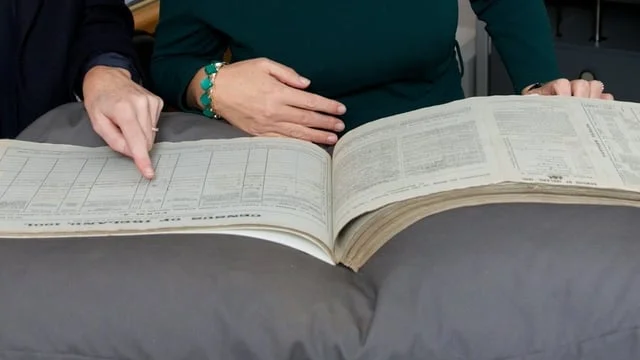
A Century-Old Reckoning: Ireland Opens Its 1926 Census to the Public
After a 100-year wait, the first census of the independent Irish Free State is now freely accessible online. As of midnight on April 18, 2026 — exactly a century after enumerators fanned out across the 26 counties on that April night — the National Archives of Ireland (NAI) published more than 700,000 individual household returns at nationalarchives.ie, free of charge. The release marks one of the most significant moments in Irish genealogical history, offering citizens and diaspora communities worldwide their first detailed digital window into the formative years of a newly independent nation.
What the Records Contain
The 1926 census aimed to count and record every individual living within the Irish Free State on the night of April 18, 1926. Its 13 categories of information are remarkably detailed by the standards of the era. Each record includes names and addresses, relationship to the head of household, age, sex, marital status, birthplace, occupation, and place of employment. There is also a category recording proficiency in the Irish language — a reflection of the new state's cultural priorities — as well as specific columns for married women, who were required to state the number of years married and the number of children born alive. Widows, widowers, and married men faced their own tailored questions about children and stepchildren.
Unlike the previously digitised 1901 and 1911 censuses, which covered all 32 counties of Ireland under British rule, the 1926 census is a strictly 26-county document, reflecting the new post-partition political geography. Northern Ireland is not included.
The Headline Finding: A Sharp Drop in Ireland's Protestant Population
Among the most striking revelations emerging from the newly released data is the scale of demographic change between 1911 and 1926. The non-Catholic population — overwhelmingly Protestant — declined by approximately one third during that period, compared to just a 2% drop among Catholics. National Archives director Orlaith McBride described this shift as "significant."
Census analysts estimate that roughly a quarter of the Protestant decline can be attributed to the withdrawal of British Army personnel and their families following independence. But the remainder reflects a broader social and political transformation: as the Irish Free State took shape following the Easter Rising of 1916, the War of Independence (1919–1921), and the subsequent Civil War, many Protestants — who were statistically more likely to identify as unionist — departed or emigrated.
Regional Variations Tell a Deeper Story
The rate of Protestant population decline was not uniform. Munster recorded the sharpest fall at 42.9%, followed by Connacht at 36.3% and Leinster at 32.4%, while Ulster border counties saw comparatively smaller declines. These regional variations hint at complex local dynamics: proximity to Northern Ireland, the intensity of revolutionary-era conflict in different areas, and the distribution of Anglo-Irish landed families all played a role.
For counties like Wicklow — a county shaped by its mountains, coastline, and closeness to Dublin — the 1926 census fills a 15-year gap in detailed demographic records. The years between 1911 and 1926 saw Wicklow transition from a county under British rule to one governed from Dublin, navigating post-war economic strain, emigration, and internal migration, all while new national policies on language, education, and agriculture began to reshape daily life.
Why This Release Matters: Genealogy, History, and National Identity
The appetite for this data is expected to be enormous. When the NAI released the 1901 and 1911 censuses digitally between 2007 and 2010 — records that had not been subject to the same 100-year embargo — they attracted millions of page views from around the world. The 1926 release is anticipated to surpass that interest, particularly because it bridges a period of extraordinary upheaval and connects to living memory: some of those recorded in 1926 were the parents and grandparents of people still alive today.
The NAI has recommended that members of the public prepare before searching by gathering all available family information — names, approximate ages in 1926, and known addresses. Because name spellings varied widely (Boyle versus O'Boyle, Maloney versus Moloney), users are encouraged to search by county or townland if a name search yields no results. In rare cases, individual entries may be redacted, as some people or their families exercised the right to opt out.
The public can search by name, address, age, and occupation. Original census return images are embedded within individual profiles, and some data points — such as the duration of a marriage — appear only on the original handwritten form, making it worth examining the source document directly.
A New Chapter in Irish Digital Heritage
The 1926 census release represents more than a genealogical resource. It is a foundational document for understanding how the Irish Free State defined itself in its earliest years — what languages its people spoke, how they earned their living, how households were structured, and how a society rebuilt itself after years of conflict and political upheaval.
The digitisation effort follows the successful model used for the 1901 and 1911 censuses, which were initially converted from black-and-white microfilm created by the Church of Jesus Christ of Latter-day Saints (the Mormons) as part of their FamilySearch database. The 1926 records have now been processed to the same standard and are fully searchable online.
For historians and researchers, the census also provides a crucial data point for studying the early Irish state's relationship with minority communities, its economic conditions, and the human cost of partition. Combined with the two earlier censuses, it will now be possible to trace Irish families and communities across a full quarter century — from 1901 through to 1926 — spanning the end of empire and the birth of a republic. That is a rare and powerful tool for any nation reckoning with its own origins.
Comments