
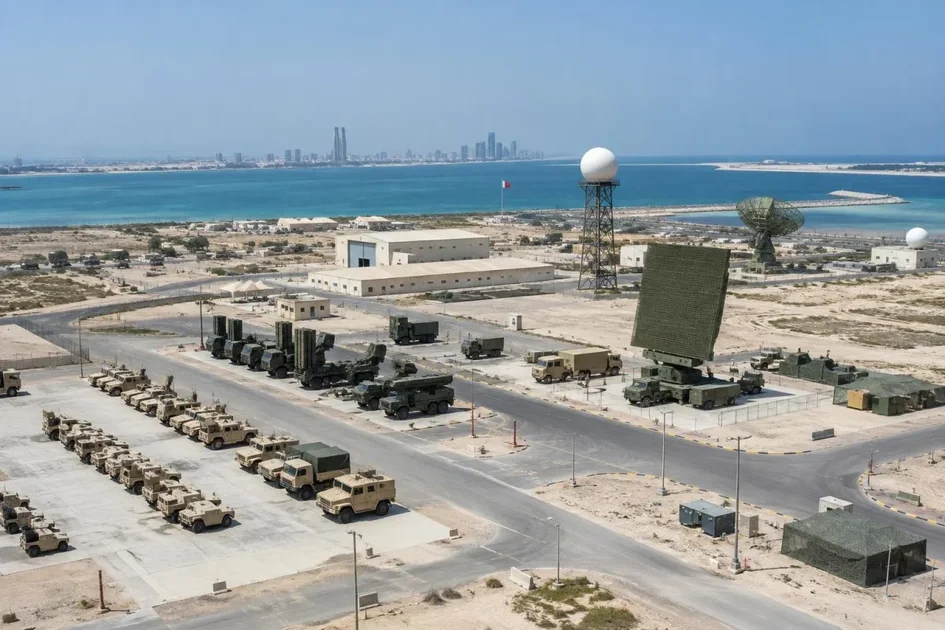
Iran Claims Drone Attack on US Base in Bahrain
Iran’s Islamic Revolutionary Guard Corps (IRGC) said it launched six drones targeting a US air-defense radar at the Al-Rifaa helicopter base in Bahrain on Sunday, according to Iranian state-run Press TV. The claim came as Bahrain’s Interior Ministry issued two safety alerts urging citizens and residents to remain calm and proceed to the nearest safe location—the first such warnings since September.
Bahrain’s Defense Force later stated it had “intercepted and destroyed” an unspecified number of Iranian munitions fired at the kingdom, calling the assault part of Iran’s “systematic hostile approach.” There was no immediate confirmation from US authorities about damage or casualties. The reported attack follows a similar IRGC claim two days earlier that it had struck a US early-warning radar in Bahrain—a claim US Central Command denied, saying it had intercepted two Iranian drones without any damage.
Conflicting Accounts and Regional Alerts
The incident underscores the fragility of the current security environment in the Gulf, where hostile rhetoric and military posturing have become routine. Bahrain hosts the US Navy’s Fifth Fleet, making it a prime target for Iranian retaliation. The Interior Ministry’s alerts, issued early Sunday, advised the public to follow official channels for updates, but provided no specifics on the nature of the threat.
Iran’s Fars news agency quoted the IRGC as saying the attack was in retaliation for “hostile US actions.” The strikes were reportedly aimed at a radar system used for air defense at the Al-Rifaa facility. While the US military has not corroborated the IRGC’s claims, the incident marks the first direct attack on US military installations in months, according to The Guardian.
Context: A War of Attrition and Stalled Diplomacy
The attack is the latest flare-up in a broader conflict that began on February 28 with joint US-Israeli strikes on Iran. Those opening strikes killed a host of top Iranian officials and commanders, including Supreme Leader Ayatollah Ali Khamenei. Since then, Tehran has launched missile and drone attacks on US bases in Gulf countries, while the US has enforced a naval blockade of Iran’s Persian Gulf and Gulf of Oman ports.
Diplomatic efforts to end the conflict have yet to produce a breakthrough. A memorandum of understanding signed in June aimed at ending the war has failed to halt the exchanges of strikes, though the intensity has not returned to the early stages of the conflict. The US maintains that it is enforcing the blockade, while Iran claims control over the strategic Strait of Hormuz and continues to assert attacks on shipping transiting the waterway.
The Strait of Hormuz: A Flashpoint for Global Energy
On Saturday, the IRGC Navy claimed that two oil tankers transiting the Strait of Hormuz struck naval mines, causing explosions and intense fires. The tankers were allegedly attempting to navigate the strait using an “unauthorized and hazardous route,” the IRGC said in a statement carried by the Islamic Republic News Agency. The claim could not be independently verified, but it highlights the persistent risk to global oil shipments through the narrow waterway.
US President Donald Trump has said in recent days that he might hold off on attacking Iran if the US faces no new provocations from Tehran or the Iran-backed Houthis in Yemen, but that he would maintain the naval blockade. Trump also indicated he had asked Vice President JD Vance to end his interest in negotiating a new deal with Iran and instead focus on domestic issues—a sign that diplomatic channels remain frozen.
Houthi Hostilities Add to Regional Instability
Meanwhile, the conflict’s regional dimensions continue to widen. The Saudi-led coalition fighting the Houthis in Yemen said on Sunday it had intercepted two Houthi ballistic missiles launched toward Riyadh and three drones in the kingdom’s oil-rich Eastern Province. The Houthis, who are backed by Iran, have repeatedly targeted Saudi military, oil infrastructure, and transport facilities in recent months.
The intertwining of the US-Iran conflict with the Saudi-Houthi war underscores the potential for the region to spiral into a broader conflagration. Gulf countries, including Saudi Arabia, have reportedly urged Trump to hold back from planned large-scale military strikes on Iran, fearing retaliation and economic disruption.
Public Opinion and Political Pressures
In the United States, the war has become a political liability. Trump has said he was disappointed in the American public because higher diesel prices were a small price to pay for preventing Iran from acquiring a nuclear weapon. His comments come amid widespread Republican losses in the midterms, which some in his party have attributed to the war.
A recent YouGov poll for the Council for Arab-British Understanding found that 65% of the British public would oppose the US resuming the war in Iran, with only 14% in support. The poll also found that 54% oppose UK bases being used by the US to mount attacks on Iran, while 45% support additional UK sanctions against Iran. The survey was conducted before two Iranians were found guilty on Thursday of spying and planning attacks on journalists in the UK—a case that the Iranian embassy rejected as an attempt to advance a political agenda.
Perspective: A Fragile Stalemate with Global Implications
The latest attack on Bahrain highlights the risks of a protracted conflict that neither side seems able to win decisively. For Iran, the drone strikes serve as a demonstration of its ability to reach US assets in the Gulf, even as its economy suffers under blockade. For the US, the intercepts and denials underscore the difficulty of deterring Iranian aggression without escalating into a full-scale war.
The stalemate has far-reaching consequences. Global oil markets remain jittery, with any disruption in the Strait of Hormuz threatening energy supplies. The conflict has also strained alliances, with Gulf states wary of being drawn into a US-Iran confrontation. Meanwhile, the humanitarian toll in Iran and neighboring regions continues to mount.
As diplomatic efforts remain stalled, the risk of miscalculation grows. The IRGC’s warnings of “serious consequences” for repeated violations suggest that Tehran is prepared to escalate further if provoked. The US, for its part, has signaled it will respond to provocations but has avoided large-scale retaliation in recent months. Whether this uneasy equilibrium holds—or collapses into renewed heavy fighting—may depend on decisions made in Washington and Tehran in the coming weeks.
For now, Bahrain’s residents are left to navigate the uncertainty, with safety alerts reminding them that the conflict is not distant but immediate. The kingdom’s ability to intercept the attacks offers some reassurance, but the psychological impact of living under threat is palpable. As one Manama resident told local media, “We are used to tension, but this feels different. It feels closer.”
In a region already scarred by years of war, the latest exchange serves as a stark reminder that peace remains elusive—and that the consequences of failure are borne by ordinary people caught in the crossfire.
Comments