
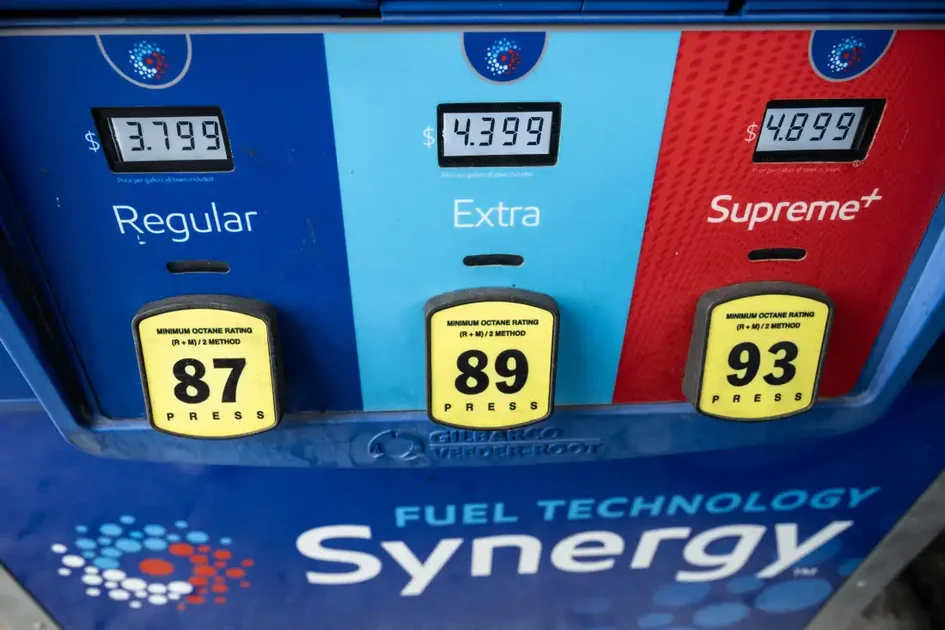
National Average Slips Below Key Psychological Threshold
The average nationwide price for regular gasoline fell below $4 per gallon on Tuesday for the first time since July 20, according to data from AAA. The milestone comes after oil futures plunged 13% last week—the biggest one-week percentage drop for Brent crude since April 2020—and slid another 5% on Monday, briefly dipping below $90 a barrel on Tuesday.
The national average dropped to $3.97 a gallon on Tuesday, down about 3 cents from Monday and roughly 17 cents over the past week, according to AAA. That is about 39 cents lower than a month ago and more than 50 cents below the peak of $4.48 reached on Sept. 21. The decline has been steady: prices have fallen every week since late September, according to Energy Information Administration data.
"The drop in pump prices came after oil futures plunged 13% last week," NBC News reported, citing market data. "For the global crude oil benchmark Brent, it was its biggest one-week percentage drop since April 2020, when the Covid pandemic began shutting down the global economy."
Oil Prices Tumble on De-Escalation Hopes and Political Shift
The slide in oil prices accelerated after President Donald Trump told NBC News last week that he did not plan to attack Iran, playing down the prospect of renewed military strikes. The fall continued after Democratic candidates posted commanding vote totals in Tuesday's midterm elections, a wave some called a "blue tsunami." Markets began betting that Democratic control of Congress would put a cap on some of Trump's most economically disruptive policies, including the Iran war.
"Given the Democrats' control of Congress, there will likely be more scrutiny over the war, while funding it could become more difficult," ING commodities strategists said in a note. "The outcome of the elections means there could be more pushback from the Republican Party, too."
Vice President JD Vance acknowledged the war's political cost, writing on social media after the results: "The reason we lost is the war." He added that "any honest conversation about where we go from here must start there." For traders, Vance's acknowledgment of the war's unpopularity bolstered the case for lower oil prices.
Still, uncertainty remains. On Friday, Trump was briefed on a narrow window for a potential new military campaign against Iran, sources told NBC News, though no decision was taken. Trump on Monday again reinforced that he was leaning against a major escalation. "Iran militarily is effectively over," the president told reporters at the White House. "We're just keeping it the status quo." He said there was "positive momentum" in talks and that he saw a "good chance" the war "could get ended."
Seasonal Factors and Supply Recoveries Add Downward Pressure
While geopolitical developments have dominated headlines, energy analysts say seasonal trends and supply-side improvements are also playing a significant role in the price decline. Gas prices typically fall in autumn as driving demand decreases and stations switch to cheaper winter-blend gasoline, which can be sold starting as early as mid-September.
"Prices usually come down in autumn, when demand falls and stations switch to cheaper winter gasoline," PolitiFact noted in a fact-check published Wednesday. "Analysts said this year's decline was slightly larger than normal." Patrick De Haan, head of petroleum analysis for GasBuddy, told PolitiFact that the seasonal shift is a key driver. Hugh Daigle, a University of Texas at Austin associate professor of petroleum and geosystems engineering, said recent prices have fallen a little more than what's normal for this time of year but remain in line with seasonal trends.
"I think the overall trend is mostly normal seasonal fluctuations," Daigle said, adding that more oil passing through the Strait of Hormuz helps, too. U.S. gasoline stockpiles, which had been below seasonal levels since late April, have started to recover, while crude prices have tumbled on hopes for a faster resolution to the war. Gasoline futures have also slumped this month.
Prices Remain Elevated Historically Despite Recent Relief
Despite the recent relief, gas prices remain significantly higher than they were before the war. The U.S. and Israel launched military strikes on Iran in late February, triggering an energy shock as exports of crude and refined products were disrupted through the crucial Strait of Hormuz. Prices remain more than 30% higher than before the war and around 40% higher than at the beginning of the year.
"US pump prices surged after the US and Israel launched military strikes on Iran in late February," Bloomberg reported, "triggering an energy shock as exports of crude and refined products were disrupted through the crucial Strait of Hormuz." The national average on Nov. 11 was about $3.94, still higher than at this time in any of the last four years, according to EIA data. On the West Coast, the average was $5.11 on Nov. 9, compared with $5.60 on Sept. 21.
Diesel prices remain particularly painful, above $6 a gallon after crossing that threshold for the first time in September. Other supply disruptions have added to the pressure: escalating Ukrainian attacks on Russian refineries and lower exports from China have contributed to a tighter global fuel market.
Fact-Checkers Push Back on Conspiracy Theories
The timing of the price decline—just after the midterm elections—sparked speculation on social media that gas companies had purposely inflated prices to hurt Trump and help Democrats. PolitiFact examined the claim and found it lacked evidence.
"Falling gas prices aren't proof gas companies inflated prices to hurt Trump," the fact-checker concluded. Prices have been falling since late September, well before the election, and U.S. gas companies have little power to dictate prices driven by global oil-market trends. The claim, posted by an Instagram account called Republican Party (not an official GOP account) and conservative influencer David J Harris Jr., among others, asserted that "the gas companies purposely increased the prices so you would blame Trump and vote blue" and that the decline "had nothing to do with the Iran war."
But energy market experts attribute the decline largely to seasonal shifts and increasing Middle East oil exports. The war remains the main cause for this year's spike in gas prices, even as it has receded as a factor in the recent decline.
What the Decline Means for Consumers and the Broader Economy
The drop below $4 a gallon offers consumers some relief at the pump and could provide a modest boost to household budgets ahead of the holiday season. But analysts caution that pump prices typically fall more slowly than they rise, and any renewed conflict between the U.S. and Iran could send gasoline soaring again.
"There are some signs of relief," Bloomberg noted. "US gasoline stockpiles, which have been below seasonal levels since late April, have started to recover, while crude prices have tumbled on hopes for a faster resolution to the war." Still, the report added, "any renewed conflict between the US and Iran could send gasoline soaring again."
For now, the trajectory is downward. AAA noted that gas prices may fall between 10 and 30 cents per gallon during the winter months, suggesting further relief could be on the way. But with the national average still nearly 40% higher than at the start of the year, the political and economic fallout from the Iran war remains a potent issue—one that Vice President Vance has acknowledged in stark terms, and one that markets will continue to watch closely as talks progress and the new Congress prepares to take its seat.
As ING strategists put it, the election outcome means "there could be more pushback from the Republican Party, too"—a dynamic that could further constrain the administration's room for military escalation and, by extension, keep downward pressure on oil prices.
Comments