
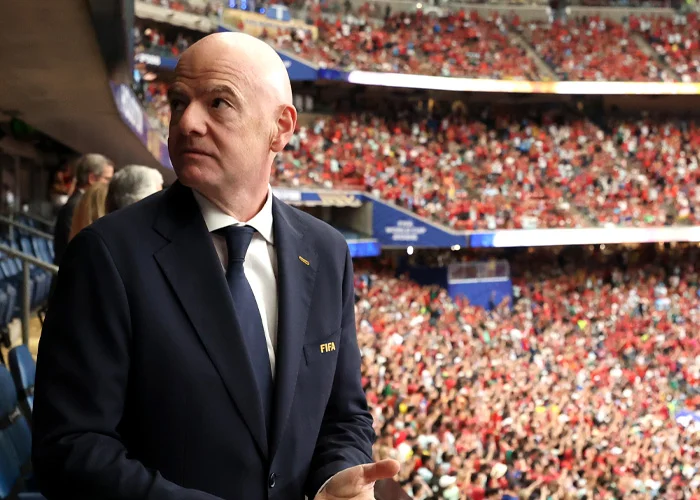
As World Cup Fever Spreads, Infantino Crisscrosses Three Nations in a Private Jet
FIFA President Gianni Infantino has become one of the most visible—and most scrutinized—figures of the 2026 World Cup, clocking more than 13,000 miles in the tournament’s first week alone. His ambition to attend two matches per day, made possible by a private jet provided through Qatar Airways, has put him in stadiums from Mexico City to Vancouver, often beaming from luxury suites as broadcasters cut to his smiling face.
Infantino’s whirlwind itinerary began on June 11 at the Azteca Stadium in Mexico City, where co-hosts Mexico beat South Africa. He then hopped 285 miles to Guadalajara to watch South Korea defeat Czechia. The following days saw stops in Los Angeles, San Francisco, Vancouver, and Miami, where he attended a FIFA summit. By June 19, he had already covered more ground than many players will travel during the entire group stage.
Private Jet, Public Scrutiny
The president’s travel arrangements have drawn sharp criticism. While teams, FIFA Council members, and senior delegates are all entitled to charter flights, the use of a private jet is reserved for heads of state and international dignitaries—a luxury Infantino enjoys at host-committee expense. Critics point out that fans struggle to afford single match tickets while the FIFA chief flits between venues. Former Liverpool CEO Peter Moore had predicted this “juxtaposition” would fuel resentment.
Sources close to Infantino insist that attending as many matches as possible is part of his mandate to “live football” and “unite the world through football.” The three-country, 16-city format makes flying the only efficient option. Still, the optics are hard to ignore: the president’s Instagram feed shows him painting pitch lines in New Jersey one week and jetting across North America the next, all while ordinary supporters complain about soaring travel and accommodation costs.
Human Touch and Political Missteps
Beyond the travel controversy, Infantino has made headlines for his interactions with players and fans. On June 16, he visited Iran’s dressing room after their 2-2 draw with New Zealand. Video footage shows him telling the team, “I know what you’ve been through,” a reference to the strict travel curbs imposed on Iranian players entering the United States. The moment was widely praised as a rare display of empathy from a leader often accused of being out of touch.
Flag Furor in Vancouver
But a more awkward encounter unfolded on June 20 during Canada’s 6-0 demolition of Qatar in Vancouver. A Russian fan approached Infantino and Canadian Prime Minister Mark Carney with a Russian flag and asked them to sign it. Both obliged. Video shows Infantino making eye contact with the man, speaking a few words in Russian, and posing for a photo.
The fan later told Russian media that he was from Moscow and had been collecting autographs from the entire Russian national team. While Carney appeared distracted and may not have realized what he was signing, Infantino’s awareness has drawn condemnation, especially given the ongoing war in Ukraine. Russian athletes remain banned from most international competitions, and the country’s flag is barred at FIFA events. The incident has added fuel to accusations that FIFA’s political neutrality shades into indifference.
What This Means for FIFA’s Reputation and Re-election
Infantino’s jet-set World Cup tour comes at a delicate moment. He faces re-election later this year, and while no serious challenger has emerged, his handling of this tournament could shape the narrative. The emotional connection with Iran’s players shows he can still command goodwill, but the flag-signing controversy and the glaring wealth gap between him and average fans risk undermining his message of unity.
The 2026 World Cup is the largest in history, spread across three nations and 16 cities. Infantino’s whirlwind schedule reflects the logistical ambition of the event, but it also highlights the centralization of power and resources within FIFA. As the tournament progresses, every cutaway to the president’s box will be watched not just for smiling faces, but for what they reveal about the priorities of world football’s top official.
For context, this is not the first time FIFA’s leadership has sparked debate during a major tournament. Earlier this month, Tuchel begs FIFA to fix photographers blocking England anthem view, a sign that even small logistical choices can stir controversy. And as Iran face Belgium under strict US travel curbs at World Cup 2026, the political undercurrents of the tournament remain strong.
Infantino’s ultimate legacy may hinge on whether he can bridge the gap between the spectacle and the substance. For now, he is everywhere and nowhere: ever-present in the stands, yet increasingly distant from the fans who pay the bills.
Comments