
A Week of Reversals and Revelations
Senator John Fetterman (D-PA) has dominated headlines in the last week with a series of high-profile stances that have left allies and adversaries alike scrambling to understand his political trajectory. From admitting regret over his silence on the COVID-19 lab leak theory during a tense hearing with Dr. Anthony Fauci to publishing a Washington Post op-ed reversing his long-held opposition to the Senate filibuster, and now openly threatening to leave the Democratic Party over its stance on Israel, the Pennsylvania Democrat is showing a pattern of ideological repositioning that may redefine his political future.
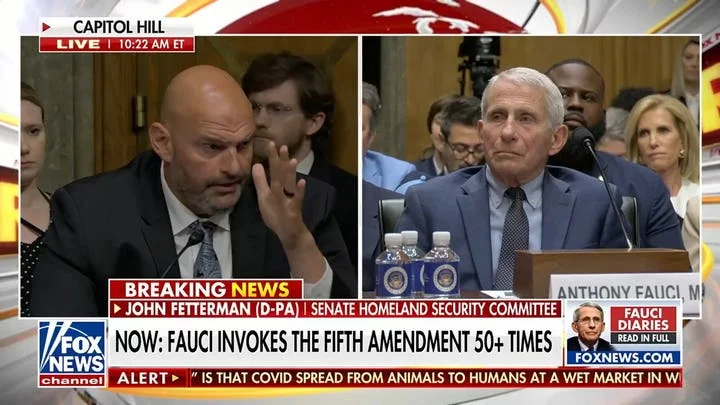
The most immediate news comes from Fetterman’s appearance on Fox News Digital following the July 28 Senate hearing with Dr. Anthony Fauci. Fetterman stated that his “one regret” from the COVID era was his unwillingness to take the lab leak theory more seriously. “I had dismissed the lab leak theory out of hand, and that was a mistake. It should have been a legitimate avenue of inquiry,” Fetterman said, according to Fox News. The comment marks a significant departure from the posture of many Democrats during the pandemic, when the Biden administration publicly favored the natural origin hypothesis.
This admission dovetails with the broader partisan theatrics of the Fauci hearing—a day of political fireworks that saw Dr. Fauci plead the Fifth Amendment 111 times, and senators like Ted Cruz and Rand Paul demand contempt proceedings. Fetterman’s public regret positions him as a bipartisan truth-seeker, but at a cost: alienating progressives who view the lab leak theory as a weaponized conservative talking point.
Meanwhile, Fetterman’s op-ed in The Washington Post on Monday July 27 stunned many of his 2022 campaign supporters. During his Senate run, he had campaigned on eliminating the filibuster to pass voting rights legislation and codify Roe v. Wade. Now, with Democrats potentially holding the Senate again in 2028, Fetterman argues that the filibuster is a “necessary tool for compromise” and warns that without it, the Senate would devolve into a “smaller version of the House of Representatives.” He wrote that if Democrats win the Senate, “we will not have enough votes to override the 60-vote threshold on our own.”
Critics were sharp. Hayes Brown, writing for MSNBC, called the reversal a case of political cowardice, accusing Fetterman of “sharing the cowardice” of former Senators Joe Manchin and Kyrsten Sinema. The filibuster, Brown noted, has no constitutional basis and was instead born from 19th-century efforts by Southern slave states to block civil rights legislation.
The Senate’s Balance of Power and the Israel Threat
Perhaps the most explosive development came from The Intercept’s report on July 27, revealing that Fetterman has been openly considering leaving the Democratic Party to either join Republicans or become an independent caucusing with the GOP. His stated red line? The Democratic Party’s evolving posture on Israel.
“If our party ever becomes, and just makes it official, the anti-Israel party, that’s when I would leave because that’s been a moral clarity for me,” Fetterman said at a convention in Washington last week. The report, citing former Fetterman chief of staff Adam Jentleson, now head of the centrist Searchlight Institute, described the senator as “addicted to attention,” and suggested the flip would be a guaranteed media circus.
Fetterman’s rift with progressives over Israel has been deepening since the October 2023 Hamas attacks and the subsequent Israeli military campaign in Gaza, which many on the Palestinian solidarity left have labelled a genocide. Fetterman has remained a staunch supporter of Israel, breaking with nearly his entire party caucus on several aid and arms resolutions. In July 2026, he was the sole Democratic senator to vote against a bill blocking drug boat attacks from the Caribbean—a vote widely seen as a signal of his independent streak.
The stakes could not be higher. The Senate is currently split 50-50, with Vice President J.D. Vance (R) holding the tie-breaking vote. If Fetterman were to switch his party affiliation or begin caucusing with Republicans, it would hand the GOP effective control of the chamber—and with it, the ability to confirm Trump’s judicial nominees, shape foreign policy, and block Democratic legislative initiatives. A polling snapshot from Pennsylvania shows that a majority of registered Democrats in the state want Fetterman to leave the party, suggesting he would likely face a primary challenge if he stays.
The Fauci Hearing: Political Theater With Real Consequences
The Fauci hearing on July 28 was a spectacle that encapsulated the lingering trauma and polarization of the COVID-19 pandemic. Dr. Fauci, the former director of the National Institute of Allergy and Infectious Diseases, invoked his Fifth Amendment rights against self-incrimination 111 times in response to questions from the Senate Health, Education, Labor, and Pensions Committee. The hearing was chaired by Senator Rand Paul (R-KY), who has pursued Fauci for years over alleged misrepresentations about the pandemic’s origins.
Fetterman’s participation in the hearing was relatively subdued until his post-hearing interview with Fox News Digital. There, he volunteered his regret about the lab leak theory, earning praise from conservative commentators. Fox News anchor Pete Hegseth described Fetterman’s comment as a “high-heat fastball.” But progressives saw it as another example of Fetterman cozying up to the right, following his appearances on conservative media outlets and his social media posts mocking the Democratic Socialists of America.
The hearing itself included moments of high drama. Senator Ted Cruz (R-TX) said Fauci should face jail time. Senator John Kennedy (R-LA) described the Democratic Socialists of America as “crazy as a bedbug.” Senator Josh Hawley (R-MO) grilled Fauci on his Fifth Amendment invocation, calling it an admission of guilt. For Fetterman, the hearing was a perfect backdrop to underscore his new posture of “moral clarity” on issues where he feels the Democratic Party has gone astray—be it on pandemic origins or on Israel.
The Shifting Political Ground: Risk and Reward
Fetterman’s current positioning is a high-risk gamble. If he stays in the Democratic Party, he faces a likely primary challenge from the progressive wing in 2028, buoyed by Pennsylvania Democrats who want him gone. A poll cited by The Intercept showed a bare majority of Pennsylvania Democrats support his departure from the party, a stunning rebuke for a sitting senator.
If he switches to the GOP, he would have to endure a Republican primary, where his socially liberal voting record—on LGBTQ+ rights, abortion, and criminal justice reform—would be a massive liability. As Fetterman himself has admitted, he would be a poor fit for the current Republican electorate.
The third option, and the one that seems most plausible given his love of the spotlight, is running as an independent who caucuses with either side. That would allow him to maintain his maverick brand and keep the media at his feet, but it carries the risk of being a spoiler without a lasting power base. Adam Jentleson, his former chief of staff, framed the decision squarely in terms of narcissism: “If he is the majority-maker, he will flip, because it would give him a massive amount of attention.”
Fetterman’s evolution from a progressive icon—the hoodie-wearing, truck-driving populist from Braddock, Pennsylvania—to a centrist(ish) Israel hawk has been marked by small steps. In 2022, he was the candidate who would abolish the filibuster. Now he wants to protect it. He once championed Medicare for All. Now he won’t rule out caucusing with a party that wants to repeal the Affordable Care Act. This ideological zigzagging has made him one of the least trusted incumbents in the Senate, according to approval ratings, but it has also made him a constant subject of cable news fascination.
Broader Implications: The Democratic Party’s Coalition at a Breaking Point
Fetterman’s flirtation with leaving the party is a symptom of a deeper fracture within the Democratic coalition over three issues: foreign policy, institutional reform, and cultural populism.
The Israel-Gaza war has acted as a stress test, splitting the party between the progressive left, which views Israel’s campaign as a war crime, and the moderate and neoliberal wings, which view Israel as a vital ally under existential threat. Fetterman has emphatically chosen the latter side, but in doing so, he has aligned himself with the Trump-era GOP, which has also doubled down on unconditional support for Israel.
On institutional reform, the filibuster debate exemplifies the conflict between pragmatists and structural reformers. Fetterman’s reversal on the filibuster makes him a lonely voice among the 49 Democrats who supported reform in 2022. This puts him in direct opposition to the grass-roots energy that drove young voters and activists to the polls in 2022, who wanted to see voting rights and abortion access codified into law. By defending the filibuster now, Fetterman is effectively telling those voters that their priorities should be subordinated to Senate etiquette.
The cultural dimension is where Fetterman’s attention-seeking nature becomes a political strategy. His embrace of right-wing media, his public feuds with progressives, and his willingness to use conservative insults (“Pontiac Platner,” “ogre”) signal that he is running for a new identity—perhaps as the “commonsense independent” or the “last honest Democrat.” But the inconsistency undermines any claim to principle. If you are a Democrat who wants to abolish the filibuster, then changes your mind, and then leaves the party because of Israel, what is the through line? The only constant is self-promotion.
What This Changes: Senate Control, 2028, and the Media Ecosystem
If Fetterman follows through on his threat, the immediate consequence is a shift in Senate control. The Republicans would gain a de facto majority, allowing President Donald Trump—who is currently leading in 2026 approval ratings—to push through his second-term agenda with ease. The filibuster, ironically, would be the only check left on a unified GOP government, and Fetterman has just recommitted to defending it. This means that even as Fetterman departs the Democratic Party, he might end up preserving the legislative minority’s only source of power.
For the 2028 election cycle, Fetterman’s move would reshape the map. Pennsylvania, a critical swing state, would become a three-way battleground. The Democratic nominee (likely a progressive backed by the DSA or a moderate like Governor Josh Shapiro) would face a Republican nominee and an independent Fetterman. It is unclear whether Fetterman would pull more votes from the Democrat or the Republican. Given his popularity with conservative voters on style (if not on policy substance), he could siphon off enough Trump-curious independents to throw the election to the Democrat—or vice versa.
Media coverage will follow wherever the drama goes. As of this writing, Fetterman has not announced a formal party switch, but he has not denied it either. In the age of 24-hour news, a senator who promises to keep us guessing is a senator who stays relevant. And for John Fetterman, relevancy may be the only ideology that remains constant.
Comments