
Court Blocks Alabama’s 2023 Congressional Map Ahead of Midterms
A federal district court has blocked Alabama from using its 2023 congressional redistricting plan in the 2026 midterm elections, ruling that the map is “tainted by intentional race-based discrimination.” The decision, issued Tuesday by a three-judge panel, grants an emergency injunction sought by Black voters and voting rights groups, who argued that the state’s last-minute redrawing of district lines would dilute Black political power.
The ruling freezes the state’s use of the 2023 map—which had been previously struck down as a violation of Section 2 of the Voting Rights Act—and requires Alabama to instead use court-ordered districts that were in place for the 2024 election. The panel’s order comes just months before November’s midterms and after absentee voting had already begun in some counties, creating widespread confusion among voters and election officials.
“Ultimately, we cannot see our way clear to requiring Alabamians to cast their votes in the 2026 elections under a districting plan tainted by intentional race-based discrimination,” the judges wrote in their opinion. They added that the Alabama legislature “understood that its map would dilute Black Alabamians’ opportunity to participate in the political process, and it intentionally enacted that very plan.”
The state is expected to appeal the injunction directly to the U.S. Supreme Court, setting up another high-stakes redistricting battle at a time when the high court’s recent ruling in Louisiana v. Callais has weakened Section 2 of the Voting Rights Act. The case now heads to a Supreme Court that has already shown a willingness to allow Alabama to use the disputed map, raising the possibility of a final decision that could reshape voting rights law across the South.
Why This Matters: The Stakes for Black Voters and the 2026 Midterms
At the heart of the dispute is a congressional map that voting rights advocates say packs most of Alabama’s Black voters—who make up roughly 27 percent of the state’s population—into a single district, while diluting their influence in the remaining six districts. The map was originally enacted in 2023, after the Supreme Court’s conservative majority surprised many by upholding a lower court ruling that found the state’s previous map likely violated Section 2 of the Voting Rights Act. In that earlier case, Allen v. Milligan, the court required Alabama to create a second majority-Black or coalition district.
Under pressure, the Alabama legislature redrew the map, but critics immediately argued that the new version continued to fracture Black communities. A federal court agreed, striking it down as intentionally discriminatory. That decision was appealed to the Supreme Court, which in a separate but related sequence of orders allowed Alabama to use the 2023 map for the 2024 election while legal challenges continued.
Then, in April 2026, the Supreme Court issued its ruling in Louisiana v. Callais, a case that effectively gutted key enforcement mechanisms of Section 2 of the Voting Rights Act. The Court held that private plaintiffs could no longer bring certain types of racial gerrymandering claims under the Voting Rights Act, significantly narrowing the law’s reach. In the wake of that decision, Alabama lawmakers moved swiftly to reinstate the 2023 map permanently, arguing that Callais had invalidated the legal basis for the earlier injunction against it.
Voting rights groups responded immediately. “Alabama cannot use Callais to legitimize its pre-Callais decision to double down on the discriminatory vote dilution that we and the Supreme Court found,” the federal court ruled this week. The panel’s logic was straightforward: even if Callais changed the legal standard for future cases, it did not retroactively cleanse a map that was enacted with proven discriminatory intent.
The stakes for the 2026 midterms are enormous. Alabama’s current delegation includes two Democrats and five Republicans. Under the 2023 map, one of those Democratic-held seats—currently held by Rep. Terri Sewell, who represents the majority-Black 7th District—is likely to remain safe. But the state’s other districts are drawn in such a way that a second Democratic seat, represented by a Black lawmaker, would be eliminated or made deeply Republican-leaning. Republicans need only a net gain of a handful of seats nationwide to flip control of the U.S. House of Representatives, making Alabama’s map a critical piece of the national midterm landscape.
The Last-Minute Redrawing and Voter Confusion
One of the most contentious aspects of the Alabama saga has been the timing. The state’s legislature approved the reinstated 2023 map earlier this spring, after primary elections were already underway. Absentee voting had begun in some counties, and election officials had already printed ballots, programmed voting machines, and trained poll workers based on the court-ordered 2024 districts.
The sudden change caused immediate chaos. Voters in communities across the state reported receiving conflicting information about which congressional district they belonged to. Some local election offices struggled to update their systems in time, leading to delayed ballot mailings and confusion at early voting sites. Voting rights groups fielded hundreds of calls from confused residents, and at least one county election commission requested emergency guidance from the secretary of state.
The federal court’s injunction effectively resets the situation, ordering the state to revert to the 2024 court-ordered map. But election officials now face a tight deadline to reprint ballots, update voter registration databases, and notify the public—all while the state’s expected appeal to the Supreme Court threatens to upend the process once again.
“We do not lightly intrude in state affairs,” the judges wrote, acknowledging the disruption their order would cause. “But our previous review of the undisputed evidence left us in no doubt that Alabama’s legislatively enacted plan intentionally discriminated based on race in violation of the Constitution.”
Broader Implications: The Supreme Court’s Next Voting Rights Test
The Alabama case arrives at the Supreme Court at a moment of profound uncertainty about the future of voting rights law. The Callais decision in April limited the scope of Section 2, but it did not eliminate the ability of plaintiffs—or the federal government—to challenge maps that intentionally discriminate on the basis of race under the 14th Amendment’s Equal Protection Clause. The Alabama panel relied specifically on that constitutional argument, distinguishing its ruling from the Voting Rights Act claims that were curtailed by Callais.
“If such retroactive validation strategies were available, States would be encouraged to govern themselves according to what they think federal law ought to be, not what it is,” the panel wrote, pushing back against Alabama’s attempt to use Callais as a shield.
Legal experts say the Supreme Court is likely to take up the state’s appeal, given the high court’s repeated involvement in Alabama’s redistricting battles. The question for the justices will be whether the 14th Amendment’s bar on intentional racial discrimination remains a viable tool for challenging maps like Alabama’s, or whether the Callais ruling’s logic extends further than the lower court assumed.
A ruling in Alabama’s favor could open the door for other Southern states—including Georgia, Louisiana, and Texas—to adopt similar maps that reduce Black political representation without risking legal consequences. Conversely, an affirmation of the injunction could reaffirm that the 14th Amendment provides an independent check on racial gerrymandering, even as statutory protections weaken.
What This Means for National Redistricting Trends
The Alabama battle is part of a broader wave of redistricting disputes across the country. In Texas, a similar case is pending after the state redrew its congressional map last year, with voting rights groups alleging that the new map dilutes Latino and Black voting power. The Trump administration has actively encouraged state-level Republicans to pursue aggressive redistricting strategies, arguing that the Callais decision gives them more leeway to draw lines favorable to their party.
President Donald Trump, who has made election integrity a central theme of his 2026 midterm campaign, has publicly supported Alabama’s efforts. His allies in the state legislature pushed for the quick reinstatement of the 2023 map after Callais, and Trump’s Justice Department has filed amicus briefs in related cases arguing for broad state flexibility in drawing districts.
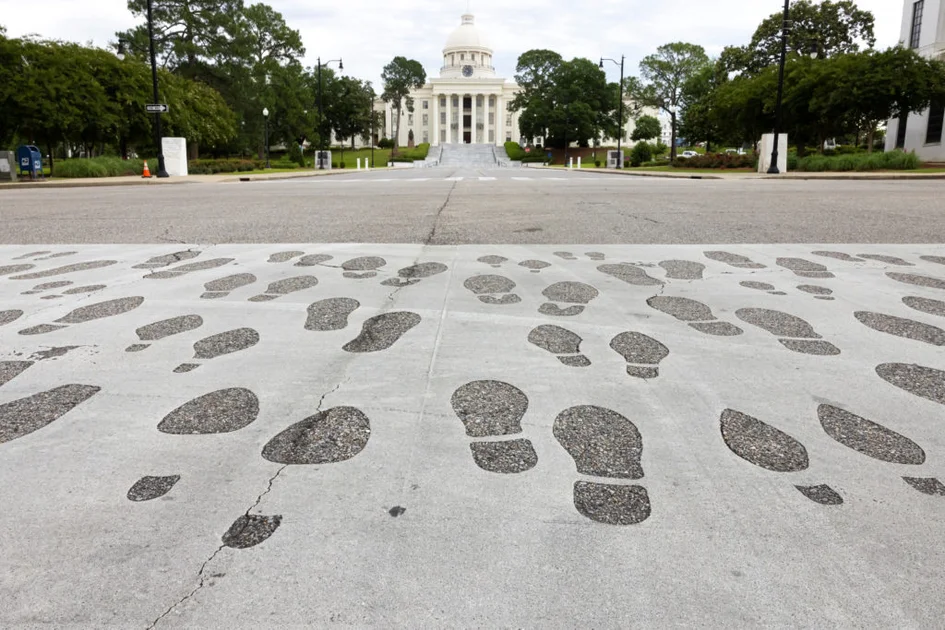
Voting rights advocates, however, are mobilizing in response. The recent events in Alabama have drawn national attention, including a “National Day of Action” earlier this month, when activists marched across the Edmund Pettus Bridge in Selma and rallied at the Alabama State Capitol. The images of demonstrators, many carrying signs reading “Protect the Vote” and “One Person, One Vote,” recall the civil rights struggles of the 1960s and underscore the high emotional and political stakes.
The case also highlights the growing role of state courts in protecting voting rights. In several states, including Florida and Ohio, state supreme courts have struck down gerrymandered maps under state constitutional provisions that bar partisan or racial discrimination. Alabama’s constitution, however, does not contain such explicit protections, leaving plaintiffs reliant on federal law and the increasingly conservative Supreme Court.
Looking Ahead: The Countdown to November
With just months until the 2026 midterm elections, the clock is ticking for Alabama’s election officials. If the Supreme Court agrees to hear the state’s appeal, it could issue an emergency stay of the injunction, allowing the 2023 map to be used in November. Alternatively, it could refuse to intervene, setting the stage for a trial on the merits later this year—well after the election is over.
The uncertainty is already having an impact on candidate filing deadlines and campaign strategies. In the Second Congressional District, which under the court-ordered plan is a competitive seat with a significant Black population, both parties are scrambling to adjust their messaging and fundraising. A Republican victory there could be a major pickup for the party, while a Democratic hold would be seen as a validation of voting rights efforts.
For Black voters in Alabama, the legal whiplash has become a familiar pattern. “We are tired of being squeezed out of our own representation,” said Marcia Johnson, a voting rights organizer from Montgomery, in a recent interview. “Every election cycle, it’s the same fight. We just want a fair map.”
The Supreme Court could issue a decision on Alabama’s emergency request within weeks. If history is any guide, the case will be fast-tracked, with oral arguments possible before the end of the summer. The eventual ruling—whether it comes this year or next—will have consequences far beyond Alabama’s borders, determining how far states can go in drawing districts that minimize the political power of minority communities.
In the meantime, Alabama’s election machinery is bracing for another round of chaos. County offices are working overtime to comply with the new order, while state officials prepare their legal briefs for the high court. For voters, the only certainty is that the fight over the map—and the broader battle for voting rights in America—is far from over.
Internal Links
For more on the intersection of technology and governance, see our coverage of ChatGPT Told Teen to Report Dad: Giants Manager Abe Arrested, Resigns. In other news, the recent shakeup at BP—BP Ousts Chairman Albert Manifold in Boardroom Shakeup Over Governance Issues—shows how institutional accountability is a recurring theme across industries.
Comments