
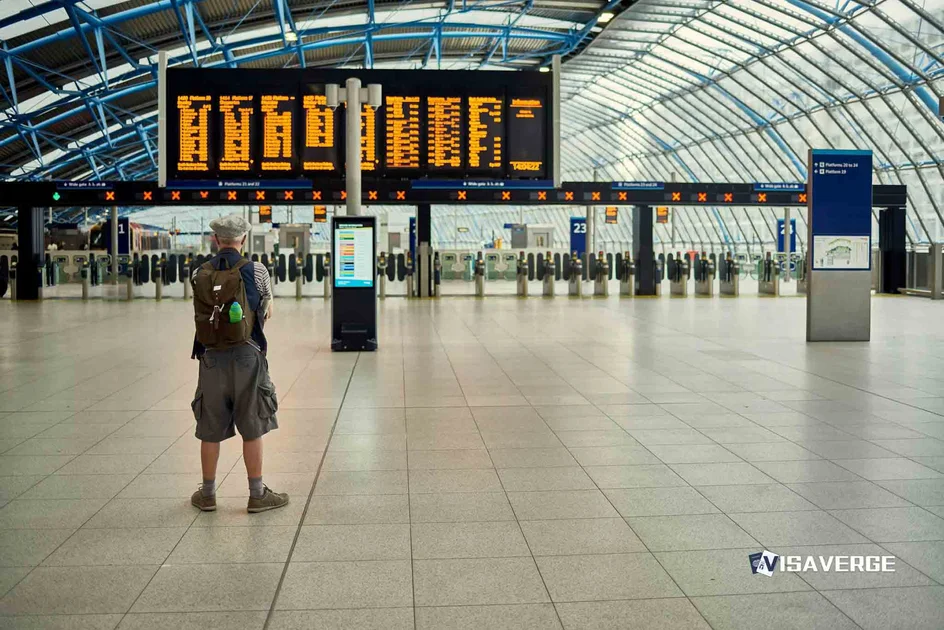
Chaos at Europe's Borders as New Digital System Goes Live
The European Union's long-awaited Entry-Exit System (EES) officially became fully operational across all 29 Schengen-area countries on Friday, April 10, 2026 — and within hours, it had triggered scenes of considerable disorder at airports across the continent. Queues stretching two to three hours at peak times, passengers vomiting and fainting in lines, and dozens of travellers stranded abroad after missing their flights: the first weekend of full EES operations has been, by almost any measure, a troubled one.
The most visible single incident occurred on Sunday, April 13, at Milan's Linate airport, where more than 100 passengers — 122, according to some reports — missed an easyJet flight bound for Manchester. The airline described the situation at passport control as "unacceptable," while affected travellers used words like "nightmare" and "just a mess" to describe their experience. At least one passenger, Max Hume, said he had been forced to spend £1,800 to secure alternative travel home. Another family reportedly spent £1,600 getting back to the UK after the same easyJet flight departed without them.
What the Entry-Exit System Actually Does
The EES replaces the traditional manual stamping of passports with a digital record-keeping system that logs every entry and exit by non-EU nationals — including British citizens following Brexit — into the Schengen zone. Beyond tracking travel history across a 90-day-in-180-day window, the system collects biometric data: facial images and fingerprints. These checks are required on both arrival and departure, effectively doubling the contact each traveller has with border infrastructure compared to the old stamp-and-go approach.
The system applies to all third-country nationals entering the Schengen area for short stays. For British travellers in particular — now firmly classified as third-country nationals since Brexit — EES represents a significant new procedural hurdle each time they cross into or out of the EU.
From Theory to Dysfunction: What Went Wrong This Weekend
Airport and airline industry groups did not mince words in their assessments of the opening weekend. A joint statement from ACI Europe, which represents airports, and Airlines for Europe (A4E), which speaks for the airline industry, noted that Friday's first day of full operations was "marked by passenger disruptions, delays and missed flights." Both organisations said they had been warning for weeks about "operational rollout challenges" and that the "major concerns" had now become reality.
By Monday, A4E had sharpened its language considerably, declaring in a separate statement that three-hour queues at border control were not an EES "teething issue" — they were a "systemic failure." The airline group stressed that while it supports the EES's stated goal of strengthening border security, the current implementation was causing persistent disruption that airlines themselves had no power to prevent or remedy.
On-the-ground reports from travellers corroborated the institutional alarm. Readers sharing experiences with The Independent described scenes of confusion at airports including Munich and Pisa, where passengers were uncertain whether to join lines for EES registration kiosks or head directly to border control desks staffed by officers. In some cases, overwhelmed border staff reportedly abandoned biometric checks altogether and reverted to traditional passport stamping as queues grew unmanageable. Technical failures and staffing shortages were frequently cited as contributing factors.
Inconsistent Implementation Across Airports
One of the more disorienting aspects of the rollout appears to be its inconsistency. Travellers reported significant variation not just between airports, but between inbound and outbound journeys at the same airport — with some passengers required to give fingerprints and facial scans multiple times, while others sailed through or were not asked to use biometrics at all. Old-style non-biometric passports created additional complications, with at least one reader noting that the EES kiosk machines could not reliably read their document.
This patchwork experience has fed a broader sense of uncertainty among travellers. According to reports, on one occasion at a major European airport, not a single passenger had arrived at a departure gate by the time it was scheduled to close — with only 12 individuals having made it through border control 90 minutes later.
Who Pays When Things Go Wrong?
For the passengers stranded by EES queues, one of the most pressing questions has been practical: who is responsible, and who will compensate them? The answers, for now, are largely discouraging.
As travel journalist Simon Calder explained in a Q&A for The Independent, passengers who miss their flights due to EES delays are, in most scenarios, entirely on their own. Airlines have made clear that it is each passenger's responsibility to be at the gate on time, regardless of what caused the delay. Travel insurance is similarly unlikely to offer relief: the Association of British Insurers has stated explicitly that "travel insurance is unlikely to cover losses from delays caused by EES queues," urging customers instead to speak directly to their airline, accommodation provider, or tour operator.
The one potential avenue for redress — and a narrow one — involves package holidays. Travellers who booked through a package tour operator may have slightly more leverage, though Calder cautioned that operators could argue their obligations end once a passenger has been delivered to the departure airport for a homeward journey.
Pursuing legal action against airports is also seen as a near-impossible route. Airports would likely direct complaints to border police, who operate under their own authority and have no legal obligation to process passengers within a timeframe that accommodates flight schedules.
What About ETIAS — and Future Costs?
Any travellers under the impression that EES is the full extent of new European border requirements will want to take note of what comes next. The European Travel Information and Authorisation System (ETIAS) — sometimes described as a "Euro visa" — is expected to launch six months after EES is deemed fully operational. ETIAS will require non-EU travellers to obtain pre-authorisation before entering the Schengen zone, at a cost of €20 (approximately £17) per application. For now, fingerprint and facial scanning under EES carries no charge, but the additional layer of ETIAS will add both cost and administrative steps for British and other third-country travellers. This trajectory mirrors challenges seen in other trusted traveller programmes globally — as noted in coverage of Global Entry and TSA PreCheck Under Threat: What a Potential Shutdown Means for Millions of Trusted Travelers, digital border management systems carry significant logistical stakes when their infrastructure wobbles.
Why This Moment Matters: Stakes for the Summer Season
The timing of the EES rollout could scarcely be more consequential. With the European summer holiday season approaching — typically the busiest travel period of the year, when tens of millions of Britons and other non-EU nationals cross into the Schengen zone — the current dysfunction has prompted urgent calls for intervention.
A4E has made its preferred solution explicit: it is calling on the European Commission to allow for "full and partial suspension" of EES operations through to the end of summer "where necessary." Until last week, border authorities had the discretion to suspend EES operations when waiting times became excessive; reports suggest that flexibility may have been curtailed or applied inconsistently. Reinstating that operational flexibility, the airline industry argues, is the only workable short-term fix.
The stakes extend beyond individual inconvenience. European airports process hundreds of millions of passengers annually, and a multi-hour bottleneck at border control has cascading effects on flight schedules, gate turnaround times, and overall airport capacity. If the problems seen in Milan, Munich, and Pisa in the first weekend become the norm through July and August, the disruption could affect millions of holidays and cost the travel industry — and individual travellers — enormous sums.
Broader Implications: Digital Border Control at a Crossroads
The EES debacle raises questions that extend well beyond the immediate travel disruption. Europe's investment in digital border management reflects a broader global trend toward biometric identification and digital tracking of population movement — a trend with genuine security benefits but also significant implementation risks. The EU spent years delaying the EES launch, repeatedly pushing back the go-live date amid concerns about readiness. That extra time, it now appears, was not enough to prevent a chaotic opening weekend.
For British travellers specifically, EES is a direct consequence of Brexit — an added friction that did not exist when the UK was part of the EU's single market and free movement framework. The frustration expressed by many UK travellers this weekend carries an implicit political dimension, even if the practical anger is directed at queues and kiosks rather than treaty negotiations.
More immediately, the system's critics have a credible case that its current design creates unnecessary bottlenecks. Requiring all passengers — including those who have already registered biometric data — to pass through physical kiosk checks on every journey prevents the kind of seamless automation that pre-registration was supposed to enable. Industry voices have suggested that a more streamlined approach, using pre-registered data and automated e-gates for frequent travellers, would dramatically reduce pressure on border infrastructure.
Whether the European Commission moves swiftly enough to ease restrictions before summer peaks arrive will determine whether the EES launch is remembered as a rough but manageable start, or the beginning of a prolonged crisis for European aviation and travel. For now, the advice from all quarters is consistent and cautionary: allow significantly more time at border control than you ever have before, and do not book a connecting flight you cannot afford to miss.
Comments