
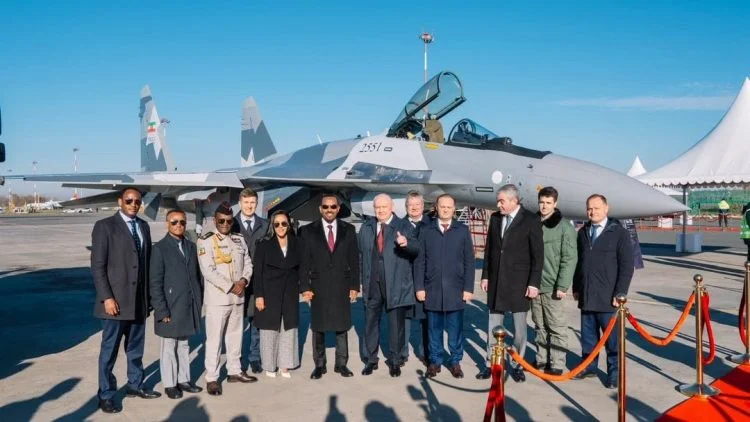
Ethiopia Receives 12 Russian Su-35 Fighter Jets, Plans S-400 Acquisition
Ethiopian Prime Minister Abiy Ahmed announced on Wednesday that Ethiopia has received 12 Russian Su-35 multirole fighter jets and plans to acquire four S-400 air defense systems, marking a significant escalation in the country's military capabilities and its security partnership with Moscow.
The announcement, made via Abiy's account on X during the two-day Russia-Africa Summit in Moscow, confirmed that the fighter jets arrived a year ahead of schedule under an existing agreement. Abiy thanked Russian President Vladimir Putin for facilitating the accelerated delivery. The financial terms of the deal, the aircraft's basing locations, and whether additional fighters are included in the agreement have not been disclosed. No delivery date was given for the S-400 batteries.
"The new equipment would strengthen Ethiopia's ability to 'preemptively deter aggression,'" Abiy said, describing the jets as newly deployed and intended to defend Ethiopian airspace. He also stated that Ethiopia had become the first country in sub-Saharan Africa to own this kind of "advanced combat technology."
A Major Capability Upgrade
The Su-35, known by NATO as the Flanker-E, is a heavily modernized derivative of the Soviet-era Su-27. It features twin thrust-vectoring engines for high maneuverability, advanced radar and sensor systems, and the ability to carry a wide range of air-to-air and air-to-surface weapons. Its radar and long-range missile capabilities represent a notable improvement for Ethiopia's ability to detect and engage hostile aircraft, while its multirole design allows it to perform strike missions.
Ethiopia already operates Russian-designed Su-27 fighters, providing a considerable degree of familiarity with the Flanker family. The current fleet comprises around 10 to 15 secondhand Su-27s, supplemented in 2024 by a pair of Su-30Ks originally produced for India and later refurbished in Belarus. The Su-35's introduction will offer significant improvements in sensors, weapons integration, and combat performance, though actual effectiveness will depend on pilot training, maintenance, and operational readiness.
The S-400 Triumf is a long-range surface-to-air missile system designed to engage aircraft, cruise missiles, and certain ballistic threats. Combined with the Su-35 purchase, the S-400 could provide Ethiopia with a layered air defense capability to protect major cities and critical infrastructure such as the Renaissance Dam.
Context: Domestic Conflict and Regional Tensions
The acquisition comes as Ethiopian forces fight renewed battles with rebels in northern Tigray and a separate rebellion in the neighboring Amhara region. The announcement follows a major shift in the fighting in Tigray, where government troops and allied forces entered the regional capital Mekelle on October 4 after fighters from the Tigray People's Liberation Front (TPLF) withdrew.
Military intelligence analyst Qalaab Segatu told BBC Amharic that Ethiopia's acquisition of additional warplanes was a key indication that "it was preparing for possible wars with other countries, not just internal conflicts." The jets are highly maneuverable and capable of covering large areas, with radars capable of ensuring air superiority and long-range scanning, he said.
Abiy said the military hardware was essential to protect the country from external threats, describing Putin as "a close friend of Ethiopia." He explained that Ethiopia signed an agreement with Russia several years ago to procure the Su-35 jets and S-400 systems, citing global air force trends and security threats facing the country. "If we fail to build this capability, surviving as a country in our region will become difficult. Countries with sufficient preparation are not easily defied," he said. He also noted that the Su-35 is equipped to detect and neutralize incoming cruise missiles at distances of up to 200 kilometers.
The announcement is the latest sign of Russia's growing military partnership with Ethiopia, following a series of agreements in recent years. The two governments signed a military cooperation agreement in Addis Ababa in July 2021 aimed at improving the Ethiopian armed forces' training and technology. In January, defense publication Janes reported that Ethiopia had displayed newly acquired Russian Yak-130 advanced jet trainers during celebrations marking its air force's 90th anniversary.
Russia supplied 15 percent of Africa's imports of major weapons between 2021 and 2025, making it the continent's third-largest supplier, according to the Stockholm International Peace Research Institute. Moscow has sought closer military and economic ties with African countries while facing Western sanctions over its war in Ukraine. The Russia-Africa Summit, which began on Wednesday, brings African leaders together for talks on trade, investment and security.
Perspective: Shifting Power Dynamics in the Horn of Africa
Ethiopia's acquisition of advanced Russian fighter jets and air defense systems represents a significant shift in the military balance in the Horn of Africa and underscores Russia's continued efforts to maintain military export relationships around the world despite the heavy demands placed on its defense industrial base by its ongoing war in Ukraine.
The deal also highlights Ethiopia's growing assertiveness in regional security affairs. Abiy's statement that the equipment would strengthen Ethiopia's ability to "preemptively deter aggression" signals a more proactive military posture. The combination of Su-35 fighters and S-400 air defenses could provide Ethiopia with a significant capability to protect and defend major cities and critical infrastructure, providing key strategic air superiority.
The acquisition may also complicate Ethiopia's relationships with Western powers, which have expressed concerns about the country's internal conflicts and human rights record. The United States and European Union have both criticized the handling of the Tigray war and the Amhara conflict. Ethiopia's turn to Russia for advanced weaponry could further strain those relations.
For Russia, the deal is a showcase of its ability to project military influence in Africa, even as its forces remain bogged down in Ukraine. The Su-35 and S-400 are among Russia's most advanced export products, and their delivery to Ethiopia could encourage other African nations to consider similar purchases. Russia has already signed military cooperation agreements with several African countries, including Mali, Burkina Faso, and the Central African Republic.
The timing of the announcement, during the Russia-Africa Summit, is symbolic. Moscow is seeking to strengthen ties with African leaders and present itself as a reliable partner in security and economic matters. The summit is expected to yield additional agreements on trade, investment, and defense cooperation.
However, the effectiveness of Ethiopia's new capabilities will depend on several factors, including pilot training, maintenance, and the integration of the S-400 systems. The Su-35 requires a high level of technical support and spare parts, which could be challenging given the distance from Russia and the ongoing conflict in Ukraine. Additionally, the S-400's delivery schedule remains unclear, and its deployment could take months or even years.
The acquisition also raises questions about Ethiopia's military strategy. While the Su-35 and S-400 are defensive systems, their presence could embolden Ethiopia to take a more aggressive stance in regional disputes, particularly with neighboring Eritrea and Sudan. The Horn of Africa is already a volatile region, with ongoing conflicts in Sudan, South Sudan, and Somalia. Ethiopia's military buildup could trigger an arms race among regional powers.
In the broader context, the deal reflects a growing trend of African countries diversifying their arms suppliers away from traditional Western partners. Russia, China, and Turkey have all increased their military exports to Africa in recent years, offering competitive prices and fewer political conditions. This shift could have long-term implications for Western influence on the continent.
As Ethiopia integrates these new systems into its armed forces, the region will be watching closely. The balance of power in the Horn of Africa may be shifting, and the consequences could be far-reaching.
Comments