
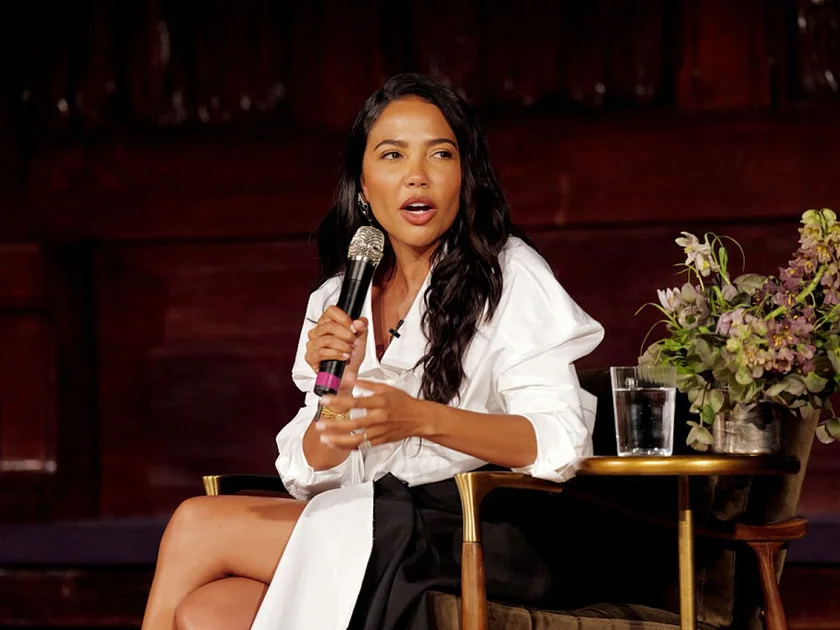
Grede Breaks Silence on the Contradiction at the Heart of Her Book Tour
Emma Grede is no stranger to controversy, but a candid admission made during her Start With Yourself book tour has reignited a debate that has been simmering since late 2025. Appearing on Les Alfred's She's So Lucky podcast in April 2026, the SKIMS co-founder and serial entrepreneur explained why she chose not to invest in Ami Colé — the celebrated clean beauty brand built specifically for melanin-rich skin by founder Diarrha N'Diaye — and why she later hired N'Diaye as Executive Vice President of beauty and fragrance at SKIMS.
The remarks, recorded as Grede promoted her debut book, have drawn sharp reactions online. Her explanation was blunt: she only backs first-time founders when she sees something "extraordinary about that founder and about that proposition." With Ami Colé, she said, she simply didn't see it. "To me, I didn't see that. I was like, 'It's okay.' But I was like, 'It's gonna come and go.' That's how I felt," Grede told host Alfred.
What Actually Happened Between Grede and N'Diaye
From Rejected Pitch to Executive Suite
The timeline matters here. Ami Colé launched in 2021 and, over the next four years, grew from a concept sketched in a Brooklyn apartment to a presence on the shelves of every Sephora location in North America. The brand won five Allure Best of Beauty Awards and cultivated one of the most loyal communities in the independent beauty space. Despite that traction, in July 2025, N'Diaye announced she was winding down the company.
In her public statement, N'Diaye pointed to mounting investor pressure and what she described as a palpable shift in attitudes among backers who had enthusiastically championed inclusivity and diversity-focused brands following the racial justice momentum of 2020, but had grown considerably cooler by 2024 and 2025. The closure was widely mourned by consumers and industry observers alike.
Just months later, in November 2025, SKIMS announced that N'Diaye had been appointed to lead the company's entire beauty and fragrance division. The connection had been facilitated by Alicia Scott, founder of Range Beauty, who introduced N'Diaye to Grede after Ami Colé's closure. The timing — and the apparent logic — did not go unnoticed.
Grede's Defense: Mentorship Over Capital
Grede acknowledged the apparent contradiction but did not apologize for it. She said that while she declined to write a check, she maintained a mentoring relationship with N'Diaye over the years. N'Diaye, for her part, never let the rejected investment opportunity sour the connection. According to Grede, N'Diaye regularly sought her perspective: asking what she was missing, requesting introductions, and consulting Grede when she was evaluating new investors.
"To her credit, she always called me. She didn't say, 'You didn't invest in my company. That's the end of our relationship,'" Grede recounted. Grede framed the SKIMS role as a "perfect opportunity" for a talented executive to operate inside a $5 billion infrastructure, gaining resources and experience she could not access as an independent founder — and potentially as a launchpad for a future venture.
Why This Controversy Cuts Deep
The Investor Retreat from Black-Founded Brands
The backlash to Grede's comments cannot be fully understood without the broader context. N'Diaye's closure statement named something that many Black founders had experienced but rarely said publicly: the wave of investment enthusiasm that followed 2020 had receded. Brands built on the promise of serving underrepresented communities were finding that the "bet big on inclusivity" energy from corporate backers had a relatively short shelf life.
For many observers, Ami Colé's story became a symbol of that broken promise. The grief at its closure was not just about a beloved product line disappearing from shelves — it was about what the brand represented and how its end arrived. When Grede admitted she had assessed Ami Colé as unremarkable from the start, critics heard an investor validating, even retrospectively, the indifference that ultimately helped kill the brand.
The situation also reflects a structural tension in how capital flows to minority-owned businesses. The story of Ami Colé is, in some ways, emblematic of the fate of other heritage businesses that have struggled when financial backing dried up — a dynamic explored in the closure of storied institutions across industries. Denby Pottery Ends 217 Years of British Manufacturing as Administrators Fail to Find a Buyer is one such recent example of how even legacy brands can fall when investors move on.
The Bigger Picture: Labor, Capital, and Who Gets to Build
At its core, the Grede-N'Diaye story is a microcosm of a much larger tension in contemporary entrepreneurship: who gets to own the upside of their own labor? Critics of the SKIMS appointment are not necessarily arguing that N'Diaye should have turned it down — the role offers real resources, real scale, and real visibility. What they are questioning is the system that closed off the pathway to independent ownership while opening the door to corporate employment.
Grede's broader public persona — including her book's argument for uncompromising ambition and her controversial stance that working from home is a "career killer" for women — frames her as an unapologetic meritocrat. That worldview makes her a compelling figure to some and a frustrating one to others, particularly when her investment calculus intersects with the structural disadvantages facing Black women founders.
Whether Grede's decision to hire N'Diaye is ultimately viewed as an act of recognition or an act of consolidation may depend less on intent than on outcome. What is clear is that the conversation it has sparked — about who funds what, who gets to build equity, and what "extraordinary" really means when the evaluator controls the checkbook — is one the industry is not finished having.
Comments