
Dyson CameraJet Launch: A $499 Gamble on the Future of Oral Care
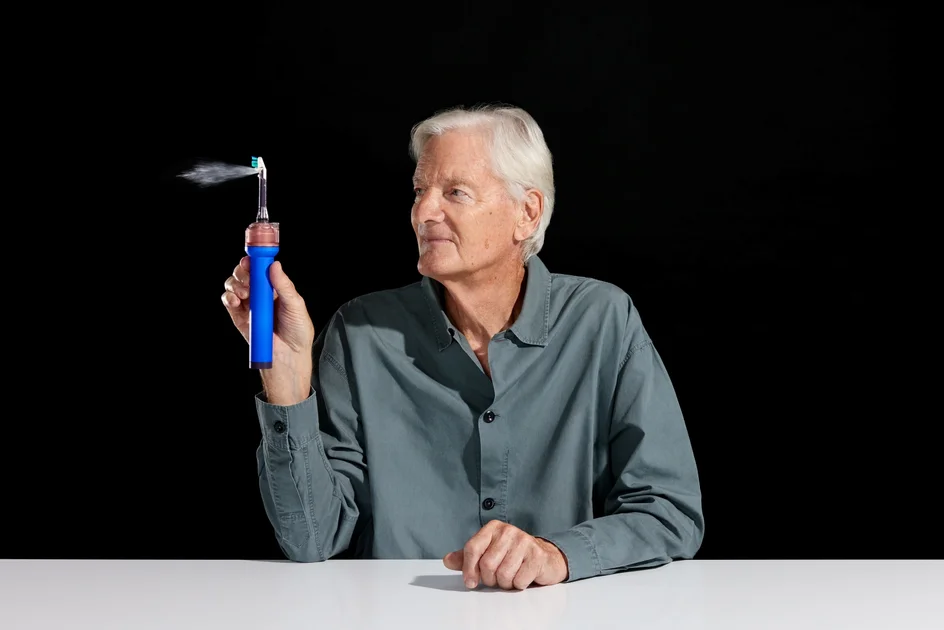
Dyson today officially launched its first oral care device, the $499 CameraJet, an electric toothbrush that integrates a camera, AI-powered gap detection, and a conical mouthwash jet to floss your teeth while you brush. The product, now available in ceramic blue and pink, represents the company's most ambitious foray yet into personal care, positioning itself as a two-in-one solution for the millions who neglect daily flossing. Powered by a 100,000-pixel macro lens and Dyson's "Gap Optical Targeting" algorithm, the CameraJet analyzes 28 images per second to detect the spaces between teeth and fires a gentle, cone-shaped stream of mouthwash within 100 milliseconds of a gap being recognized. The device streams a live video feed to a smartphone app, allowing users to inspect their own mouths in real time—a feature Dyson says is both for transparency and for better brushing accuracy.
The launch, which has been anticipated since early 2025 under the code name "682," marks a significant expansion for the British tech firm best known for its vacuum cleaners and hair care tools. The CameraJet is Dyson's first product that does not rely on air movement, instead centering on liquid—specifically, an alcohol-free mouth rinse developed in-house. The toothbrush's handle contains a small reservoir that is refilled automatically from a docking station in three seconds when the brush is placed back. The company says the CameraJet can simultaneously brush and floss, cutting down the time users spend on oral hygiene from roughly 10 minutes (including separate flossing) to just two. However, the hefty price tag—more than double the cost of most premium electric toothbrushes—raises the question: will consumers pay for a device that promises to solve a problem they've largely ignored for years?
Why the CameraJet Matters: The Oral Hygiene Crisis
The stakes behind Dyson's entry into oral care are clear: the vast majority of people are bad at brushing and flossing. According to brand research cited in the launch, the average American and Brit brushes for just 45 seconds—less than half of the recommended two minutes. Only about a third of people floss daily, and even that figure is self-reported and likely overstated. Dentists have long warned that inadequate plaque removal leads to gum disease, cavities, and tooth loss, yet behavioral change remains stubbornly difficult. Dyson sees an opportunity to apply its engineering prowess to a problem that has resisted simple instruction. "We're not just making a gadget; we're trying to make oral hygiene more engaging—and more effective—so that people actually do it properly," said Sir James Dyson in a video call previewing the product to journalists.
That engagement strategy rests heavily on the camera. Beyond simply detecting gaps, the CameraJet's live feed turns brushing into a visual experience, almost like a mini dental exam. The 100,000-pixel macro lens with a strobing LED stabilizes images for the AI, which was trained on 470,000 dental images collected over six years of development. The camera is only active when the device is in 'auto-jetting' mode; images are processed on-device and not stored or sent to the cloud, addressing privacy concerns. Users can also use the app to see a recorded view of their mouth, which Dyson says helps them understand where they're missing spots. "We wanted to demystify the back of your mouth," said a Dyson spokesperson. "People are often surprised to see what they're not cleaning."
A key technical challenge was the need to see through toothpaste foam. To solve this, Dyson created a proprietary non-foaming toothpaste, formulated without SLS, a common foaming agent. The company also advises that if you use your own paste, it must be SLS-free and clear, otherwise the camera's view will be obscured. This is a notable shift for consumers accustomed to the foam of regular toothpaste, and it may be a hurdle for adoption. Yet Dyson insists the non-foaming paste is just as effective at cleaning, and the lack of foam allows the camera and water jet to work unimpeded.
The Engineering Behind the Floss
Dyson has built significant hype around the CameraJet's flossing mechanism. Unlike traditional water flossers that shoot a thin, needle-like stream of water, the CameraJet emits a cone-shaped blast from a nozzle nestled under the brush head. Dyson claims this wider spray cleans a larger area of the gap between teeth with less pressure, making it gentler on gums and enamel. The company tested the device using a custom-created “proxy plaque” developed in collaboration with the National University of Singapore's Faculty of Dentistry, which allowed them to iterate quickly without running a full clinical trial after every design tweak. The result, Dyson says, is a flossing that removes plaque effectively while feeling far more comfortable than a WaterPik. "Most people describe the water flosser sensation as unpleasant," Sir James Dyson said. "We've optimized the pressure and shape of the jet to be effective yet comfortable."
The CameraJet's internal pump is also designed to maintain consistent jet performance regardless of angle, a complaint often leveled at existing oral irrigators. The 12.5-milliliter reservoir in the handle holds enough rinse for about two minutes of continuous flushing; the dock refills it in three seconds. A diaphragm pump pressurizes the fluid, delivering a blast within milliseconds of the AI detecting a gap. Dyson claims the entire system is so responsive that the flossing feels natural, as if you're brushing and flossing at the same time. The brush heads themselves are replaceable and feature a contour designed to cover a greater proportion of the tooth's surface, with softer outer bristles for the gums and firmer inner bristles for the teeth. Each brush head has an radio-frequency identification tag to remind you when to replace it (every three months, as with most electric brushes).
The Price and Competitive Landscape
At $499, the CameraJet is a premium product, but it's not outrageously more expensive than other high-end smart toothbrushes. For instance, the Oral-B iO series with a charging case can cost north of $300, and Philips Sonicare's premium models approach $250. What's new is the camera-plus-flossing combination. Dyson's prior launches—from the Supersonic hairdryer at $400 to the $549 Airwrap—have shown that consumers are willing to pay for well-engineered, design-forward personal care devices. The Supersonic, initially mocked for its price, became a cult favorite. But those products addressed visible beauty concerns (hair), whereas the CameraJet tackles a behind-the-scenes health maintenance issue. "This is a gamble," said tech analyst Sarah Thompson, who tracks the personal care market. "Dyson has the brand and the engineering chops, but flossing is a habit that people avoid. You're asking them to spend $500 on a tool to do something they could do with a $5 piece of string. The value proposition has to go way beyond convenience—it has to make flossing irresistible, maybe even fun."
Early reviews from tech and beauty outlets, including the first-hand experience from Allure, are largely positive, describing the CameraJet as a "wild" and "surprisingly effective" device. Wired notes that the product's AI and camera work seamlessly, and The Verge highlights the immediate, tangible benefit of seeing your mouth at 28 frames per second. The most common criticism is the cost, along with the dependence on Dyson's proprietary mouthwash and non-foaming toothpaste, which adds a recurring expense. Dyson says the mouthwash is alcohol-free and pleasant-tasting, and that third-party clear rinses may also work, but the company's own formula is optimized for the jet's mechanics.
The Broader Implications: Hygience Tech Meets Surveillance
Dyson's move into oral care signals a wider trend: the convergence of everyday health routines with sophisticated technology. Just as smart mirrors, smart scales, and even smart toilets are entering consumer homes, the toothbrush is becoming a data-generating device. The CameraJet's livestream, if adopted widely, could change how we interact with our own bodies—turning a private, routine act into a self-monitoring experience. But privacy advocates are also watching. Dyson has gone out of its way to emphasize that images are processed locally and never uploaded, but the fact that a toothbrush has a camera at all raises questions about security. "We're entering an era where every personal care item can be a surveillance device," said cybersecurity expert James Park. "The onus is on manufacturers to prove they're not collecting or sharing data. Dyson's stance is reassuring, but it's a new territory."
The product also taps into the broader trend of 'preventive' health. Sales of water flossers have been rising for years, and the global oral care market is projected to reach $50 billion by the end of the decade. Dyson's entry could push competitors to innovate—perhaps by adding cameras to their own devices, or by improving the comfort of water flossing. Already, the company's foray into beauty products disrupted the market, and its track record suggests that the CameraJet might force Oral-B and Philips to rethink their roadmaps. Yet the biggest impact may be behavioral. If the CameraJet genuinely encourages better brushing and flossing habits—through the feedback of the camera, the comfort of the flosser, and the simplicity of doing both at once—it could have a significant public health effect, potentially reducing the prevalence of gum disease and tooth decay. Dentists welcome that, even if they remain skeptical about the price. "If a $500 toothbrush gets people to floss, great," said Dr. Maria Gonzalez, a periodontist in Chicago. "But I also worry that patients will think they can skip regular checkups because their toothbrush is 'smart.' Technology can help, but it doesn't replace professional care."
As the CameraJet hits shelves, it's clear that Dyson is betting on a future where oral hygiene is not just a chore but an experience that engages our senses and our data-driven curiosity. Whether it succeeds or flops, it has already changed the conversation about what a toothbrush can be. And for the millions who dread the dentist's admonishments, there might now be a gadget that makes flossing less of a chore—and more of a spectacle. Only time will tell if the wildest gadget of 2026 becomes a bathroom staple or a niche curiosity.
For more on how innovative technologies are reshaping our daily routines, check out our coverage of other consumer tech trends. And if you're planning a vacation to test out your new toothbrush, you might want to check the Old Farmer's Almanac September 2026 Weather: Cool East, Warm Interior Predicted.
Comments