
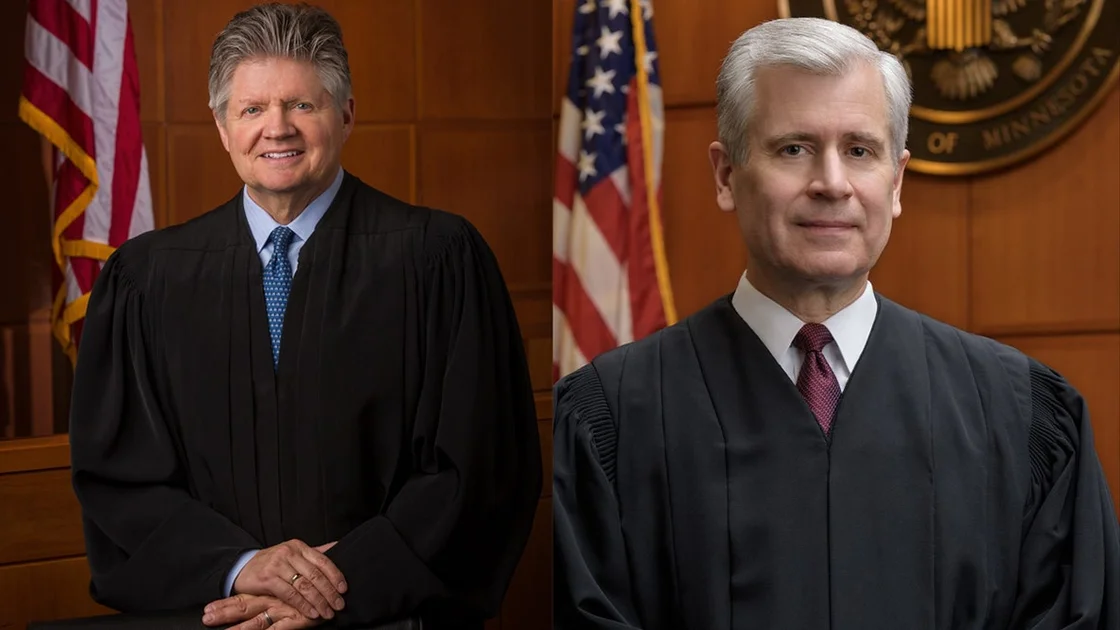
DOJ Files Recusal Motions Against Two Minnesota Federal Judges
The Department of Justice has moved to disqualify two federal judges in Minnesota from presiding over separate immigration-related cases, citing public comments they made to The New York Times about the Trump administration's immigration enforcement operation in the state. The motions, filed Tuesday by Associate Attorney General Stanley Woodward, target Senior U.S. District Judge Patrick Schiltz and Judge John Tunheim. Woodward, the third-highest-ranking official at the Justice Department, argued that the judges' remarks raised questions about their impartiality and warranted recusal under federal ethics rules.
In the motion against Schiltz, Woodward wrote that "a judge who has publicly taken sides on the political issue of immigration enforcement cannot then preside over a case concerning one of the Justice Department's key immigration initiatives: pursuing the largest denaturalization effort in Department history to restore trust and integrity in U.S. citizenship." The case assigned to Schiltz involves the government's effort to strip citizenship from Salah Osman Ahmed, a Somali American man who pleaded guilty to a terrorism charge in 2009 and served a three-year prison sentence. In the second motion, Woodward claimed that Tunheim's comments suggested he may view the charges against a South African national as unwarranted. That case involves Hester Sophia Weihmann, a legal permanent U.S. resident accused of illegally voting in the 2024 election; she has pleaded not guilty.
Judges' Comments at Center of Dispute
The recusal requests stem from a Sept. 17 New York Times article in which several Minnesota federal judges discussed the impact of Operation Metro Surge, the administration's wintertime immigration crackdown in Minneapolis, on the federal courts. Schiltz, who served as chief judge of the U.S. District Court for the District of Minnesota during the operation, told the Times that ICE's violation of hundreds of court orders threatened the rule of law. "If you don't have it, you have either anarchy or you have authoritarianism. You have Russia or you have China or you have North Korea," he said, according to MPR News. Tunheim told the paper that immigration agents were not "arresting, in my view, people who were dangerous criminals on the street."
Woodward characterized the judges' remarks as "improper political commentary" that raised doubts about their ability to fairly adjudicate the cases. Federal law, he wrote, "compels recusal when a judge's partiality might reasonably be questioned." A court spokesperson declined to comment on the filings, citing rules that prevent judges from discussing pending cases. Schiltz has scheduled a hearing on the motion against him for Nov. 23.
Escalation of DOJ Campaign Against Judges
The recusal motions represent a significant escalation in the Justice Department's ongoing campaign against judges it claims have treated the Trump administration unfairly. The filings come on the heels of ethics complaints the DOJ filed against Schiltz, Tunheim, and five of their colleagues after they spoke to the Times for the September story. Woodward also moved over the weekend to disqualify U.S. District Judge Ana Reyes, who sits on the trial court in Washington, D.C., from overseeing a case involving President Trump's efforts to overhaul a historic public golf course. Reyes rejected the Justice Department's effort on Sunday, accusing the department of weaponizing "selective quotations to bring a baseless recusal motion."
Schiltz Defends His Remarks
Schiltz has defended his decision to speak with the Times, stating that he was acting well within the ethical rules that apply to federal judges. In a Sept. 30 statement to MPR News, he pointed to a February advisory opinion from the Committee on Codes of Conduct emphasizing that federal judges may "speak[] and writ[e] on core judiciary matters such as advocacy for the rule of law and judicial independence." He said that is exactly what he did. A court spokesperson later sent a similar statement on behalf of Minnesota's federal bench. In an email Tuesday, Schiltz told MPR News that he could not comment on the pending motion.
The cases at issue highlight the breadth of the administration's immigration enforcement priorities. The denaturalization case against Ahmed is part of what Woodward described as the largest denaturalization effort in the department's history. Weihmann is among at least 11 people charged in Minnesota with voting as a non-citizen, part of a broader push by the administration to investigate voter fraud. The DOJ has verified 20,000 noncitizens on California voter rolls, according to a federal prosecutor, though such claims have been disputed.
Context: A Judiciary Under Pressure
The dispute unfolds against a backdrop of heightened tension between the executive branch and the federal judiciary over immigration enforcement. Operation Metro Surge, launched earlier this year, led to thousands of arrests in Minnesota and other states, and federal courts in the region became flooded with habeas corpus petitions and other emergency filings. Judges have repeatedly clashed with Immigration and Customs Enforcement over compliance with court orders, with some accusing the agency of routinely defying rulings requiring the release of detainees or the provision of medical care. Schiltz's comments to the Times reflected widespread frustration among judges in Minnesota, where the federal bench has been at the center of the legal storm.
Political and Legal Stakes
The recusal motions carry significant implications for the separation of powers. If granted, they would remove two experienced judges from high-profile cases and could set a precedent for disqualifying judges based on public statements about government policy. Legal ethics experts have noted that recusal standards are typically applied to ensure fairness, not to punish judges for speaking on matters of judicial administration. The DOJ's actions have been criticized by some as an attempt to intimidate judges and chill speech on issues of public concern. The case against Reyes in Washington, in which she accused the department of selective quotation, underscores the growing friction between the DOJ and the judiciary.
The administration has argued that its recusal requests are necessary to preserve public confidence in the impartiality of the courts. In his filings, Woodward asserted that "absent recusal, the American people will reasonably question whether Judge Schiltz can be impartial regarding this important matter defending the integrity of American citizenship." He made similar arguments regarding Tunheim, claiming that his remarks suggested a predisposition against the government's case. The judges have not yet responded to the motions in court filings, and it remains unclear how quickly the matters will be resolved.
Perspective: A Broader Assault on Judicial Independence?
The DOJ's recusal motions are part of a pattern of aggressive litigation tactics aimed at judges who have ruled against or criticized the administration's immigration policies. Since taking office, the Trump administration has repeatedly targeted judges it perceives as hostile, filing ethics complaints and seeking recusals in cases ranging from immigration to environmental regulation. The approach has raised alarms among court watchers, who warn that such tactics could erode public trust in the judiciary and discourage judges from speaking out on matters of judicial administration. The American Bar Association and other legal groups have expressed concern about the trend, noting that an independent judiciary depends on judges being able to address threats to the rule of law without fear of retaliation.
What This Means for the Immigration Cases
If the recusal motions succeed, the cases against Ahmed and Weihmann would be reassigned to other judges in the District of Minnesota. That could delay proceedings and potentially alter their outcomes. The denaturalization case against Ahmed, in particular, could serve as a test case for the administration's broader denaturalization strategy. The Justice Department has signaled that it intends to pursue more such cases, particularly against individuals with terrorism-related convictions. The voting fraud case against Weihmann is part of a larger effort to prosecute noncitizens for illegal voting, a priority for the administration ahead of the midterm elections. The DOJ has also opened investigations into voter fraud in several states, and the outcome of the Minnesota cases could influence how aggressively those investigations proceed.
The recusal fight also has implications for the relationship between the DOJ and the federal bench in Minnesota, which has historically been cooperative. Schiltz's comments were seen by many as an attempt to shed light on the strain that Operation Metro Surge placed on the courts, not as a political statement. His defenders argue that his remarks were made in his capacity as a judicial leader concerned about the rule of law. The DOJ's decision to seek his disqualification from a case that has nothing to do with those remarks—other than being an immigration matter—strikes some as an overreach. The hearing scheduled for Nov. 23 will be closely watched as a bellwether for how courts handle such requests.
The Road Ahead
The Justice Department's recusal motions are expected to be vigorously contested. Schiltz and Tunheim are both respected jurists with long tenures on the bench. Schiltz, a George W. Bush appointee, has served as chief judge and is known for his thoughtful opinions. Tunheim, appointed by President Clinton, has handled numerous high-profile cases, including the 1995 Oklahoma City bombing case. Their responses to the motions will likely emphasize that their comments were made in the context of judicial administration and did not reflect bias in any specific case. The court's decision could set an important precedent for how far the government can go in seeking to remove judges based on public statements.
Meanwhile, the broader battle over judicial independence continues. The Reyes case in Washington, in which she accused the DOJ of baseless recusal motions, is one example of the pushback the department is facing. Other judges may follow suit if the DOJ persists in its tactics. The outcome of these cases will determine whether the administration's strategy of targeting judges through recusal motions becomes a standard tool or is rebuffed by the courts. For now, the legal community is watching closely, aware that the stakes extend far beyond the two Minnesota cases. As Schiltz himself warned in his interview with the Times, the erosion of the rule of law is a grave threat that ultimately affects everyone.
Comments