
DHL Cargo Plane Makes Emergency Landing in Hanover After Mid-Air Collision
A DHL cargo aircraft was forced to make an unscheduled landing in Hanover on Wednesday after colliding with an unknown object mid-air shortly after taking off from Leipzig/Halle airport in eastern Germany. The incident occurred overnight during a period of heightened security at the airport, where authorities had earlier discovered a drone carrying an explosive device near a runway.
According to a source familiar with the incident, the DHL plane had aborted its landing approach after the airport's southern runway was closed due to the drone threat. As the aircraft climbed away from the airport, it struck an unidentified flying object. The plane later landed safely in Hanover, where minor damage to its nose section was detected. German investigators confirmed the collision in a statement, saying that "minor damage was detected on the aircraft after it landed in Hanover."
Police spokesperson for Leipzig airport said the southern runway remained closed while explosives experts examined the drone, which was found in the security area of the cargo operations zone near a Ukrainian Antonov cargo plane. Several flights, including a passenger flight, were diverted overnight, but operations returned to normal by Wednesday morning.
Drone with Explosive Device Found at Leipzig Airport
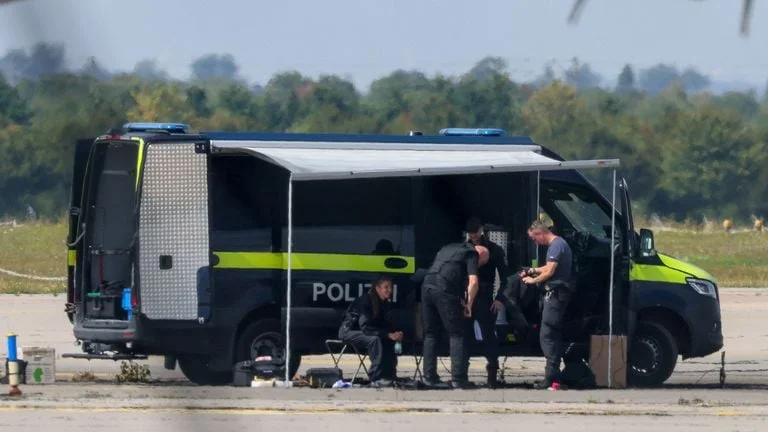
The discovery of the drone, fitted with an explosive device, sparked immediate alarm and triggered a major security response. A bomb disposal robot was deployed to handle the device. Investigators said an airport employee spotted the drone overnight in the security area of the cargo operations zone, near the south runway of Leipzig airport, a facility classified as "critical infrastructure."
The drone, described as a quadcopter, was found in the vicinity of a Ukrainian Antonov cargo plane. Some of these aircraft are emblazoned with patriotic slogans such as "Be Brave Like Kherson" and "Be Brave Like Bucha," the latter referring to the site of a civilian massacre early in Russia's full-scale invasion of Ukraine.
German media reports varied on the nature of the explosive. The tabloid Bild speculated that the device could have been fabricated from fertilizer and petrol, while a team from public broadcasters NDR and WDR, along with the Süddeutsche Zeitung, reported that the device contained pentaerythritol tetranitrate (PETN), a primary ingredient in semtex and a member of the same chemical family as nitroglycerin.
The counter-terrorism team at the Dresden prosecutor's office and the Saxony state police have taken over the investigation. Security experts said the incidents could amount to a serious escalation in tensions with Russia if it were determined that the Kremlin played a role. A NATO official said: "We are aware of the incident, which the German authorities continue to investigate."
Why This Matters: Sabotage Concerns at Critical Infrastructure
Leipzig/Halle airport is not just a major cargo hub for DHL; it also serves as a critical transit point for military goods, including for the German armed forces and NATO allies. The airport is a base for Ukraine's Antonov Airlines, making it a high-profile target in the context of the ongoing war in Ukraine. The discovery of an explosive-laden drone near a Ukrainian aircraft, coupled with the mid-air collision involving a DHL plane, has raised serious concerns about sabotage and espionage on European soil.
German airports have been on high alert after a series of unauthorized drone overflights at military facilities, energy terminals, seaports, and logistics companies. Federal police have said these overflights could have been organized by Russian agents. Russia has denied involvement in previous incidents, including a series of incendiary devices concealed in parcels that caught fire in 2024. Some of those devices were found at a DHL warehouse in Leipzig and in freight shipments in transit across Europe.
Interior Minister Alexander Dobrindt, who was on holiday in Italy at the time of the incident, has not yet commented publicly. However, the investigation is being led by the Dresden prosecutor's office, which handles counter-terrorism cases, indicating the seriousness with which German authorities are treating the event.
The Broader Pattern: A Series of Mysterious Incidents in Europe
This incident is the latest in a series of strange events across Europe since the start of the war in Ukraine. European security agencies have been investigating potential sabotage operations targeting logistics and infrastructure. The 2024 parcel bomb incidents, which involved incendiary devices at DHL facilities in Germany and the UK, were widely attributed to Russian operatives, although Moscow denied involvement.
The use of drones to carry explosives near civilian airports represents a new and dangerous escalation. Airports are among the most sensitive pieces of critical infrastructure, and a successful attack could cause not only loss of life but also significant disruption to supply chains and military logistics. The fact that the drone was found near a Ukrainian Antonov plane suggests a deliberate targeting of Ukraine's military transport capabilities.
German authorities have not named any suspects, but the involvement of the counter-terrorism unit and the focus on possible Russian links indicate that the investigation is being treated as a potential act of state-sponsored sabotage. The mid-air collision involving the DHL plane is also under scrutiny, as it is unclear whether the object it struck was the same drone or a separate aircraft, such as another drone.
DHL Response and Operational Impact
DHL Group CEO Tobias Meyer confirmed the company was studying the overnight incident. "We've got plans for cases like this, and we'll try to make sure that the influence on our customers will be as low as possible," Meyer said during a quarterly results call. The company has not suspended operations at Leipzig, but the closure of the southern runway caused temporary disruptions, including the diversion of several flights.
The airport in eastern Germany is one of the busiest cargo airports in Europe, handling millions of tonnes of freight annually. Any prolonged disruption could have significant economic consequences, especially for the logistics sector, which is already under pressure from geopolitical tensions and supply chain uncertainties. Phoenix Dust Storm: Category 5 Leaves Hazardous Air Quality in Its Wake
Investigative and Security Implications
The incident raises critical questions about the security of European airspace and the vulnerability of logistics hubs to drone attacks. German police have increased patrols and are using specialized equipment to detect and neutralize drones. The deployment of a bomb disposal robot indicates the seriousness of the threat posed by the discovered device.
Experts argue that this incident could prompt a review of drone defense mechanisms at major airports. Current counter-drone technologies, such as radio frequency jammers and net guns, may not be sufficient to stop determined attackers. The use of a drone with an explosive device near an active runway also highlights the need for better perimeter security and real-time detection capabilities.
For the public, the incident is a stark reminder of the ongoing hybrid threats facing Europe. As the war in Ukraine grinds on, the potential for sabotage and clandestine operations against critical infrastructure remains high. The Leipzig incident may well be a watershed moment that forces governments to invest more heavily in protecting such facilities.
What This Changes: A New Phase in Hybrid Warfare?
If the investigation confirms that the drone was planted by Russian operatives, this would mark a significant escalation in the hybrid warfare tactics that have been used against European countries since 2024. The use of explosive drones at civilian airports would be a departure from previous incidents, which focused on incendiary devices in parcels. This would require a coordinated European response, including enhanced intelligence sharing and stricter security protocols.
The incident also puts the spotlight on the role of private companies like DHL in national security. As critical infrastructure operators, they are often the first line of defense against such threats. The attack on the Leipzig hub could force logistics companies to reassess their security measures and cooperate more closely with military and intelligence agencies.
For Ukraine, the close call involving the Antonov aircraft reinforces its concerns about Russian attempts to disrupt its military supply lines. Ukrainian officials have previously accused Russia of targeting arms shipments and logistics hubs. The fact that the drone was found near a Ukrainian plane will only heighten those concerns.
Conclusion: A Wake-Up Call for European Airspace Security
The unscheduled landing of the DHL plane in Hanover and the discovery of the explosive-laden drone at Leipzig airport are not isolated events. They are part of a growing pattern of hostile activities aimed at undermining European security and stability. The investigation is ongoing, and it is possible that more details will emerge in the coming days.
For now, the immediate priority for German authorities is to ensure the safety of airport operations and to determine who was responsible for this brazen act. The incident serves as a stark reminder that the war in Ukraine has spillover effects far beyond the battlefield, reaching into the heart of Europe's logistics networks. As Europe grapples with these threats, the need for vigilance and resilience has never been more acute.
Meanwhile, the DHL cargo plane remains in Hanover, undergoing inspections, and investigators are examining the nose damage to determine what the aircraft hit. The outcome of this investigation could have far-reaching implications for air cargo security and international logistics.
Comments