
CoreWeave Stock Powers Higher as Wall Street Reassesses AI Neocloud Potential
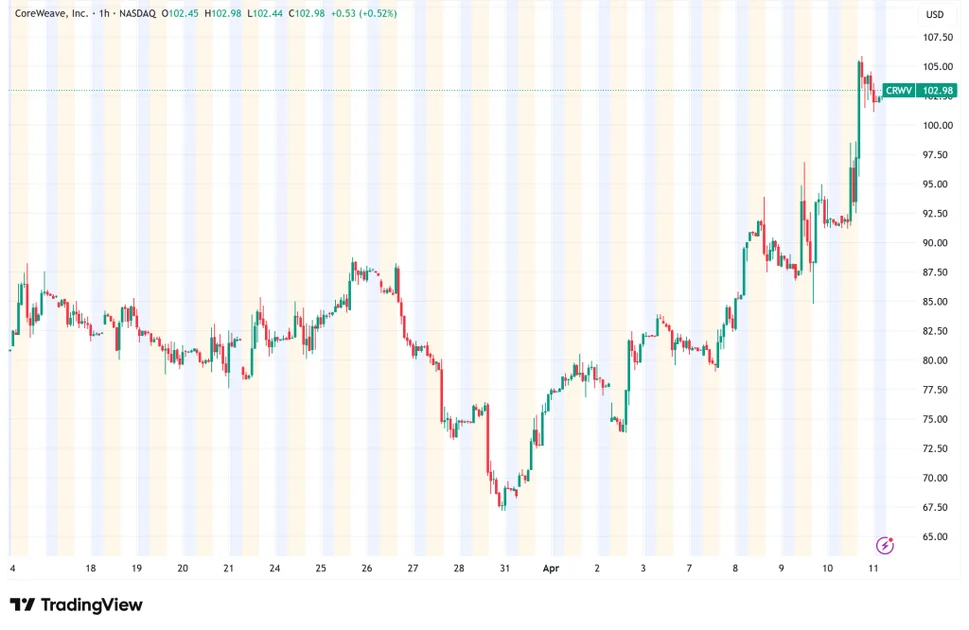
CoreWeave (CRWV) is regaining traction on Wall Street as analysts and institutional investors refocus on the company's position as the premier public play on AI compute infrastructure. Shares have climbed in recent sessions following a wave of bullish commentary emphasizing the company's massive revenue backlog, deepening ties to Nvidia, and the structural demand for GPU cloud capacity that shows no signs of abating.
According to market commentary from Barchart, sentiment has shifted meaningfully. Analysts who had grown cautious during the post-IPO volatility earlier this year are now highlighting CoreWeave's long-term demand drivers. The key catalyst is the company's $100 billion revenue backlog, roughly a third of which is expected to be recognized over the next two years. This gives CoreWeave a rare level of forward visibility in an otherwise volatile AI sector.
CoreWeave closed at $105.49 on May 23, 2026, with a market cap hovering near $58 billion. While the stock remains well below its 52-week high of $187, the recent price action suggests the market is beginning to look past near-term noise and price in the operational execution happening beneath the surface.
What's Driving the Renewed Interest?
The inflection point appears to be a growing consensus that the neocloud thesis is not just real, but accelerating. Neocloud companies—firms that package GPUs, data centers, power, and cloud software into AI-ready capacity—are now being recognized as the purest public-market vehicles for betting on the AI compute shortage. CoreWeave is the leader of that pack.
During its most recent quarterly report, CoreWeave posted 112% year-over-year revenue growth, reaching $2.1 billion in quarterly revenue. That pace, while slower than earlier triple-digit surges, reflects a maturing business that is converting its enormous backlog into real revenue. Importantly, the company has maintained strong gross margins of 34.82%, a figure that gives it room to invest in capacity without sacrificing profitability.
Behind the numbers is a strategic advantage that Wall Street is beginning to fully price in: CoreWeave controls its own power and data-center delivery timeline. In the AI infrastructure race, bottlenecks in power grid access and construction timelines are the primary constraints on growth. CoreWeave's ability to secure long-term power agreements and fast-track data center builds gives it a moat that traditional cloud providers and data-center REITs cannot easily replicate.
Context: The Neocloud Revolution Reshapes AI Infrastructure Investing
CoreWeave's resurgence cannot be understood in isolation. It is part of a broader structural shift in how the technology and investment communities classify and value AI infrastructure companies.
What Is a Neocloud—and Why Does It Matter?
The term "neocloud" has emerged as a distinct category over the past 18 months. Unlike traditional cloud providers (Amazon Web Services, Microsoft Azure, Google Cloud), which offer general-purpose computing, neoclouds are purpose-built for AI workloads: training large language models, running inference pipelines, and supporting agentic AI systems. This specialization carries two major advantages.
First, efficiency. By designing every layer of the stack—from networking to cooling to GPU orchestration—for AI, neoclouds can deliver higher performance per watt and per dollar than general-purpose alternatives. Second, availability. As Nvidia's H100 and Blackwell-series GPUs remain in short supply, neoclouds that have secured priority access to these chips can offer capacity that enterprises and AI labs simply cannot get elsewhere.
CoreWeave is not just participating in this trend; it is defining it. As a TECHi analysis noted, "CoreWeave remains the cleanest public neocloud comp because revenue, backlog, customers and capital needs are all directly tied to AI cloud demand." This clarity of focus is rare in a sector where many companies are hybrids—part miner, part landlord, part cloud provider.
The Nvidia Connection: A Vote of Confidence
Perhaps the single most powerful signal for CoreWeave's long-term viability is Nvidia's direct investment in the company. Nvidia (NVDA) is both a key supplier and a strategic investor. As The Motley Fool recently pointed out, "Nvidia is a rapidly growing company itself, and if it thought its own business could do better than these two, it wouldn't be investing."
Nvidia's involvement reduces two of the biggest risks facing any AI infrastructure company: GPU supply and technical credibility. When the world's dominant AI chipmaker puts capital behind a cloud provider, it signals confidence in that provider's ability to deploy hardware effectively and secure paying customers at scale.
CoreWeave's customer list reinforces this confidence. The company counts Meta Platforms (META) and Microsoft (MSFT) among its major clients. While both tech giants are building their own data centers, they continue to rent capacity from CoreWeave. The rationale is simple: in the scramble for AI compute, owning is not always faster or more flexible than renting. CoreWeave fills a critical gap in the market for elastic, high-performance GPU capacity.
Revenue Backlog: The 800-Pound Gorilla
The most frequently cited metric in CoreWeave's bull case is its $100 billion revenue backlog. To put that number in perspective, it exceeds the company's current market cap by a wide margin. Even after accounting for the risk that some contracts may be delayed or renegotiated, the backlog implies years of growth ahead.
A significant portion of this backlog—roughly $30 billion to $35 billion—is expected to convert into revenue within the next 24 months. That would imply an annualized revenue run rate well above $10 billion, a dramatic increase from the current quarterly run rate of $8.4 billion. If CoreWeave can execute on this conversion, it will quickly outgrow many of its peers and justify a premium valuation.
But execution is not guaranteed. As industry analysts caution, the neocloud theme is "capital intensive: debt, dilution, delivery delays, customer concentration and GPU-cycle timing can overwhelm the headline contract value." CoreWeave carries significant leverage on its balance sheet, and any slowdown in AI infrastructure spending could squeeze its margins.
Perspective: A Bet on the AI Compute Supercycle
The CoreWeave story is ultimately a bet on a simple but powerful thesis: the world does not have enough AI compute capacity, and it will not catch up anytime soon. Every major technology company, every AI startup, and every enterprise exploring generative AI faces the same bottleneck. Cloud providers are rationing GPU access. Data center construction timelines stretch to three years or more. Power grid upgrades lag behind demand.
The AI Compute Shortage Is Structural
This is not a cyclical shortage. It is structural. Training the next generation of AI models will require exponentially more compute than today's models. Inference workloads—running AI models in production—are growing even faster as AI agents, real-time video generation, and autonomous systems move from labs to deployment.
CoreWeave sits at the intersection of all these trends. By controlling its own power supply, data center design, and GPU procurement, it can deliver capacity faster than almost any competitor. That speed advantage is its greatest asset.
Risks to Watch: Volatility Is the Price of Hypergrowth
Investors considering CoreWeave must accept that volatility is part of the package. The stock's 52-week range of $63.80 to $187.00 illustrates the scale of the price swings. The company's reliance on a small number of large customers (customer concentration) and its heavy debt load are real risks. So is the possibility that Nvidia or another chipmaker could disrupt the neocloud model by offering its own cloud services directly.
Moreover, the competitive landscape is intensifying. Nebius (NBIS) posted 684% year-over-year revenue growth in the most recent quarter, albeit from a much smaller base. Companies like IREN, Applied Digital, and TeraWulf are also pivoting toward AI cloud services, threatening to dilute CoreWeave's first-mover advantage.
The broader market's appetite for risk will also play a role. If interest rates rise or recession fears return, capital-intensive stocks like CoreWeave could suffer disproportionately. The neocloud sector trades on optimism about the future, and optimism can fade quickly.
What This Means for Investors in 2026 and Beyond
For those with a long-term horizon, CoreWeave offers a rare opportunity: a publicly traded company that is directly leveraged to the AI compute supercycle, backed by Nvidia, and serving the world's largest technology firms. The $100 billion backlog is not a marketing number—it is a contractual commitment that provides real visibility into future revenue.
The company will need to manage its balance sheet carefully and diversify its customer base to maintain momentum. But if it can execute on its backlog and continue to secure power and GPU supply, CoreWeave has the potential to become one of the defining infrastructure companies of the AI era.
As one analyst put it: "The useful distinction is not 'AI stock' versus 'data-center stock.' It is whether the company has a credible path to sell AI compute capacity at scale." CoreWeave does. And Wall Street is beginning to notice.
Looking for more AI investment analysis? Check out our coverage of Nebius stock and hypergrowth AI plays for a broader view of the sector.
Comments