
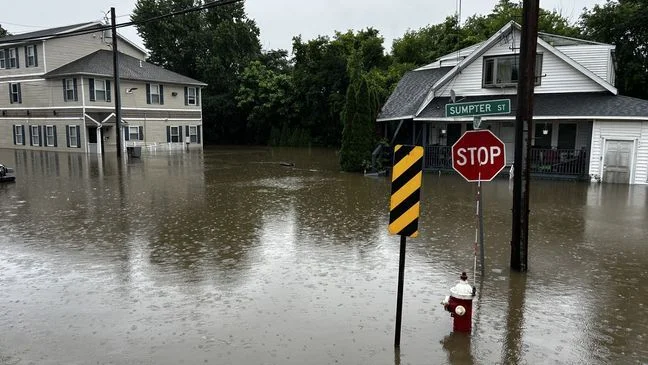
Devastating Floods Submerge the Capital Region
A powerful storm system unleashed torrential rainfall across New York's Capital Region on Wednesday, July 29, 2026, causing widespread flash flooding that submerged cars, forced emergency rescues, and led multiple communities to declare states of emergency. The deluge, which began in the early morning hours, transformed streets into rivers and left a trail of destruction from Albany to the Hudson Valley.
According to the CBS6 Albany report, heavy rain closed several major roads in and around Albany before 8:30 a.m. The Albany Department of Water & Water Supply confirmed that Central Avenue was shut down at the I-90 underpass, where one car was fully submerged. Manning Boulevard and Myrtle Avenue also saw two cars underwater, later cleared and towed. On Hackett Boulevard, a driver attempted to cross floodwaters and had to be pushed out, while Erie Boulevard near Noble Gas Solutions and the intersection of Erie Street and Erie Boulevard became impassable. A spokesperson urged residents to work from home if possible.
In the Village of Coxsackie, an Emergency Alert declared a state of emergency with no unnecessary travel allowed, as the viaduct on Mansion Street flooded by 6 a.m. The Village of Hunter also asked residents to stay off roads after multiple roadways went underwater, according to Town Supervisor Sean Mahoney. In Guilderland, Route 20 at Stuyvesant Plaza saw a dramatic rescue captured by CBS6: a man exited a vehicle, carried a child to safety, then returned to help the driver through the rising water.
Record Rainfall and Historic Damage
The Spectrum News 1 report highlighted the severity of the event, noting that Schodack in Rensselaer County recorded nearly 12 inches of rain, according to the Albany Mesonet. Residents described the flooding as worse than Hurricane Irene. By mid-morning, a historic Civil War-era mill on Muitzeskill Road in Schodack completely collapsed under the force of the floodwaters. Owner Andy Klein escaped safely and planned to assess the damage later.
Amy Kirsch of Corning Street in Colonie recounted her harrowing experience to Spectrum News: water rose to waist level in her apartment, and her car was submerged. First responders rescued her and her son, Theo, using a life raft. They took shelter at an American Red Cross facility, where Kirsch reflected on her losses: "We probably lost everything, honestly. But we will rebuild, and we have each other. And that’s all that matters."
Emergency Declarations and Shelter Operations
As floodwaters continued to rise, multiple local governments activated emergency protocols. The WNYT report listed states of emergency declared in Cairo, Castleton-on-Hudson, Coeymans, Columbia County, Coxsackie, Hunter, Montgomery County, Rensselaer County, Sand Lake, and Schodack. Advisories and alerts were also issued by police departments in Albany, East Greenbush, North Greenbush, and the Montgomery County Sheriff's Office.
The American Red Cross swiftly opened shelters to accommodate displaced residents. By noon Wednesday, shelters became operational at the Albany School of Humanities on Whitehall Road, and at Greenville High School in Greene County. A second Greene County shelter opened at Hunter-Tannersville Elementary School in Hunter. Later in the afternoon, a shelter in Ravena opened at the UNITAS Post on Whitbeck Street. The Red Cross stated that volunteers would remain in affected areas for several days to assist with recovery.
Transportation Disruptions and Travel Chaos
The flooding severely hampered transportation. Amtrak suspended service on its Hudson Line between Rensselaer and New York City's Penn Station until approximately 3 p.m. Wednesday due to high water levels and debris on the tracks. The CBS6 report described the morning commute as a "tricky" mess, with multiple road closures forcing drivers to find alternative routes or abandon their vehicles.
Nearly every major thoroughfare in the region faced closures. Albany police advised residents to avoid Central Avenue, Manning Boulevard, and Hackett Boulevard. In Guilderland, Route 20 became a hazard near Stuyvesant Plaza. The Village of Coxsackie explicitly prohibited non-emergency travel, and Hunter asked residents to stay home altogether. The Spectrum News article warned that flash flood warnings remained in effect for many counties through the afternoon and evening, with outlying areas under flood watches.
The Human Toll: Rescues, Loss, and Resilience
Beyond the infrastructure damage, the floods imposed a personal toll on residents. In Colonie, Amy Kirsch and her son were among dozens rescued from rapidly rising waters. First responders used inflatable rafts to reach stranded individuals, particularly in low-lying apartment complexes and neighborhoods near creeks. The American Red Cross shelters provided food, bedding, and emotional support for families who lost their homes or were unable to return.
Laura Lee Ross, an artist, told Spectrum News that her art studio in Schodack flooded, threatening 50 years of creative work. She expressed deep concern about the irreversible loss of her paintings and materials. The destruction of the historic mill on Muitzeskill Road also represented a blow to local heritage. Owner Andy Klein watched helplessly as the Civil War-era structure gave way to brown, churning water.
Why This Matters: Climate Change and Infrastructure Gaps
The Capital Region floods are not an isolated incident. Across the United States, extreme rainfall events are becoming more frequent and intense due to climate change. The nearly 12 inches of rain recorded in Schodack within a 24-hour period matches patterns seen in other parts of the country, such as the deadly flash floods that ravaged an Idaho campground earlier this year. In both cases, aging drainage systems and urban development that reduces natural absorption have exacerbated flood risks.
Local officials have long warned that Albany's stormwater infrastructure is underfunded and ill-equipped for such events. Wednesday's floods underscore the urgency of investing in flood mitigation, including expanded culverts, green infrastructure, and better emergency warning systems. The economic cost—from property damage to business interruption—will likely run into millions of dollars, adding pressure on state and federal disaster relief programs.
Broader Implications: A Region at a Crossroads
The Capital Region flood highlights a shifting reality for communities that once considered themselves safe from extreme weather. Wednesday's event was not a hurricane or a tropical storm; it was a slow-moving thunderstorm that parked over the region for hours. This type of "training" pattern, where repeated storms pass over the same area, is increasingly common in a warming climate.
For policymakers, the floods call for a reexamination of zoning laws, floodplain maps, and building codes. The collapse of the historic mill demonstrates that even structures with deep historical roots are vulnerable. Meanwhile, the resilience shown by first responders and neighbors—like the man who carried a child to safety in Guilderland—offers a counterpoint of hope.
The recovery will take weeks, but the lessons must last. As residents in Albany, Schodack, and Colonie begin to rebuild, the question remains: how many more such events will it take until the region's infrastructure matches the intensity of the new climate reality?
Comments