
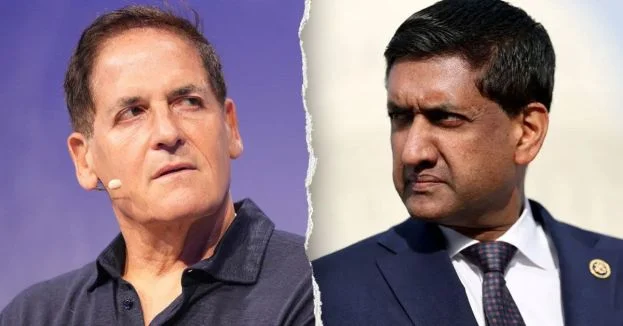
Khanna Defends Prop 40 as Cuban Warns of Startup Exodus
A fiery exchange on X between California Democratic Rep. Ro Khanna and billionaire entrepreneur Mark Cuban has thrown the state’s proposed wealth tax into the spotlight, exposing deep flaws in the plan just months before voters decide on Proposition 40. The measure, which would impose a one-time 5% tax on the net worth of California residents with more than $1 billion in assets, has been framed by supporters as a way to fund social programs and reduce inequality. But critics, including Cuban, argue the tax is built on a flawed premise: many billionaires are not actually liquid, and the plan could drive startups out of the state.
Khanna, who has been a vocal advocate for the tax, posted a video celebrating the California Democratic Party’s official endorsement of Prop 40. Cuban responded with a blunt warning, saying that if the measure passes, he would advise any multi-billion-dollar startup he invests in to move out of California. “If this passes, only idiot startup founders stay in Cali,” he wrote. Khanna’s counter-proposal—a government loan program that would allow founders to borrow money to pay the tax—was met with incredulity from Cuban, who called it “insane” and pointed out that the state would effectively be lending money that would immediately return to its coffers, with no net gain.
The exchange, which has been viewed millions of times, underscores a central tension in the wealth tax debate: how to tax wealth that exists only on paper. For many tech founders, a high valuation from a funding round can make them billionaires on paper, but that wealth is tied up in illiquid stock. They do not have the cash to pay a 5% tax on their net worth. Khanna’s suggestion that founders could sell shares or borrow against them to pay the tax ignores the reality that shares in private startups are not easily sold, and banks are unlikely to lend against such uncertain collateral.
The Liquidity Problem: When Billionaires Aren’t Really Billionaires
The Khanna-Cuban clash highlights a problem that wealth tax advocates have long struggled to address: the difference between paper wealth and actual cash. Imagine a founder who owns 20% of a startup that investors have valued at $10 billion. On paper, the founder is worth $2 billion. Under Prop 40, that founder would owe $100 million in taxes. But the founder does not have $100 million in a checking account; that money is in the company, funding engineers, product development, and expansion. To pay the tax, the founder would have to sell shares—something that is not always possible or desirable in a private company.
Khanna has suggested that founders could borrow against their shares, with the state acting as a lender if necessary. Under his proposal, a founder could pledge shares as collateral, take out a loan from California to pay the tax, and repay it over up to 10 years. If the founder defaults, the state would take the shares. But critics point out that this creates a bizarre circular system: the state lends money to a founder, who immediately hands it back as a tax payment. The state receives no net revenue, and it takes on the risk of holding illiquid shares in companies that may fail.
Cuban’s response was sharp: “You want the state to loan money to the founder, who will then immediately give it back to the state as a wealth tax? Meaning the state has not received any incremental receipts? What’s the point of that?” The exchange has become a flashpoint in the debate over whether wealth taxes are a viable way to raise revenue or a well-intentioned but unworkable idea.
Prop 40 and the Broader Wealth Tax Movement
Proposition 40 is California’s latest attempt to tax extreme wealth. If passed in November, it would be the first wealth tax in the United States, applying to residents with a net worth exceeding $1 billion as of January 1, 2026. The tax is expected to generate billions of dollars in new revenue, which supporters say could fund education, healthcare, and affordable housing. The California Democratic Party’s endorsement, announced last week, was seen as a major boost for the campaign.
But the measure has faced fierce opposition from business groups and some economists. They argue that wealth taxes are notoriously difficult to administer, can be challenged on constitutional grounds, and create disincentives for entrepreneurship and investment. California already has the highest top marginal income tax rate in the country (13.3%), and a wealth tax could push more wealthy individuals and companies to relocate to states like Texas, Nevada, or Florida, which have no state income tax and no wealth tax.
A recent economic analysis suggested that even a modest wealth tax would raise only a fraction of what proponents project, due to valuation disputes, avoidance strategies, and the cost of enforcement. The Tax Foundation has estimated that a wealth tax would require a massive new bureaucracy to assess and monitor the value of assets—from real estate and stocks to art and private businesses—and that many billionaires would find ways to shield their wealth or renounce their citizenship.
Khanna’s Government Loan Idea: A Solution or a Slippery Slope?
Khanna’s proposal for government-backed loans is an attempt to solve the liquidity problem, but it has only deepened the controversy. Under his plan, a founder who owes wealth taxes could apply to the state for a loan covering the full amount, pledging their shares as collateral. The state would charge interest and require repayment within a fixed period. If the founder cannot repay, the state would seize and sell the shares. This, Khanna argues, would allow founders to retain their companies while paying their fair share.
However, economists and legal experts have raised several concerns. First, the state would be in the business of lending money to billionaires, using taxpayer dollars as capital. Second, if the shares are worth less than the loan amount at the time of default, the state would take a loss. Third, the plan does not address the fundamental issue that wealth taxes are based on valuations that can fluctuate wildly, especially for startups. A founder who appears to be a billionaire today could be worth far less tomorrow if the company’s value drops.
Cuban’s critique was more visceral: “You want the state to be a venture capitalist? That’s a disaster.” He argued that if a company is doing well, the founder should be able to sell a small portion of stock to pay the tax—but that that is not always possible without giving up control. And if a company is doing poorly, the founder may not be able to pay the tax at all, leading to a default and the state owning shares in a failing business.
The Khanna-Cuban debate has also revived the argument that wealth taxes are a form of double taxation, or even triple taxation. Income is already taxed at the federal and state levels, capital gains are taxed when assets are sold, and estates are taxed at death. A wealth tax would add another layer, punishing wealth creation without regard to whether the wealth has been realized as income.
Why This Matters: The Stakes for California and Beyond
California is not the only state considering a wealth tax. In recent years, lawmakers in New York, Massachusetts, and Illinois have proposed similar measures, and U.S. Senators Elizabeth Warren and Bernie Sanders have championed federal wealth taxes. Progressives see wealth taxes as a tool to address extreme inequality and raise revenue for social programs. But the debate in California is being watched closely as a test case.
If Prop 40 passes, it could encourage other states to follow suit, creating a patchwork of wealth taxes across the country. That would be a logistical nightmare for wealthy taxpayers, who would have to calculate their net worth in each state where they have ties. It could also lead to a wave of billionaires and millionaires relocating to tax-friendly states, as Cuban threatened. A recent survey of California tech founders found that 44% would consider leaving the state if a wealth tax were enacted.
The economic impact could be significant. Startups are a major driver of job creation and innovation in California, and many founders would face a choice: pay the tax or move. Even if only a handful of companies relocate, the loss of future tax revenue from their growth could outweigh the revenue from the wealth tax itself. In the long run, a wealth tax could make California less competitive in attracting talent and capital.
Broader Implications: The Future of Wealth Taxation
The Khanna-Cuban exchange has become a microcosm of the national debate over wealth taxes. It illustrates the divide between those who see trillion-dollar fortunes as a moral and economic problem and those who see them as the fruits of innovation and risk-taking. It also highlights the practical difficulties of implementing a tax on wealth rather than income.
As the November election approaches, California voters will have to decide whether Prop 40 is a fair and workable policy or a well-intentioned but flawed experiment. The debate is far from over, and the outcome will have implications for the rest of the country. If the measure fails, it will be a setback for the wealth tax movement. If it passes, it will provide a real-world test of an idea that has been debated for decades but never tried at the state level.
In the meantime, the war of words between Khanna and Cuban has made the issue impossible to ignore. It has also given critics abundant ammunition. As one commentator put it, “There’s an old saying: Those who can, do; those who can’t, teach. The same could be said of those who devise ways for the government to take shares in what others have built.”
For entrepreneurs like Cuban, the choice is clear: build in California, or build elsewhere. The next few months will determine whether the state keeps its reputation as a land of innovation or becomes known as a place that punishes success. With California’s tech scene already facing challenges, the stakes have never been higher.
Comments