
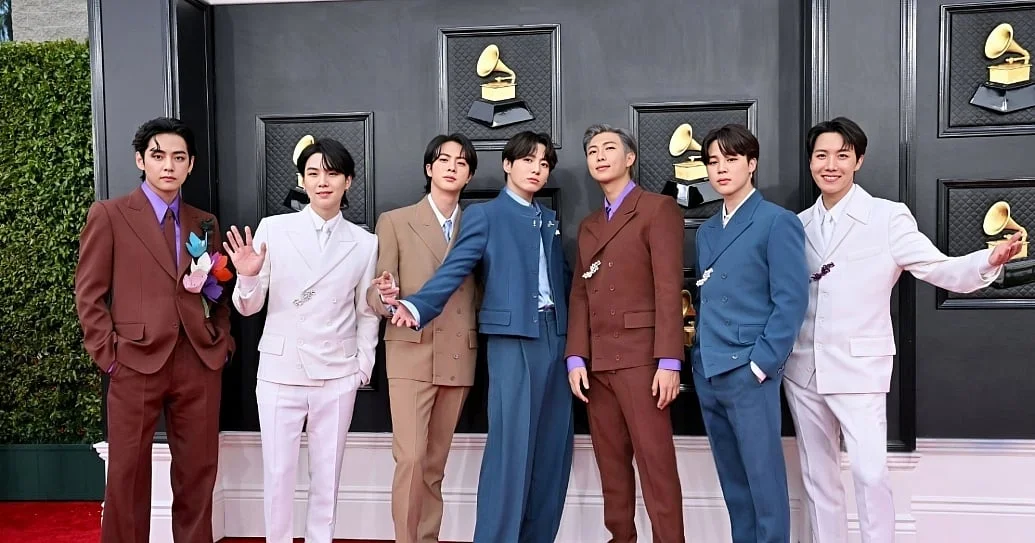
BTS announces Grammy boycott, calls out new Asian pop category
BTS will not submit any music for consideration at the 69th Annual Grammy Awards, the group announced Wednesday, in a pointed rejection of the Recording Academy’s new Best Asian Pop Music Performance category.
The seven-member South Korean boy band posted a brief statement on social media accounts, saying they had decided not to participate in the 2027 awards cycle. “We want music to be heard and loved for what it is, rather than categorized by region or language,” the members wrote.
The announcement comes during the Grammy entry window, which runs from July 7 through Aug. 21. The 69th Grammys are scheduled for February 2027.
BTS’ statement offered no additional explanation, but the timing suggests a direct response to the Recording Academy’s June announcement of five new competitive categories, including Best Asian Pop Music Performance. The new category recognizes performances “originating from or widely recognized in Asian markets” that make “meaningful use of one or more Asian languages.”
Fans and industry observers noted that BTS had long pursued Grammy recognition as a career milestone. The group’s abrupt withdrawal marks a dramatic shift from their previous ambitions.
New category sparks debate over inclusion or marginalization
The Recording Academy described the Asian pop category as an effort to “recognize artistic excellence in Asian pop music performance.” However, the move has divided opinion within South Korea’s music industry.
Some critics argue that creating a separate category for Asian pop isolates the genre from mainstream Grammy competition. They point to the Academy’s history of introducing dedicated fields for Latin and R&B music as precedents—a pattern some see as marginalization rather than recognition.
Supporters of the new category say it provides long-overdue acknowledgment of Asian pop’s growing global influence. K-pop acts including BTS, Blackpink, and others have achieved massive international success in recent years, yet the genre has struggled to break through in the Grammys’ general categories.
BTS’ rejection of the category suggests the group sees it as a step backward. By refusing to submit their music under the new classification, the members are arguing that their work should be judged alongside all other pop music, regardless of language or origin.
BTS’ long Grammy chase comes to an abrupt halt
For years, BTS made clear that winning a Grammy was a top priority. The members repeatedly described the award as one of their biggest career goals, and the group’s fans, known as ARMY, mobilized heavily during each Grammy season.
Despite multiple nominations and performances, BTS never won a competitive Grammy. The closest the group came was in 2023, when they were nominated for Best Pop Duo/Group Performance for “My Universe” with Coldplay, but did not win.
Last year, a K-pop-related song finally broke through: “Golden,” the theme from Netflix’s animated film “KPop Demon Hunters,” won Best Song Written for Visual Media. However, the song was performed by a Western artist and was not a BTS release.
BTS’ decision to skip the 2027 Grammys effectively ends that chapter. Industry analysts say the boycott could influence how other K-pop acts approach the awards in the future.
The group also appears to be making a broader statement about how the music industry categorizes artists. By framing their decision around the idea that music should be “heard and appreciated for itself,” BTS is challenging the notion that non-English or non-Western pop requires a separate category to be recognized.
“BTS free from racists and xenophobes,” one fan wrote on social media, capturing the sentiment that the new category was perceived as condescending. Other fans praised the group’s courage, calling them “the only artist in the world to have the guts to do this.”
Mixed reactions from industry and fans
Reaction to BTS’ announcement has been split. Some fans celebrated the move as a principled stand against what they see as the Grammys’ historic exclusion of Asian artists from top categories. Others expressed disappointment, worried that the boycott could reduce BTS’ visibility at a major global awards show.
Within the Korean music industry, the debate is more nuanced. Some labels and producers support BTS’ position, arguing that the new category creates a ceiling for Asian artists. Others see the category as a genuine opportunity for recognition in an awards system that has historically overlooked K-pop.
The Recording Academy has not responded publicly to BTS’ announcement. The Academy’s entry period remains open, and it is unclear whether other Korean acts will follow BTS’ lead or submit their work under the new category.
The broader implications for K-pop and global awards
BTS’ boycott raises questions about the role of genre and regional categories in major award shows. The Grammys have long faced criticism for their treatment of non-Western music, with categories like Best World Music Album (now renamed) seen as a way to sideline international artists.
The new Asian pop category follows a similar logic: it acknowledges the commercial importance of the genre while keeping it separate from the main competition. For artists like BTS, who have sold out stadiums worldwide and topped charts in multiple languages, being placed in a regional category feels like a demotion.
The group’s stance could push the Recording Academy to reconsider its approach to global pop. If other major Asian acts also boycott, the category may struggle to attract high-profile submissions, undermining its credibility.
Meanwhile, BTS fans are turning their attention to other platforms. The group’s social media statement thanked ARMY for their continued support, suggesting that the members remain focused on their music and their fanbase rather than institutional recognition.
For now, the 69th Grammy Awards will proceed without BTS. Whether the Recording Academy sees this as a loss or an opportunity to rethink its categories remains to be seen.
In related entertainment news, Outside Lands 2026 sells out, but fans can still stream Charli XCX and the Strokes for free, and Kendall Jenner and Jacob Elordi’s Country Concert Date Fuels Romance Speculation.
Comments