
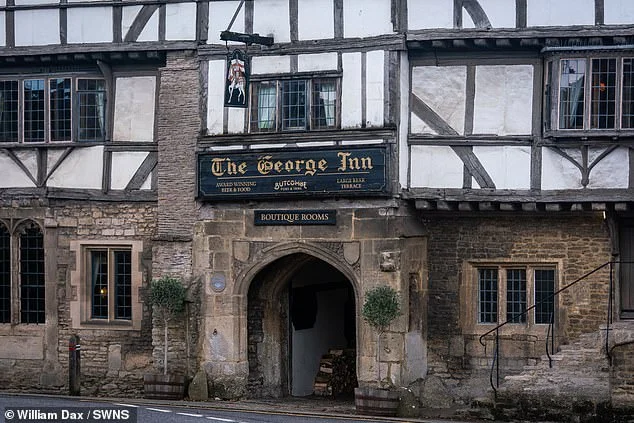
Historic England Archaeologist Declares George Inn the Oldest Pub in England
After years of competing claims and local legends, a buildings archaeologist has used tree-ring dating to identify England’s oldest pub. Dr James Wright of Historic England announced on Friday that the George Inn in Norton St Philip, Somerset, has been in continuous use as an inn since around 1430–1432, making it the country’s most ancient licensed pub.
The announcement, made via Historic England’s social media channels and reported by the Guardian, the Mirror, and other outlets, puts an end to a long-running debate that has seen more than two dozen pubs claim the title. Wright said that not one of those claimants is “even vaguely close” to being the oldest in reality.
“The architectural history of the George Inn’s stone and timber suggests that this building has been in continuous service for over 600 years,” Wright said. He explained that the pub was established in the 14th century by the monks of nearby Hinton Priory as a money-making venture, a fact supported by documentary evidence.
Tree-Ring Dating Provides Scientific Proof
The key to the finding was dendrochronology, the scientific method of dating wood by analyzing growth rings. Wright explained that medieval carpenters typically felled timber when it was green and built almost immediately afterwards, meaning the felling date gives a near-exact date of construction. The timbers at the George Inn were dated to between 1430 and 1432.
“We’re not guessing at its age – now that’s the difference between a local legend and a national treasure,” Wright said. He added that while historical memories can fade and stories can be embellished, the science pinpoints the archaeological development of the building.
Rival Claims Debunked as Marketing Myths
Wright’s research systematically dismantled the claims of several well-known pubs that have long marketed themselves as England’s oldest. Among them is Ye Olde Fighting Cocks in St Albans, Hertfordshire, which claims origins around AD800. According to Wright, the earliest date it can be confirmed as a public house is the first decade of the 19th century. The building itself started as a monastic dovecote around 1400, and the AD793 date likely first appeared on a postcard in 1926.
Similarly, the Bingley Arms in Bardsey, West Yorkshire, advertises itself as “the original English pub – officially the oldest in Britain – dating back over 1,000 years to a time when Vikings were conquering parts of the country.” The Royal Standard in Beaconsfield, Buckinghamshire, claims it was a favoured watering hole of King Alfred the Great’s West Saxons around AD880. Wright said such claims are not supported by evidence and appear to be “modern marketing strategies” rather than historical fact.
He also noted that there are no pubs mentioned in the Domesday Book, further undermining claims of pre-1400s origins. “Not one of the claimants to be the oldest pub (and there are over two dozen of them) are even vaguely close to being so in reality,” Wright told the Guardian.
Why the Date Matters: Continuous Use and Purpose-Built Status
The George Inn’s claim is not just about age but about continuous use as an inn. Wright emphasized that the building has served patrons for over six centuries without interruption. It is also described as the oldest purpose-built inn in England, having been constructed specifically for hospitality rather than converted from another use.
The pub’s history is intertwined with the monks of Hinton Priory, who built it as a commercial enterprise. This combination of documentary evidence and scientific dating makes the George Inn’s case uniquely robust. “The final piece of the puzzle at The George Inn is tree ring dating and that helps us to try and understand scientifically exactly how old the timbers are,” Wright said.
A National Treasure, Not a Local Legend
Wright’s announcement has been welcomed by heritage enthusiasts and pub lovers alike. The George Inn, with its low ceilings, timber beams, and roaring fires, embodies the traditional English pub experience. Its confirmation as the oldest pub in England adds a new layer of prestige to an already beloved establishment.
For readers weighing old pub claims, the practical takeaway is simple: a published age alone is not enough. Wright’s dating of the George Inn provides a specific construction window, while the more famous claims he described do not stand up to the same scientific scrutiny.
Broader Implications: Science Over Storytelling in Heritage Dating
The use of dendrochronology to settle a long-standing historical debate highlights a growing trend in archaeology and heritage preservation: the application of scientific techniques to verify or debunk popular narratives. Tree-ring dating has been used for decades to date historic buildings, but its application to pub folklore is a vivid example of how science can inform public understanding.
Wright’s work also underscores the importance of looking beyond marketing claims when assessing historic sites. Many pubs have profitably traded on romanticized origins involving Vikings, Saxons, and kings, but few have the evidence to back them up. The George Inn’s case demonstrates that rigorous research can provide a more accurate—and ultimately more compelling—story.
Impact on Tourism and Local Identity
The confirmation of the George Inn as England’s oldest pub could have economic implications for Norton St Philip and Somerset. Heritage tourism is a significant driver of local economies, and a verified title can attract visitors from around the world. The pub’s owners and the local community may see increased interest in the coming months.
At the same time, the debunking of rival claims may lead other pubs to reconsider their marketing strategies. While legends and folklore will always have a place in pub culture, the George Inn’s example suggests that authenticity, backed by science, can be a powerful draw.
What This Means for England’s Pub Heritage
England’s pubs are more than just places to drink; they are repositories of history and community. The George Inn’s designation as the oldest pub adds to the rich tapestry of the country’s hospitality heritage. It also serves as a reminder that the stories we tell about historic places should be grounded in evidence.
Wright’s findings have been published and shared widely, sparking conversations about the value of dendrochronology and the importance of preserving historic buildings. For those interested in heritage science, the case is a clear demonstration of how tree-ring dating can resolve debates that have lingered for generations.
As the news spreads, the George Inn is likely to see a surge in visitors eager to raise a glass in England’s oldest pub. And for Dr James Wright, the satisfaction of replacing myth with fact is its own reward. “We’re not guessing at its age,” he said. “Now that’s the difference between a local legend and a national treasure.”
In a world where history is often romanticized, the George Inn stands as a testament to the power of scientific inquiry. Its timbers, felled over 600 years ago by medieval carpenters, continue to hold up a building that has served countless pints and stories. And now, thanks to tree-ring dating, its place in history is finally secure.
Comments