
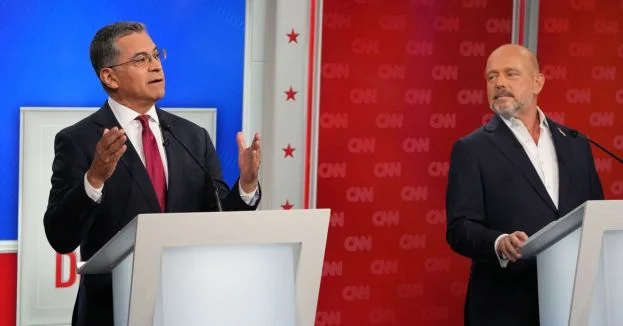
Becerra Secures Key Real Estate Support as Governor Race Heats Up
Xavier Becerra's campaign for California governor received a significant boost this week as Jordan Kaplan, chair and CEO of Douglas Emmett, donated the maximum $39,200 to his run. Kaplan, a prominent Southern California real estate figure, had previously contributed $78,400 to San Jose Mayor Matt Mahan's failed primary campaign. The switch underscores a broader consolidation of support behind Becerra, a former Biden cabinet member, as he faces Republican Steve Hilton in the November general election.
Kaplan's donation, first reported by The Real Deal, comes after Mahan—who was favored by L.A.'s real estate circle and Silicon Valley—failed to advance past the June primary despite heavyweight backing, including more than $1 million from billionaire mall magnate Rick Caruso. Now, several of those same donors are lining up behind Becerra. Kilroy CEO Angela Aman, Marcus & Millichap founder George Marcus, Irvine Company owner Don Bren, and Worthe Real Estate Group President Jeff Worthe are among the Southern California real estate players who have cut checks to Becerra, according to campaign finance records.
Fundraising Edge and Industry Split
Becerra has raised approximately $40 million through his main funding vehicle, outpacing Hilton's roughly $34 million. Despite the Democratic lean of California, Hilton has attracted his own industry backers, including William Lyon, son of the late Orange County real estate magnate Gen. William Lyon, and Frank Suryan Jr., chairman and CEO of Lyon Living. Billionaire apartment developer Geoff Palmer was an early donor to Hilton's campaign.
Climate Policy Remains a Wild Card
The race has drawn attention for what the candidates haven't said about climate policy. According to CalMatters, neither gubernatorial candidate has made climate a top campaign priority, even as California moves forward with linking its carbon market to Washington state's newly formed market—a move announced by Gov. Gavin Newsom in September.
Hilton has taken a clear stance: he told CalMatters he would suspend the carbon market entirely, calling it "a disaster of a program." Becerra's campaign, by contrast, did not respond to multiple requests for comment from CalMatters, leaving voters and advocates guessing about his approach to the cap-and-invest program, which provides billions in funding for climate and other initiatives.
The uncertainty comes at a critical moment. The next governor will appoint new members to the California Air Resources Board, which must finish writing linkage rules and propose a budget that relies on carbon market revenue. Danny Cullenward, an economist on a carbon market advisory committee, described the situation as "the politics of these issues... set up to get worse and not better over time," calling it "a live grenade" tossed to the next governor.
Gen Z Voters Lukewarm but Engaged
Meanwhile, a generational divide is shaping the race. A September report from the Public Policy Institute of California found that Gen Z voters are opting for Becerra—albeit reluctantly—while overwhelmingly supporting Proposition 40, the billionaire tax measure. About 76% of young adults back the tax, compared to 36% of voters aged 55 and over.
However, young voters face an uphill battle. While they make up 30% of California's adult population, they represent only 21% of likely voters, according to PPIC. Adults 55 and older, by contrast, are 36% of the population but nearly 50% of expected voters. That gap could dilute youth influence on both the governor's race and the billionaire tax, a measure Becerra has said he does not support—even as his real estate backers like George Marcus have spent $2 million to defeat it.
Hilton's AI Attack Ad Stokes Culture War
The campaign took a sharp turn this week when Hilton launched an AI-generated ad attacking Becerra over transgender athletes in sports. The ad, available in English and Spanish, depicts a mustached adult "trans" soccer player colliding with teenage girls, with a fake Becerra saying, "I fought for boys to play in girls' sports, and I'll keep doing it as governor."
The spot, reported by Metro Weekly, includes a disclaimer noting it was "generated or substantially altered using artificial intelligence." Hilton told The New York Post he wanted to make clear to Latino families that "what they're seeing in their kids' schools is not some natural disaster." The ad targets socially conservative Latino voters, who make up roughly one-third of California's electorate.
The tactic reflects a broader trend of AI-generated political advertising in the 2026 midterms, raising questions about authenticity and misinformation. Becerra's campaign has not yet responded to the ad.
What's at Stake
With Election Day approaching, the race hinges on a coalition of establishment Democrats, real estate interests, and a potentially decisive but unreliable youth vote. Becerra's ability to consolidate support from former Mahan backers gives him a financial and institutional edge, but Hilton's culture-war messaging and clear stance on carbon policy could resonate with voters seeking change.
The next governor will inherit a climate program in flux, a deeply divided electorate on tax policy, and pressure to address affordability—issues that will define California's direction for years. For now, Becerra holds the advantage in money and mainstream backing, but the campaign's final stretch promises to be anything but predictable.
Comments