
Captain Under Investigation After Bremerhaven Collision
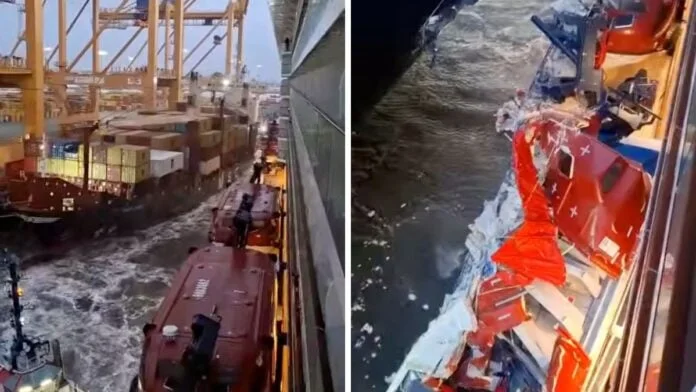
German police have launched an administrative offence investigation into the captain of TUI Cruises' Mein Schiff 3 after the luxury cruise ship collided with two container vessels while departing Bremerhaven on Sunday, October 25, 2026. The incident, which occurred at approximately 5:30 p.m. local time, caused severe damage to the cruise ship's lifeboats, cranes, and hull, and has forced the cancellation of the vessel's 20-night Western Europe and Canary Islands itinerary.
A police spokeswoman confirmed on Monday that proceedings had been initiated against the captain to determine whether he breached his duty of care. "Investigations are under way to determine whether he breached his duty of care," the spokeswoman stated, without providing further details on the specific allegations. The news was initially reported by broadcaster RTL.
According to police, a strong gust of wind pushed the 99,526-gross-ton cruise ship toward two container ships—identified as the MSC Victorine and MSC Anne F—that were moored alongside the harbour wall. The Mein Schiff 3 was departing with the assistance of at least one tugboat when the aft of the ship swung dangerously close to the first container vessel. While it remains unclear whether contact occurred with the MSC Anne F, eyewitness video captured the moment the cruise ship's starboard side struck the MSC Victorine, with the sound of screeching metal confirming the collision.
Extensive Damage and Voyage Cancellation
The collision tore open the port side of the larger container ship over a length of several metres and deformed its container guides, according to police. The smaller container ship sustained minor damage, while the Mein Schiff 3 suffered considerable damage to its lifeboats, associated cranes, and hull. Images from the scene show at least two lifeboats severely crushed, with glass barriers along the ship's edge shattered and displaced.
Remarkably, no injuries were reported among the 2,428 passengers and 922 crew members on board the Mein Schiff 3, nor on either of the container ships. Authorities confirmed that no water entered any of the vessels, as the damage occurred a few metres above the waterline. All three ships have been barred from leaving the port while investigations continue.
TUI Cruises confirmed on Monday that the remainder of the 20-night voyage had been cancelled. "Immediately after the incident, technical teams and experts began a thorough inspection of the ship. The assessment has shown that repairs will need to be carried out at a shipyard," a TUI Cruises spokesperson told PEOPLE. The cruise line stated that the safety of guests and crew is its top priority and expressed relief that no one was injured.
The Mein Schiff 3, which first debuted in 2014, remains docked at the Columbuskaje cruise terminal in Bremerhaven. It is currently unknown whether additional voyages will be impacted by the incident, but TUI Cruises has pledged to keep guests informed as details are confirmed.
Safety Concerns and Industry Implications
The collision has raised questions about navigational safety in one of Europe's busiest ports, particularly during adverse weather conditions. Bremerhaven, located at the mouth of the Weser River, is a major hub for container shipping and cruise traffic, and strong winds are not uncommon in the region. The incident highlights the challenges faced by large vessels navigating confined harbour waters when sudden gusts can overwhelm even assisted manoeuvres.
The involvement of tugboats in the departure—standard procedure for cruise ships leaving port—did not prevent the collision, suggesting that wind speeds may have exceeded operational limits or that coordination between the bridge team and tug operators was insufficient. Police estimate the total property damage to run into millions of euros.
The investigation into the captain's actions will likely focus on whether appropriate precautions were taken given the weather conditions, including whether the departure should have been delayed or aborted. Under German maritime law, captains hold ultimate responsibility for the safe navigation of their vessels, and administrative offence proceedings can lead to fines or other penalties if negligence is established.
TUI Cruises' Response and Passenger Impact
TUI Cruises, a joint venture between TUI Group and Royal Caribbean Group, operates a fleet of premium cruise ships catering primarily to German-speaking passengers. The Mein Schiff 3 is one of the line's older vessels, having entered service in 2014, but underwent refurbishments in subsequent years. The cancellation of the 20-night voyage represents a significant disruption for the 2,428 guests who had embarked expecting a journey through Western Europe and the Canary Islands.
The cruise line has not yet disclosed how passengers will be compensated or repatriated, but standard practice in such incidents typically involves full refunds, future cruise credits, and assistance with travel arrangements. The ship's stay in Bremerhaven for repairs could last several weeks, depending on the extent of the damage to the lifeboat davits and hull structure.
Broader Maritime Safety Context
The incident comes amid heightened scrutiny of maritime safety protocols in European ports. In recent years, several high-profile collisions involving large vessels have prompted calls for stricter regulations and improved communication between ship masters, pilots, and port authorities. While cruise ship collisions remain rare, the potential consequences—both human and economic—are substantial.
The Bremen Water Police's investigation is ongoing, and authorities have not released a timeline for its conclusion. The sailing ban on all three vessels will remain in effect until investigators complete their assessment and any necessary repairs are certified. For now, the Mein Schiff 3 sits idle at the terminal, a stark reminder of the unpredictable forces that can overwhelm even the most modern vessels in adverse conditions.
As the cruise industry continues to recover from pandemic-era disruptions, operational safety remains paramount. This incident serves as a cautionary tale about the importance of weather-related decision-making and the need for robust contingency planning in port operations. The outcome of the captain's investigation may set a precedent for how similar cases are handled in the future, reinforcing the principle that safety must always take precedence over schedule adherence.
Comments