
Barron Trump Present at World Cup Final but Missing from Sibling Photo
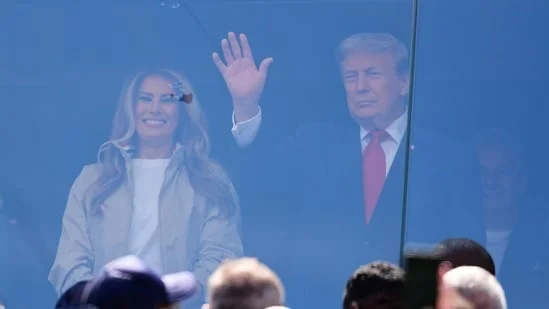
President Donald Trump, first lady Melania Trump, and their son Barron Trump attended the 2026 FIFA World Cup final at MetLife Stadium in East Rutherford, New Jersey, on July 19. The match saw Spain defeat Argentina 1-0. While the Trump family watched from a glassed-in suite, a seemingly innocuous social media post has drawn attention to the family's internal dynamics.
Eric Trump shared a photo on Instagram Stories showing his siblings Ivanka Trump and Donald Trump Jr. enjoying the game. The image featured Ivanka in a yellow halter dress and the brothers in suits without ties. Conspicuously absent was Barron Trump, the president’s youngest son and his only child with Melania. Bettina Trump, Don Jr.’s new wife, also posted a picture of the four oldest Trump children—Donald Jr., Ivanka, Eric, and Tiffany—further underscoring Barron’s exclusion from the group shot.
Despite not appearing in those photos, Barron was confirmed to be at the event. A Getty photograph captured him in a suit and red tie emerging from the suite alongside his parents, appearing to chat with FIFA President Gianni Infantino. His presence at such a high-profile event is rare; the 20-year-old New York University student has kept a deliberately low profile since his father returned to the White House.
Trump’s Game-Day Drama: Boos, Trophy Hug, and a Suspended Ban
The president’s attendance at the World Cup final was anything but uneventful. Trump was booed by sections of the crowd when shown on the stadium’s video screens after the U.S. national anthem. Later, during the trophy presentation, he lingered on stage alongside Infantino as Spain’s players prepared to lift the cup—an echo of his behavior at the 2025 Club World Cup, where he similarly inserted himself into Chelsea’s celebration. The Guardian described the moment as Trump “staying stubbornly in the frame as another team enjoyed the pinnacle of their professional careers.”
Trump’s involvement with the tournament has been controversial beyond the final. Earlier in the World Cup, the U.S. men’s national team crashed out in the round of 16 with a 4-1 loss to Belgium. That defeat came after Trump personally called Infantino to successfully lobby for the suspension of a red card given to striker Folarin Balogun. Critics argued the intervention undermined the sport’s disciplinary process, while the president framed it as supporting American athletes. The incident added to a growing perception among U.S. sports fans that Trump’s presence at major events is a jinx—a sentiment that gained traction after the New York Knicks lost the only NBA finals game he attended this year at Madison Square Garden, where he was also booed lustily.
During the final, Trump was seen in his suite alongside Infantino, Spain’s King Felipe VI, Canadian Prime Minister Mark Carney, and Mexican President Claudia Sheinbaum. At one point, he was spotted conversing with Carney during the second half of a tense 120-minute match. TV broadcasts showed him touching the trophy from his seat early on and chatting with Melania in the 85th minute. After the game, Trump told Fox Sports he wants the World Cup “back in the U.S. immediately,” signaling a potential bid for the 2034 tournament.
Barron’s Private Life vs. Public Narrative
Barron Trump’s absence from the sibling photo has reignited speculation about his relationship with his half-siblings and his parents. In recent months, reports have suggested a rift between Melania and the older Trump children. A former Melania assistant claimed in a since-disputed interview that the first lady deliberately kept Barron distanced from his half-brothers and sister. Those allegations have never been substantiated, but they have fueled a narrative of tension within the Trump family.
President Trump has spoken warmly about Barron in public. At a FIFA reception at Trump Tower on July 17, he called his youngest son “a good soccer player” who “loves soccer.” He recounted a conversation in which Barron insisted on his ball-handling skills and ability to defend against faster players—a glimpse into the otherwise opaque life of the presidential son. Melania, too, has described Barron as an “incredible young man” who gives political advice to his father and understands politics. “This time it’s very different because he’s 19 years old and first time he was 10 years old,” she said in January 2026. “He understands politics, he gives advice to his father.”
Still, Barron’s preference for privacy contrasts sharply with the public roles of his siblings. While Donald Trump Jr., Eric, and Ivanka have been fixtures of the Trump campaign and presidency, Barron has made only a handful of public appearances. He was a founding partner of Sollos, a South Florida real estate development firm, but otherwise stays out of the political fray. His appearance at the World Cup final—albeit mostly away from the cameras—was a notable exception.
Related: Zlatan Ibrahimovic Censored by Fox, Then Bids Farewell After World Cup Final
The sibling photo incident may be less a sign of discord than a reflection of logistical reality. Barron, at 20, is a full-time college student and does not engage in the campaign circuit or family business in the same way his older siblings do. Still, the absence is a subtle but persistent reminder that the Trump family’s public image is not monolithic—and that Barron remains the outlier in a famously media-savvy clan.
Spain’s Triumph: Yamal Makes History
The match itself provided a historic milestone. Spain’s 19-year-old winger Lamine Yamal became the youngest player ever to win both the FIFA World Cup and the UEFA European Championship. After the final, Yamal told reporters he feels no pressure because he has “faced much harder moments in life.” His winning goal in the 73rd minute sealed a disciplined defensive performance by Spain, who held off an aggressive Argentina side that had dominated possession.
The victory reshapes the landscape for the upcoming UEFA Nations League season, with Spain now carrying world champion status into the 2026-27 campaign. Argentina, meanwhile, faces questions about its future after a tournament that saw 10 million fans sign a petition demanding the team be disqualified over a controversial group-stage incident. The petition ultimately went nowhere, but the lingering controversy added to the tension of a final that was decided by a single goal.
Related: Spain World Cup Win Reshapes UEFA Nations League Stakes for 2026-27 Season
The Trump World Cup Factor: Curse or Character?
The 2026 World Cup has been defined as much by its host country’s politics as by its football. Trump’s hands-on involvement—from the Balogun red card appeal to his trophy-stage antics—has drawn criticism from pundits and players alike. The Guardian’s match report noted that a “Drake-like sentiment” has grown among American sports fans, meaning Trump’s presence at events is “dreaded, and avoided at all costs.” That sentiment was underscored by the U.S. team’s early exit and the jeers that greeted the president at MetLife.
But Trump’s actions also align with his long-standing brand: inserting himself into moments of victory and asserting American—or at least presidential—dominance. His call for the World Cup to return immediately hints at a desire to leverage the tournament’s popularity for diplomatic and economic gain. Whether that will be welcomed by FIFA or by the American public remains to be seen.
For now, the final image of the 2026 World Cup is not just of Spain’s players hoisting the trophy, but of a president standing beside them, unwilling to step away. And of his youngest son, seen only briefly, walking alongside his parents—present but apart, a quiet shadow in the glare of the spotlight.
Comments