
The August 12 Total Solar Eclipse: A Rare Celestial Spectacle
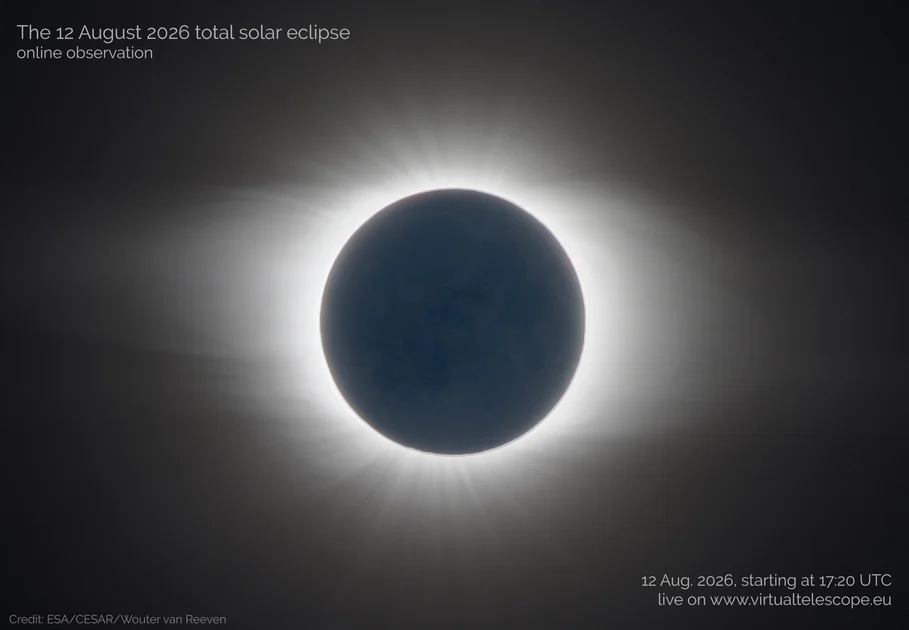
On August 12, 2026, a total solar eclipse will sweep across the Northern Hemisphere, treating skywatchers in Greenland, Iceland, Spain, Portugal, and northern Russia to a dramatic celestial show. NASA has announced it will provide comprehensive coverage of the event, which marks the only total solar eclipse of the year. The eclipse’s path of totality begins off the Arctic coast of eastern Russia, curls near Earth’s northern rotational pole, arcs over Greenland and Iceland, and ends with a photogenic sunset over the western Mediterranean.
The eclipse will peak at approximately 17:45 UT, with totality lasting up to 2 minutes and 18 seconds in western Iceland. Most viewers in northeastern Spain will see less than two minutes of totality, but the event’s unique trajectory — crossing the Arctic and ending at sunset — makes it a must-see for eclipse chasers. Partial phases will be visible across a much wider area, including parts of the northeastern United States, Canada, Europe, and northwestern Africa, offering millions a chance to witness the Moon partially cover the Sun.
A Day of Multiple Celestial Events
What makes August 12 even more remarkable is the convergence of other celestial events. In the early morning, a rare planetary parade of six planets — Mercury, Mars, Jupiter, Uranus, Saturn, and Neptune — will line up across the sky before sunrise. While Mars and Saturn will be easily visible to the naked eye, Mercury and Jupiter will be low on the horizon, requiring clear skies and binoculars for the faintest members of the lineup.
After the eclipse, the night sky will come alive with the peak of the Perseid meteor shower, promising up to 100 meteors per hour under dark skies. This triple-header of astronomical phenomena has generated significant excitement among scientists and amateur observers alike, with many calling it one of the most memorable celestial days in years.
NASA’s Science and Coverage Plans
NASA is not just providing coverage; the agency is also using the eclipse as a unique scientific opportunity. Researchers will study the Sun’s corona, the outer atmosphere that becomes visible during totality, and will launch sounding rockets to measure atmospheric disturbances caused by the sudden drop in sunlight. These experiments help scientists understand solar dynamics and their impact on Earth’s upper atmosphere, which is critical for satellite operations and communications.
In addition, the agency’s coverage will include live streams from multiple locations along the path, expert commentary, and educational segments. NASA has also emphasized the importance of eye safety, urging viewers to use certified eclipse glasses or indirect viewing methods. The eclipse offers a prime chance for citizen science, with projects like Eclipse Megamovie encouraging observers to capture images that can be used for research.
The Path of Totality
The path of totality is narrow and challenging, with long stretches over open ocean. The Basque region of Spain offers the largest land area for viewing, but it has also experienced record heat and wildfires this summer, which could affect viewing conditions. Observers in Iceland will have the longest totality, but weather forecasts often call for clouds in the North Atlantic. Eclipse chasers are advised to check local forecasts and have flexible travel plans.
Partial phases will be visible across a broad swath of North America and Europe. On the U.S. East Coast, the eclipse will occur around 2:00 PM EDT, with roughly 20-50% coverage depending on location. Canadians, especially in the Maritimes, will also see a partial eclipse.Those who missed the 2024 total solar eclipse across the U.S. may want to dig out their eclipse glasses again for this event, though it’s crucial to inspect them for scratches or damage before use.
Broader Implications and Future Eclipses
The August 12 eclipse is a reminder of the enduring public fascination with solar eclipses, which draw crowds and generate cultural moments. It also highlights how these events can drive scientific discovery, engaging both professional researchers and the public in shared exploration. With the next total solar eclipse visible in the U.S. not until 2033 (Alaska) and 2044 (lower 48), the 2026 eclipse offers a prime opportunity for many to witness totality without traveling far.
Moreover, the alignment of the eclipse with a planetary parade and meteor shower underscores the dynamic nature of our solar system and the importance of accessible science communication. As NASA continues to expand its coverage and scientific outreach, such events will likely increase in their capacity to inspire a new generation of astronomers and space enthusiasts. For those unable to travel, NASA’s live streams and interactive maps provide a way to experience the eclipse from anywhere, ensuring that the wonder of a total solar eclipse reaches a global audience.
Comments