
Artemis II Launch Created Unprecedented Ionospheric Disturbances
NASA's Artemis II mission, which sent four astronauts around the Moon in April 2026, generated unusually large disturbances in Earth's upper atmosphere that researchers say could temporarily affect GPS accuracy, according to a pre-print study published in July in Geophysical Research Letters.
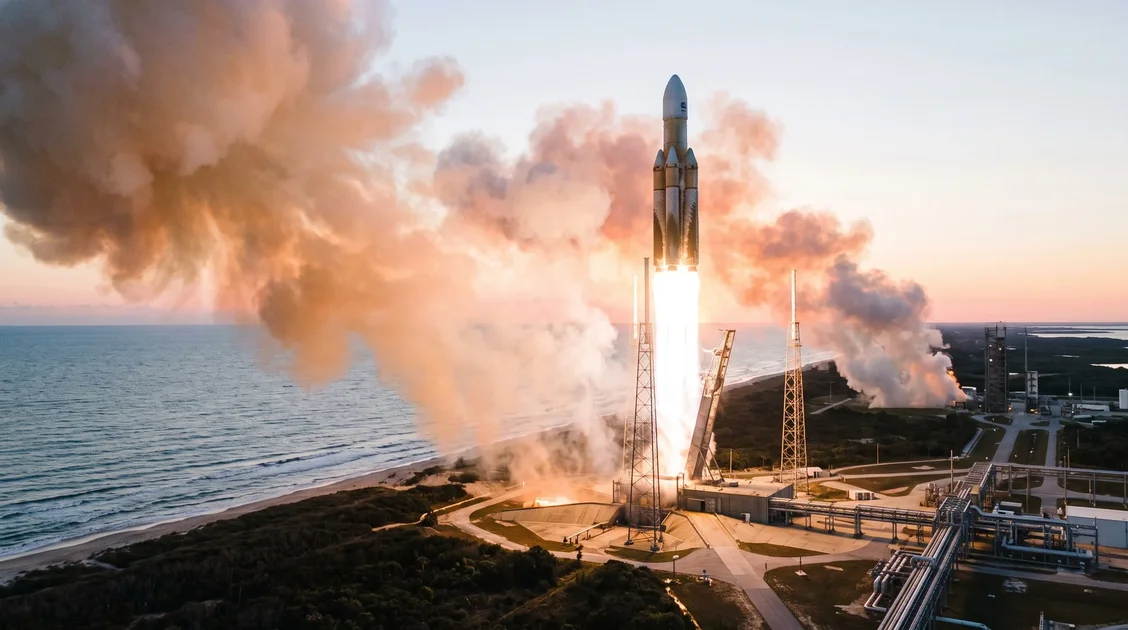
The launch from Florida on April 1 aboard the Space Launch System (SLS) rocket produced three separate disturbances in the ionosphere—a region of electrically charged particles beginning about 50 kilometers (30 miles) above Earth's surface through which satellite navigation signals travel. Researchers at National Cheng Kung University in Taiwan analyzed high-precision GPS receiver data across the United States and found that the largest disturbance stretched across roughly 50 degrees of longitude, equivalent to about 2,500 miles at typical U.S. latitudes.
According to the study, the initial lift-off sent waves through the upper atmosphere, but some of the most significant changes occurred later when the spacecraft fired its engines high above Earth. An engine burn about two hours after launch produced shock waves and what the researchers described as "unprecedented large-scale disturbances." A second burn roughly 25 hours after launch created a similar but weaker effect. The exhaust caused a temporary drop in charged particle concentration in part of the ionosphere—what scientists call an "ionosphere hole"—which can affect technologies relying on signals passing through that region.
GPS Errors of Several Meters Raise Questions for Autonomous Navigation
Study co-author Charles Lin, an earth science professor at National Cheng Kung University, warned that the disturbances created potential positioning errors of several meters. He told Space.com that even relatively small errors could have consequences for autonomous navigation.
"A positioning error of a couple of meters is enough to cause an autonomous car to change lanes," Lin said, also raising concerns about drone positioning and other technologies requiring precise location information.
However, the research did not document any vehicle changing lanes, malfunctioning, or causing an accident. The study did not test self-driving vehicles or establish how their additional navigation and safety systems—including cameras, radar, and other sensors—would respond to inaccurate GPS data. A GPS positioning error does not automatically mean a vehicle would steer into another lane. The findings instead highlight a potential navigation risk that may warrant further investigation as increasingly powerful rocket launches become more frequent.
The Artemis II mission itself was historic: it marked the first time in more than 50 years that astronauts traveled around the Moon. The nine-day flight carried astronauts Reid Wiseman, Victor Glover, Christina Koch, and Jeremy Hansen. NASA has separately announced plans to accelerate the Artemis program and return humans to the Moon, suggesting launch activity will only increase in the coming years.
Context: Growing Launch Cadence Could Amplify Atmospheric Effects
The Artemis II findings arrive as NASA seeks to ramp up its lunar exploration efforts. The agency recently shared plans to accelerate Artemis and return to the Moon, which could mean more frequent SLS launches and other heavy-lift rocket activity. Each launch has the potential to disturb the ionosphere, and the cumulative effect of more frequent launches remains an open question.
Researchers emphasized that the disturbances are temporary and that the ionosphere naturally fluctuates due to solar activity and other factors. Yet the study's identification of "unprecedented" disturbances from a single launch raises questions about the potential consequences for GPS-dependent technologies as launch rates climb. The research adds to a broader conversation about the environmental and technological impacts of spaceflight at a time when commercial and government launches are increasing.
For now, the warning describes a possible consequence rather than an observed incident. The study did not test self-driving vehicles or establish how their redundant navigation systems would respond. Nevertheless, the findings suggest that launch-related atmospheric disturbances deserve further study as autonomous vehicles and drones become more common.
Perspective: Balancing Space Exploration with Terrestrial Technology
The Artemis II study underscores a growing tension between ambitious space exploration and the reliability of everyday technologies that depend on precise positioning. While the disturbances were temporary and did not cause documented problems, the research highlights the need for further investigation into how rocket launches affect the ionosphere and, by extension, GPS signals.
As NASA pushes to accelerate Artemis and return to the Moon, the frequency of heavy-lift launches is likely to increase. That could mean more opportunities for ionospheric disturbances—and more reason to understand their effects. Autonomous vehicle developers already rely on multiple sensors to ensure safety, but GPS remains a critical component. Even small errors could have outsized consequences in edge cases.
The study's authors stop short of alarmism, framing their findings as a potential risk rather than a present danger. Still, the research serves as a reminder that space exploration does not happen in isolation. The same rockets that carry astronauts to the Moon also leave ripples in the atmosphere that can affect technologies on the ground. As launch activity grows, monitoring and mitigating those effects may become an increasingly important part of mission planning.
For now, the takeaway is caution rather than crisis. The Artemis II mission achieved its historic goals, and the atmospheric disturbances it created were temporary. But the findings offer a preview of the kinds of questions that may arise as space becomes more accessible—and as the technologies that depend on it become more deeply embedded in daily life.
Comments