
Widespread Apple Outage Affects Core Services
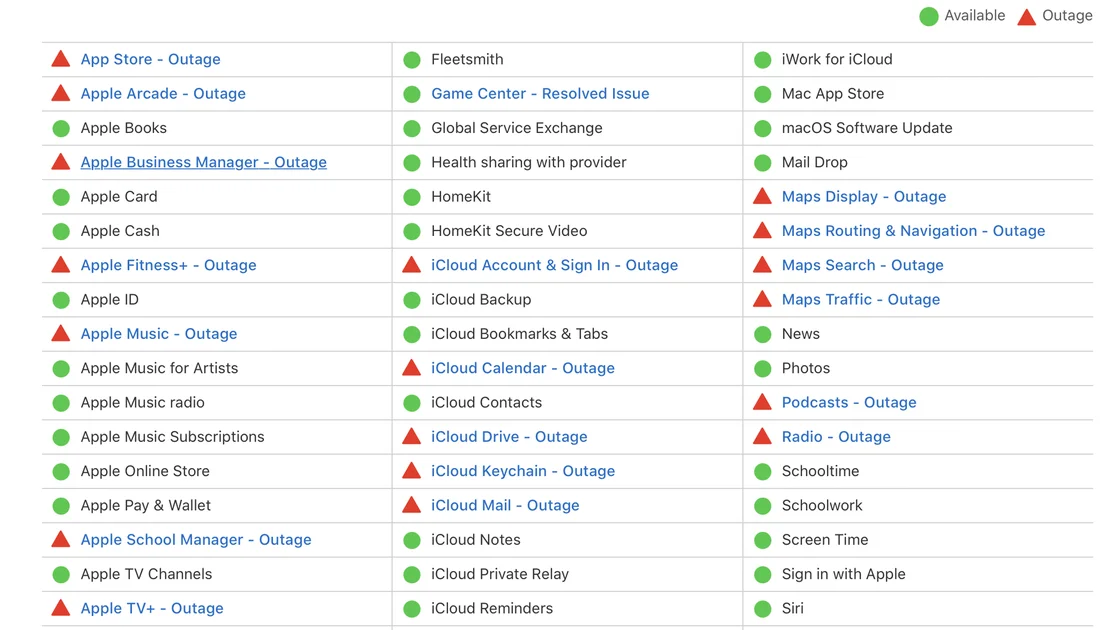
Apple is grappling with a broad outage that has disrupted multiple key services, including iCloud, the App Store, Apple Pay, and Apple Support, according to user reports and outage-tracking platform Downdetector. The problems began around mid-morning on Tuesday, November 17, 2026, and by early afternoon, thousands of users had flagged issues across various Apple offerings.
Downdetector's data shows a surge in reports for services such as iCloud, App Store, Apple Pay, Apple Card, Apple Business Manager, Apple Music, and Sign In with Apple. Apple's own System Status page, however, continued to list most services as available, and the company has yet to publicly acknowledge the disruption on that page or through other channels.
What Users Are Experiencing
Reports from affected users paint a picture of frustration. Many describe unexpected iCloud sign-outs on both iPhone and Mac, followed by verification failures or cryptic errors when attempting to sign back in. Others say the App Store won't load or download apps, and some report issues with Apple Music and device activation—particularly for new iPads. Developers have also reported trouble accessing App Store Connect, hindering their ability to manage apps.
"I can't activate a new iPad," one user wrote on X, while another asked, "Does anyone else have random charge on their card just now from Apple Store for $21?" The latter may be unrelated, but it underscores the confusion during service disruptions.
Downdetector's official account posted at 11:45 AM EST that user reports indicated problems with Apple Support, using the hashtag #AppleSupportDown. By 5:27 PM UTC, the account had aggregated multiple system outages, listing the same set of affected services. The outage appears to be ongoing as of this writing, with no estimated time for resolution.
Context: A String of Technical Failures
The Apple outage comes on the heels of several high-profile technical incidents that have rattled consumers and businesses alike. Just last week, a major Microsoft outage took down Outlook and other services for thousands of users. According to a preliminary post-incident report, Microsoft blamed a software bug introduced in a July update. The bug was latent and evaded normal rollback and feature-flag mechanisms, causing servers to become overwhelmed under certain load conditions. That outage peaked at 130,000 reports on Downdetector and also affected Microsoft 365, Teams, and Copilot. For a deeper look at that incident, see our coverage: Microsoft Reveals Three Causes Behind Global Outlook Outage.
The Microsoft disruption coincided with a national ground stop ordered by the FAA, though officials dismissed any connection. That event raised fears about the resilience of critical infrastructure, as reported in 911 Outage Fears Emerge Amid FAA Ground Stop and Microsoft Disruption.
Yesterday, banking services also experienced problems after a technical issue at JPMorgan Chase disrupted online access and delayed some transactions. The cumulative effect of these incidents has heightened awareness of the fragility of digital services and the interconnectivity of modern tech ecosystems.
Apple's Response and Historical Precedents
Apple has not yet commented on the cause of the current outage. Historically, the company has been slow to update its System Status page during disruptions, often leaving users to rely on third-party trackers and social media for real-time information. This outage is reminiscent of past Apple service disruptions, such as the 2019 iCloud outage and the 2020 App Store and Apple Music outages, which were resolved within hours. However, the breadth of affected services this time—spanning support, payments, identity, and content—suggests a potentially more systemic issue, possibly related to authentication or network infrastructure.
The fact that Sign In with Apple and device activation are impacted points to problems with Apple's identity and activation servers, which are critical for accessing most Apple services. If the root cause lies in a core authentication service, it could explain why so many disparate services are down simultaneously.
Perspective: The Growing Cost of Downtime
As digital services become increasingly integrated into daily life, outages like this underscore the operational risks faced by tech giants. For Apple, whose services revenue has grown to nearly $100 billion annually, reliability is paramount. Even short disruptions can erode user trust and lead to lost revenue, especially for services like the App Store and Apple Pay.
The timing is particularly sensitive. Apple is in the midst of the holiday shopping season, and any extended outage could impact sales of apps, digital content, and physical devices that require activation. Moreover, the outage follows a pattern of high-profile tech failures in recent weeks, which may prompt regulators and enterprises to scrutinize service-level agreements and disaster recovery plans more closely.
For consumers, the incident serves as a reminder that even the most valuable tech companies are not immune to downtime. It also highlights the importance of alternative communication channels and offline capabilities. As Apple works to restore services, the industry will be watching closely for a post-mortem that could inform best practices for outage prevention and transparency.
We will update this article as more information becomes available.
Comments