
Tesla FSD v15 Begins Early Access Rollout
Tesla has started rolling out Full Self-Driving (FSD) version 15 to its Early Access Program members, marking the first phase of a broader release that CEO Elon Musk said will reach a wide audience in December. The update, announced on November 21, 2026, brings a comprehensive overhaul of the end-to-end driving network, including a claimed 25-fold improvement in handling safety-critical cases.
According to release notes shared by Tesla and reported by Teslarati and TeslaNorth, v15 upgrades every part of the system, from perception to planning. The company says the new vision encoder—shared across FSD, Robotaxi, and Optimus—was trained on millions of internet videos to improve generalization and data efficiency, resulting in a critical intervention rate that is 25 times better. Tesla emphasizes that this is its own intervention metric, not a crash-rate comparison.
Key Features: Reality View, Smarter Navigation, and Bike Rack Mode
Tesla Reality View
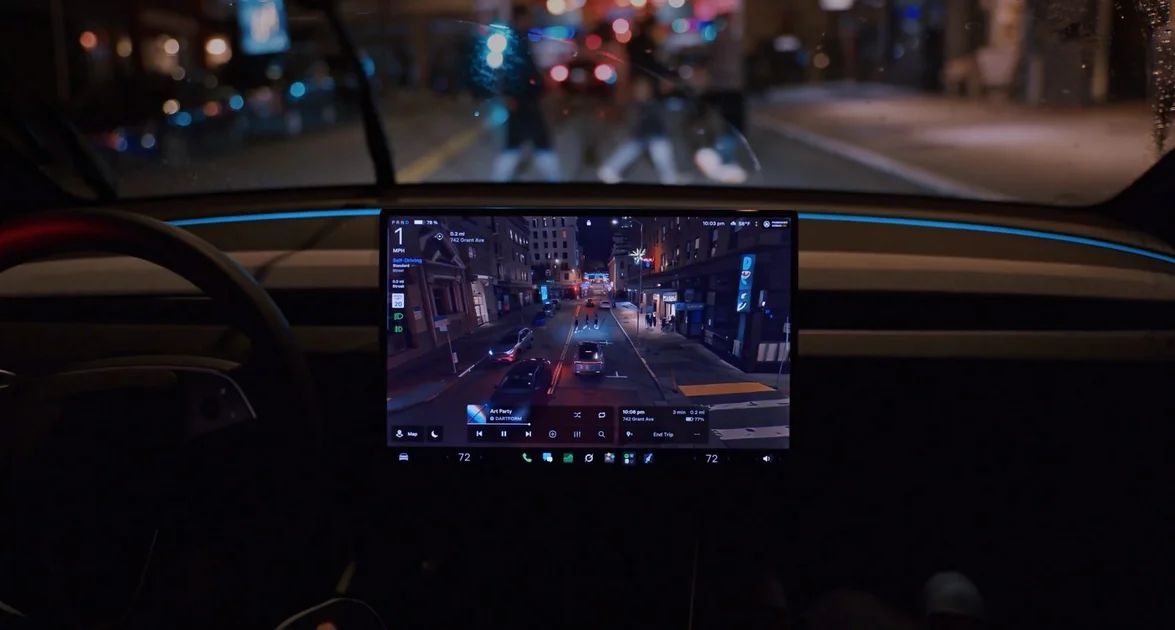
One of the headline features is Tesla Reality View, a new driving visualization that provides a live, overhead view of the car’s surroundings and the path FSD plans to take. Tesla AI software chief Ashok Elluswamy said the same model renders the scene, with arrows for planned turns and pins for intended parking spots. The new view uses less computing power than the previous visualization, according to Tesla, and users can choose between full-screen, map, split view, or quiet mode.
Improved Navigation and Detection
Navigation has been enhanced with an end-to-end learned model that uses route preference data from the Tesla fleet. Initially, this affects only the start and end of trips, but Tesla says later v15 releases will expand it to entire routes. The system also improves parking location selection by learning from personalized parking history and displays multiple parking options at destinations.
Detection capabilities have been broadened: the car now better recognizes road signs, small animals, road debris, chains, and potholes. It is also designed to avoid deep standing water. Speed handling has been made more natural in school zones and inclement weather, and FSD can now slow down for speed cameras. Drivers can override the slowdown by pressing the accelerator or selecting a higher speed profile; doing so twice at the same camera will teach the car not to slow there again.
Bike Rack Mode and Driver Monitoring
A new Bike Rack Mode allows FSD to be used when a bike rack or similar hitch accessory is attached. In this mode, the car pulls over near the destination without reversing, and Autopark, Summon, and backup chimes are disabled. Driver monitoring has also been improved: the vision-based attention system now works more often when drivers wear hats or sunglasses, and attention checks are less strict in higher-speed driving profiles.
Context: Musk Confirms December Wide Release, Robotaxi Ambitions
The early access rollout comes after Musk confirmed on November 21 that FSD v15 would receive a wide release in December 2026. In a statement, Musk described the update as “something special,” though Tesla has not announced an exact date or published detailed performance results beyond the release notes.
The release is a significant step in Tesla’s effort to bridge consumer vehicles with technology developed for its dedicated robotaxi fleet. During Tesla’s October earnings call, executives outlined plans to bring technology derived from the Cybercab program to customer-owned vehicles through FSD v15. The company has also discussed making unsupervised driving available to eligible privately owned vehicles around the second quarter of 2027, initially within designated geographic areas. However, FSD v15 does not automatically permit drivers to stop monitoring the road or operate as unsupervised robotaxis; it remains a supervised system.
Tesla’s autonomous driving ambitions are increasingly central to its valuation. The company reported 1.74 million active FSD subscriptions in the third quarter of 2026, up from 1.04 million a year earlier—approximately 67% annual growth. That expanding base represents a recurring revenue opportunity beyond vehicle sales, though Tesla has not disclosed how much incremental subscription revenue v15 might generate.
Safety Claims and Industry Scrutiny
Tesla’s claim of a 25x improvement in handling safety-critical cases is striking, but it relies on the company’s internal intervention metric. The release notes state that the upgraded vision encoder improves the critical intervention rate by 25x, but without independent verification, it is difficult to assess how this translates to real-world safety. Tesla has faced regulatory scrutiny over its driver-assistance systems in the past, and the supervised nature of FSD means drivers must remain attentive.
The new driver monitoring improvements—better detection with hats and sunglasses, and less strictness at higher speeds—could raise questions about the balance between convenience and safety. Tesla argues that the system’s improved perception reduces the need for frequent attention checks, but critics may argue that relaxed monitoring could lead to complacency.
Perspective: A Step Toward Robotaxi, But Challenges Remain
FSD v15 represents Tesla’s most substantial software update to date, integrating learnings from its robotaxi program into consumer vehicles. The emphasis on fleet-based learning, improved detection, and new visualization tools suggests Tesla is laying the groundwork for a future where its cars can operate without human supervision. However, that future is still years away, and regulatory approval remains a significant hurdle.
The update also highlights Tesla’s focus on recurring software revenue as vehicle sales face increasing competition. With 1.74 million subscribers, FSD is becoming a meaningful business line, and v15’s features may encourage adoption or retention. Yet the true test will be whether the promised safety and performance improvements materialize in everyday driving—and whether regulators and the public accept Tesla’s internal metrics as evidence.
As the wide release approaches in December, all eyes will be on how v15 performs in the hands of ordinary drivers. For now, Early Access members are the first to experience what Tesla calls “upgrading every part of the end-to-end driving network.” Whether that upgrade delivers on its bold claims will determine the next chapter in Tesla’s autonomy story.
Comments