
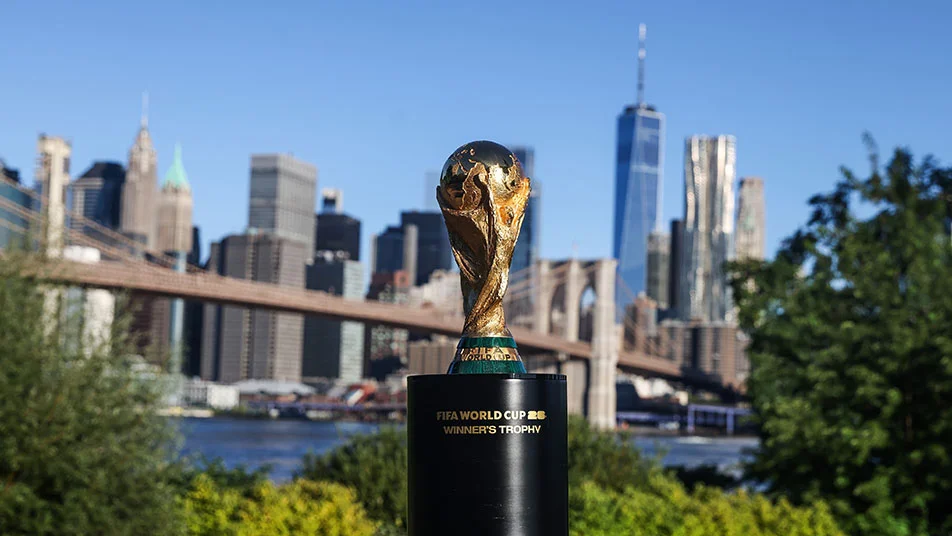
Opening Match Set for June 11 as World Cup Fever Hits North America
The wait is nearly over. The 2026 FIFA World Cup will kick off on June 11 at the iconic Estadio Azteca in Mexico City, where co-host Mexico will face South Africa in the tournament's opening match. The United States and Canada, the other two host nations, will begin their campaigns the following day, June 12.
With just over two weeks until the first whistle, the expanded 48-team field is now finalized following the conclusion of qualifying playoffs. The tournament, which will run through the final on July 19, represents the most ambitious World Cup in history: three host countries, 108 matches across 16 venues, and a radically new format designed to accommodate the largest field ever assembled.
"After years of anticipation, the biggest soccer tournament in the world is returning to North America, and it's quite literally bigger than ever," NBC Chicago reported on May 26, reflecting the excitement as fans and teams finalize their preparations.
Key Dates for Host Nations
- Mexico: Opens vs. South Africa, June 11, Mexico City
- United States: Opens vs. Paraguay, June 12, SoFi Stadium, Inglewood, California
- Canada: Opens vs. Bosnia and Herzegovina, June 12, BMO Field, Toronto
The Expanded 48-Team Format: What Changes and Why It Matters
The most significant change to this year's tournament is the expansion from 32 to 48 teams, a move that FIFA approved years ago to broaden global participation. Instead of eight groups of four, the tournament now features 12 groups of four, with the top two teams from each group advancing to the knockout stage. Joining them will be the eight best third-place finishers, creating a 32-team round of 32.
The implications are enormous. The number of matches jumps from 64 to 108, adding an entire new knockout round. Teams must now win five knockout matches to lift the trophy, rather than four in previous editions.
"The first and biggest change will be the number of teams involved, as the field will expand from 32 teams to 48," NBC Chicago noted. "In all, that will increase the number of games from 64 to a staggering 108, and will also add an entire new round to the competition."
FIFA has also introduced a tweak to the bracket to maintain competitive balance: two distinct pathways to the semifinals will prevent the two highest-ranked teams from meeting before the final, provided they win their respective groups.
How Group Stage Tiebreakers Work
Tiebreakers will follow a standard order: goal differential, goals scored, head-to-head results, fair play record, and, if needed, drawing of lots. Given the expanded field and the inclusion of third-place qualifiers, every goal in the group stage could prove decisive.
USA Roster Finalized: 26 Players Ready to Make History
The United States men's national team announced its 26-player roster on May 26, a squad that blends youth, experience, and a new generation of talent playing in Europe's top leagues. The team will be led by captain Christian Pulisic, alongside key figures such as Weston McKennie, Tim Weah, and Tyler Adams.
Forward Folarin Balogun, the New York-born striker who plays for AS Monaco, is expected to lead the attack. "U.S. fans are counting on the New York-born, London-raised Folarin Balogun to score the bulk of the goals this summer," FOX Sports reported. "The hard-running striker found the net 18 times in 40 UEFA Champions League and Ligue 1 last season."
Brenden Aaronson, now with Leeds United, adds creativity and energy. The 25-year-old, once nicknamed the "Medford Messi," has made 57 appearances for the USA and brings Premier League and Bundesliga experience.
Group D: A Tough Road for the Americans
The United States is in Group D alongside Paraguay, Australia, and Türkiye. The Americans will face Paraguay first, followed by Australia and then Türkiye, which secured its spot by defeating Kosovo in the qualifying playoffs. This group offers a mix of South American grit, Asian speed, and European tactical discipline.
Favorites and Dark Horses: Who Could Implode?
As always, a handful of teams enter the tournament as clear favorites. According to ESPN, oddsmakers have identified six teams as the likeliest winners: Spain, France, England, Brazil, Argentina, and Portugal. Argentina, the defending champion, will attempt to win back-to-back World Cups for the first time since Brazil in 1958 and 1962.
But the World Cup's single-elimination nature after the group stage creates volatility. "Favorites in soccer win way less often than favorites do in any of the major American sports," ESPN's Ryan O'Hanlon wrote on May 26. "The bounce of the ball writes the history of the World Cup just as much as Lionel Messi or Kylian Mbappé's ability to control it."
Statistically, even if each of the six favorites has a 90% chance of advancing from their group, there is roughly a 47% chance that at least one will be eliminated in the group stage. That makes the opening matches critical not just for underdogs, but for the sport's elite.
Why This World Cup Changes the Game
The 2026 World Cup is not just a tournament; it is a structural shift for international soccer. The expansion to 48 teams ensures that more nations than ever before will experience the world's biggest stage, including debutants like Cabo Verde and DR Congo from Africa, and Curacao and Haiti from CONCACAF. Canada hosts games for the first time, while Mexico returns as a host for the first time since 1986, and the United States for the first time since 1994.
The economic and logistical stakes are staggering. Matches will be spread across three time zones, from Vancouver to Mexico City to Miami, presenting unique challenges for teams and fans alike. The tournament will also test FIFA's ability to manage a sprawling, multi-country event ahead of the 2030 World Cup, which will be co-hosted by Morocco, Portugal, and Spain, with additional centenary matches in Argentina, Paraguay, and Uruguay.
A Template for the Future?
If the tri-nation model succeeds, it could become the norm for future tournaments. The 2026 edition will serve as a case study in logistics, fan experience, and competitive integrity. For now, the focus remains on the pitch: 48 teams, 108 matches, one champion.
How to Watch and Travel Considerations
Fans in the United States can watch matches on FOX Sports and Telemundo, with streaming options available via those networks' digital platforms. For those traveling to matches, planning is essential. The tournament coincides with summer travel peaks, and disruptions are possible. For instance, travelers heading to matches in London for related events should be aware of potential transit strikes: the London Tube Strikes June 2026: RMT Walkout Dates, Routes and Travel Advice provides details on planned walkouts that could affect journeys.
The Countdown Is On
With the opening match just over two weeks away, the 2026 World Cup is poised to be a landmark event in sports history. The expanded format, the three host nations, and the depth of talent on display promise a tournament unlike any before. For the United States, Mexico, and Canada, the opportunity to perform on home soil adds an extra layer of pressure and pride. As the world's eyes turn to North America, the question is no longer "when does the World Cup start?" but "who will rise to the occasion?"
Comments