
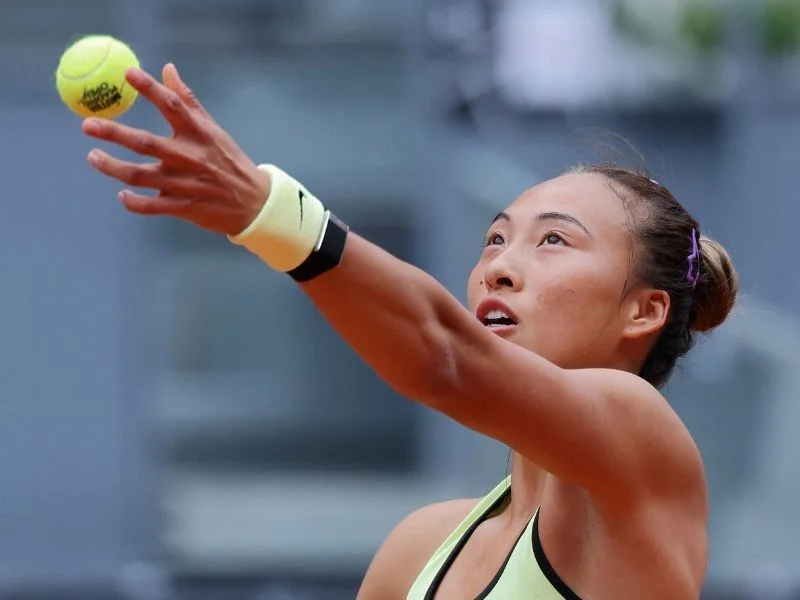
Zheng Qinwen Stuns Madison Keys in US Open Comeback from the Edge of Defeat
NEW YORK — For the third time in just under a fortnight, Zheng Qinwen collapsed on her back on the blue hard court of the USTA Billie Jean King National Tennis Center. But this fall was different — it was the fall of a woman who had just pulled off the most improbable victory of her comeback year.
From 5-0 down in the third set, the 2024 Olympic champion won seven games in a row to stun 2025 Australian Open champion Madison Keys 6-4, 2-6, 7-5 on Saturday in the third round of the U.S. Open. The win pushed Zheng, who entered the tournament as a qualifier and ranked No. 121 in the world, into the fourth round — her deepest run at Flushing Meadows since 2024.
Zheng, 23, fought off the only match point she faced, saving it while serving at 5-1 in the final set. The Chinese star then reeled off five straight games, breaking the 2025 Australian Open champion twice and closing out the match on her own serve.
"I just told myself to keep fighting, to keep believing," Zheng said in an on-court interview. "Even at 5-0, I knew that if I could win one game, then another, the pressure would move to her side."
The win sets up a fourth-round meeting with either Iga Świątek or Marie Bouzková, who were scheduled to play later Saturday.
A Comeback Years in the Making
Zheng's journey back to this stage has been arduous. After winning gold at the Paris Olympics in 2024, she underwent surgery on her right elbow in late 2025, a procedure that kept her off the tour for months. She returned to competition earlier this year but struggled to rediscover the form that made her a top-10 player. Her ranking plummeted to No. 121, forcing her to enter U.S. Open qualifying — a position she had not experienced since her early days on tour.
"I really miss the big courts, honestly," she deadpanned after her second-round win over Yulia Putintseva. "When you are playing on Court 4 and the only people watching are your team and the ball kids, it's hard to feel the same adrenaline."
But Zheng has gradually rebuilt her game and confidence. She won two matches in qualifying, then defeated Liutova in the first round and Putintseva in a three-set battle. Against Keys, she showed the resilience and tactical nous that had carried her to the Olympic title.
"This U.S. Open is the first time I've felt like myself again in a long time," Zheng told reporters. "I still remembered how to play tennis after I came back from injury, but spending so long living life 'without any pressure, without any adrenaline,' made me forget how to compete. I remember now."
The Match That Flipped in a Flash
The third-round match on Grandstand had all the makings of a lopsided affair in the final set. Keys, a crowd favorite and former U.S. Open runner-up, had dominated the second set and raced through the third with ease. She served at 5-1, and a vintage forehand winner seemed to put her on the brink at 40-15. But Zheng saved the first match point with a deep return that forced a Keys error, and the American then double-faulted to hand the break back.
From there, Zheng's game transformed. She began using her high-arcing forehand to push Keys behind the baseline, breaking the rhythm of the American's flat, powerful shots. Keys, who had come through her own dramatic three-setter in the previous round — saving five match points against Anna Bondar — began to show signs of frustration.
By the 11th game of the third set, Keys was hitting herself in the head with her racket and taking her cap off in disbelief as another groundstroke sailed long to give Zheng the chance to serve for the match. Zheng closed it out with a service winner, then collapsed to the court in tears.
Ranking Rise and a Historic Run
With the win, Zheng is guaranteed to rise back into the top 100, a significant milestone given she had dropped so far. More importantly, she has reminded the tennis world — and herself — that she belongs on the game's biggest stages.
"I never doubted my level," Zheng said. "I knew I could still compete with the best. It was more about handling the emotions, the pressure, and being able to sustain my focus for two or three hours. That's what I've been working on."
Her performance against Keys echoed her run to the final at the 2024 Australian Open and her quarterfinal appearance at the same Grand Slam earlier this year. She has now won six consecutive matches in New York, including two in qualifying, a streak that has boosted her confidence.
Broader Trends in Women's Tennis
Zheng's resurgence highlights a broader theme in the 2026 women's game: the return of established stars after injury layoffs. With veterans like Keys, Świątek, and Aryna Sabalenka (who was eliminated earlier this week) all competing at high levels, the tour is as deep as ever. But Zheng's story also underscores the fragility of success in professional tennis. The 23-year-old's surgical recovery and ranking freefall serve as a reminder that even Olympic champions are not immune to the sport's brutal physical demands.
In an era when players are extending their careers well into their 30s, Zheng's year away from the top has been a reset of sorts. She now plays with a more measured approach, relying less on raw power and more on intelligent point construction. Against Keys, that maturity was evident as she adjusted her tactics mid-match, turning defense into offense with sharp angles and well-placed lobs.
For the fans who packed Grandstand, the match was a testament to the unpredictability of tennis. But for Zheng, it was another step in a journey that began with a dream in Wuhan, China, where she started playing at age six after watching the Williams sisters on TV — a story she shares with many of her generation.
Looking Ahead: A Potential Clash with Świątek
Next up for Zheng is either World No. 1 Iga Świątek or Marie Bouzková, who have yet to play their match. Zheng beat Świątek twice in 2024, including in the Olympic semifinals, though the Polish star has dominated their recent meetings. Regardless of opponent, Zheng said she is embracing the opportunity to play on the sport's biggest stage.
"I just want to enjoy it," she said. "For a long time, I was just trying to survive. Now I can feel that competitive fire again. I know I still have a lot of work to do, but this is where I want to be."
That determination was visible in her celebration — a moment of raw emotion that has become her signature. It was a scene that reminded many of her breakthrough win at the 2024 Australian Open, where she first announced herself to the world. Now, two years later, she is writing another chapter in what has already been a remarkable career.
A New Chapter for Chinese Tennis
Zheng's run in New York also carries significance beyond her own comeback. Chinese tennis has long searched for a women's Grand Slam champion, and Zheng's Olympic gold and consistent performances have made her the standard-bearer. Her resurgence, alongside the rise of other Chinese players such as Wang Xinyu and Zhu Lin, signals a growing depth in the country's tennis program.
Her emotional victory over Keys was watched by millions back in China, where she has become a national hero. The country's tennis federation has invested heavily in developing young talent, and Zheng's success serves as both an inspiration and a benchmark.
As she prepares for the fourth round, Zheng remains mindful of the road she has traveled. "I was thinking about all the months of rehab, the doubts, the tears," she said after the match. "But I also thought about my team, my family, and all the people who never stopped believing in me. That's who I'm playing for."
Her next match is scheduled for Monday, giving her two days of rest and recovery. No matter the result, Zheng has already accomplished something significant at this U.S. Open: she proved to herself that she can still beat the best in the world when it matters most.
Comments