
Six Teams Remain as World Cup 2026 Quarterfinals Deliver Drama
The 2026 FIFA World Cup has been whittled down to just six contenders after a thrilling round of quarterfinal action. France and Spain have already punched their tickets to the semifinals, while England, Norway, Argentina, and Switzerland still have to settle their quarterfinal ties on Saturday, July 11, and Sunday, July 12.
As of this morning, the tournament—the first to feature 48 teams—is hurtling toward its climax at MetLife Stadium in New Jersey on July 19. With the Round of 16 and quarterfinals producing upsets, late goals, and unforgettable moments, the teams still alive represent a mix of traditional powerhouses and rising forces eager to lift the trophy.
France and Spain Secure Semifinal Berths
France became the first team to book a semifinal spot after a commanding 2–0 victory over Morocco on Thursday, July 9. Kylian Mbappé scored his 20th career World Cup goal, while Ousmane Dembélé added a second to send Les Bleus to their third consecutive World Cup semifinal. The win continued France’s dominance: they rolled past Sweden 3–0 in the Round of 32 and edged Paraguay 1–0 in the Round of 16 on a penalty kick by Mbappé.
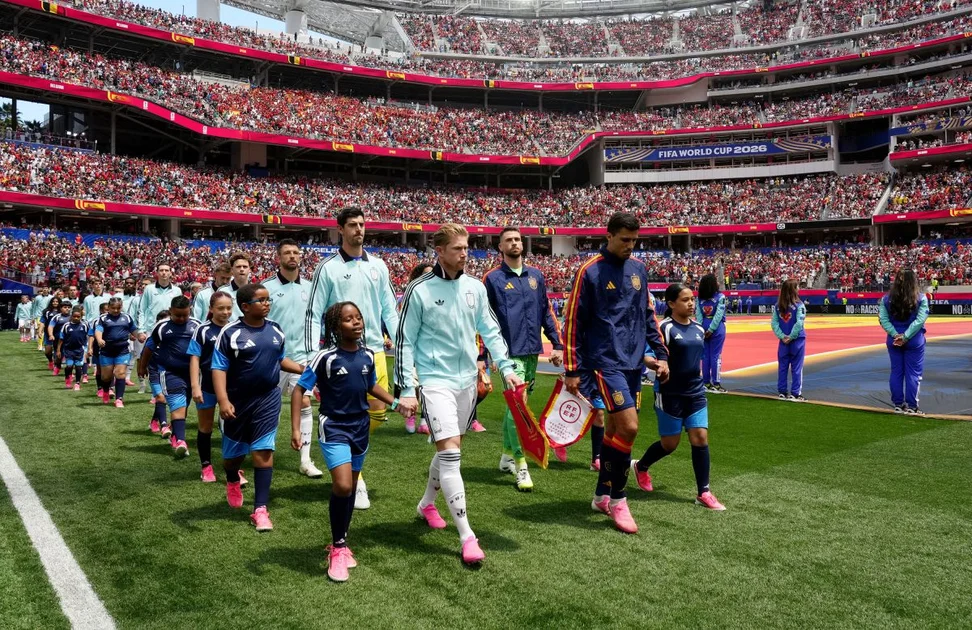
Spain followed suit on Friday, July 10, beating Belgium 2–1 in a tense quarterfinal. Substitute keeper Senne Lammens’ error allowed Mikel Merino to score his second late winner in as many matches, sending La Roja to the semifinals. Spain has conceded just one goal all tournament and will face France in a mouthwatering semifinal showdown on Tuesday, July 14.
Quarterfinals Continue: England vs. Norway and Argentina vs. Switzerland
The remaining quarterfinal matches take place over the weekend. On Saturday, July 11, England faces Norway in Miami, while Argentina takes on Switzerland later in the day. These matches will determine the final two semifinalists.
England, led by Jude Bellingham, has impressed so far, while Norway boasts Erling Haaland, one of the most feared strikers in the world. Both teams are chasing their first World Cup title since England’s 1966 triumph and Norway’s debut as a genuine contender.
Argentina, the defending champions, rely heavily on Lionel Messi, now 39, but still capable of magic. Their Round of 16 victory over Egypt 2–1 and quarterfinal match against Switzerland will test their depth. Switzerland, meanwhile, is focused on containing Messi and hoping to cause a major upset.
The Road to the Semifinals: What’s at Stake
For the six teams still alive in the World Cup, the stakes could not be higher. The semifinals are just days away, and every remaining match is a high-wire act. The tournament’s expanded format has already produced surprises, but the final field is now stacked with elite squads.
How the Bracket Shapes Up
The updated bracket shows that France will face Spain in the first semifinal on July 14, while the winners of England vs. Norway and Argentina vs. Switzerland will meet in the second semifinal on July 15. The final will be held on July 19 at MetLife Stadium.
Teams eliminated so far include heavyweights like Brazil, Portugal, Germany, and the Netherlands, all gone before the quarterfinals. Belgium and Morocco were the last to fall in the quarterfinals, leaving a path for the remaining teams. The smallest nation still alive is Norway, which has never won a World Cup but has thrilled fans with its attacking style.
Key Players to Watch
Kylian Mbappé leads France’s charge as the tournament’s top scorer with five goals. Spain relies on a balanced attack with Mikel Merino and young star Lamine Yamal. England’s Jude Bellingham and Harry Kane, Norway’s Erling Haaland, and Argentina’s Lionel Messi are all capable of decisive moments. Switzerland’s Granit Xhaka and Yann Sommer are key to their defensive strategy.
The semifinalists will have added motivation: this marks France’s third straight trip to the semis, while Spain returns to the final four after missing out in 2022. Argentina aims to defend its title, and England seeks to end its 60-year drought.
Eliminated Teams: A Look Back at the Fallen Giants
With 48 teams starting the tournament, 42 have already been eliminated. The group stage saw surprising exits from Scotland, New Zealand, and Uruguay, while the knockout rounds claimed some of the biggest names in football.
Group Stage Casualties
Teams that failed to advance include South Korea, Czechia, Qatar (host nation), Scotland, Haiti, Turkey, Curaçao, Tunisia, Iran, New Zealand, Uruguay, Saudi Arabia, Iraq, Jordan, Uzbekistan, and Panama. Haiti’s participation was especially poignant: qualifying for only their second World Cup, they lost both matches without scoring and exited early.
Round of 32 and Round of 16 Departures
The Round of 32 saw the elimination of Netherlands, South Africa, Germany, Sweden, Japan, Ivory Coast, Ecuador, DR Congo, Austria, Croatia, Bosnia and Herzegovina, Senegal, Cape Verde, Australia, Algeria, and Ghana. Notable exits included Germany, who failed to reach the quarterfinals for the first time since 1938.
The Round of 16 was brutal for traditional powers: Canada, Paraguay, Brazil, Mexico, Portugal, United States, Egypt, and Colombia all went home. The United States, under coach Mauricio Pochettino, showed improvement but fell to the defending champions Argentina in a tightly contested match.
Quarterfinal Fallen: Belgium and Morocco
Belgium’s Golden Generation officially ended with their 2–1 loss to Spain, while Morocco’s historic run—they reached the semifinals in 2022—ended against France. Both teams had strong tournaments but couldn’t break through.
How the Expanded Format Shaped the Competition
The 2026 World Cup is the first with 48 teams, up from 32, and it has dramatically reshaped the tournament’s drama. The new format included 16 groups of three, with the top two from each group advancing to a Round of 32, followed by a Round of 16, quarterfinals, semifinals, and the final.
More Matches, More Surprises
The expanded format provided more opportunities for smaller nations to compete. Haiti, Cape Verde, and Curaçao made historic appearances, while Norway and Switzerland reached the quarterfinals. However, critics argue that the early rounds lacked intensity due to predictable group winners. The knockout stages, however, have been electric, with close matches and late goals.
The Global Impact
The tournament has been hosted by the United States, Canada, and Mexico, the first time three nations have co-hosted a World Cup. Attendance and viewership have broken records, with matches in Los Angeles, New York, and Mexico City drawing massive crowds. The economic impact has been estimated at $10 billion across the three countries.
Football’s global growth is evident: players from 48 nations compete, but the concentration of success among traditional powers persists. France, Spain, Argentina, England, and Norway are all European or South American, a pattern that analysts expect to continue.
What’s Next: Match Schedule and How to Watch
Every remaining match of the 2026 FIFA World Cup airs on FOX in the United States, with streaming available on FOX One. For international viewers, broadcasters include the BBC and ITV in the UK, and various local networks.
Full Remaining Schedule
The quarterfinals wrap up this weekend: England vs. Norway on Saturday, July 11, at 4:00 p.m. ET in Miami, followed by Argentina vs. Switzerland at 8:00 p.m. ET. Semifinals are July 14 and 15, and the final is July 19.
The winner will be crowned in New Jersey, with a victory parade planned in their home country. With no clear favorite, any of the six remaining teams could lift the trophy. France and Spain are slight favorites given their form, but Norway’s Haaland and Argentina’s Messi are known for defying odds.
How to Stay Updated
Fans can follow live scores, analysis, and bracket updates on ESPN, FOX Sports, and Yahoo Sports. The World Cup 2026 Quarterfinals Set: Spain, Argentina, England Among Eight Left article provides a detailed bracket overview, while England Face Norway in World Cup Quarterfinal: Haaland Looms Large in Miami previews that key match.
The Broader Implications for Football’s Future
The 2026 World Cup is a watershed moment for football—not just because of the format change, but because of what it reveals about the sport’s evolving power dynamics. The rise of nations like Norway, which has never won a major trophy but now boasts the best striker in the world, signals a shift.
Growing Competition from Non-Traditional Powers
Until this year, only eight nations had won the World Cup: Brazil, Germany, Italy, Argentina, France, Uruguay, England, and Spain. That list is unlikely to change in 2026, as all semifinalists except Norway are established winners. However, Norway’s presence in the quarterfinals—and possibly beyond—demonstrates that the gap is closing. Investment in youth academies in Scandinavia, the United States, and Africa is producing top-tier talent.
Similarly, Morocco’s run to the quarterfinals after reaching the semis in 2022 shows African football’s growing competitiveness. Belgium’s exit, meanwhile, marks the end of an era for a team that topped FIFA’s rankings for years but never won a trophy.
The Tournament’s Legacy
Beyond the pitch, the 2026 World Cup has redefined hosting logistics. The three-nation effort created challenges but also maximized revenue and fan access. The next World Cup, in 2030, will be hosted by Morocco, Spain, and Portugal, a continued move toward multi-nation hosting.
For players, the tournament has been a platform for legends like Messi to cement their status, while stars like Mbappé, Haaland, and Bellingham are building their own legacies. The final week promises to be a fitting climax to the biggest World Cup ever.
As the six remaining teams prepare for the semifinals, the question of who will be left standing is on everyone’s mind. Will France repeat? Will Spain reclaim glory? Can England or Norway break through? Or will Messi lead Argentina to another title? The answers come in just seven short days.
Comments