Wall Street's Fear Gauge Flashes Warning as Volatility Returns
The CBOE Volatility Index — universally known as the VIX — has surged in recent sessions, drawing renewed attention from investors, analysts, and everyday market participants alike. Often called Wall Street's "fear gauge," the VIX measures the market's expectation of near-term volatility in the S&P 500, derived from options pricing. When the index climbs sharply, it signals that traders are bracing for turbulence ahead.
In the current environment, the VIX has pushed into elevated territory — above levels considered normal in calm, bull-market conditions — reflecting a market grappling with a convergence of pressures. These include persistent macroeconomic uncertainty, geopolitical flashpoints, and shifting expectations around Federal Reserve monetary policy. The spike has prompted a wave of commentary from strategists urging both caution and opportunity, depending on an investor's risk profile.
Key Numbers Behind the Surge
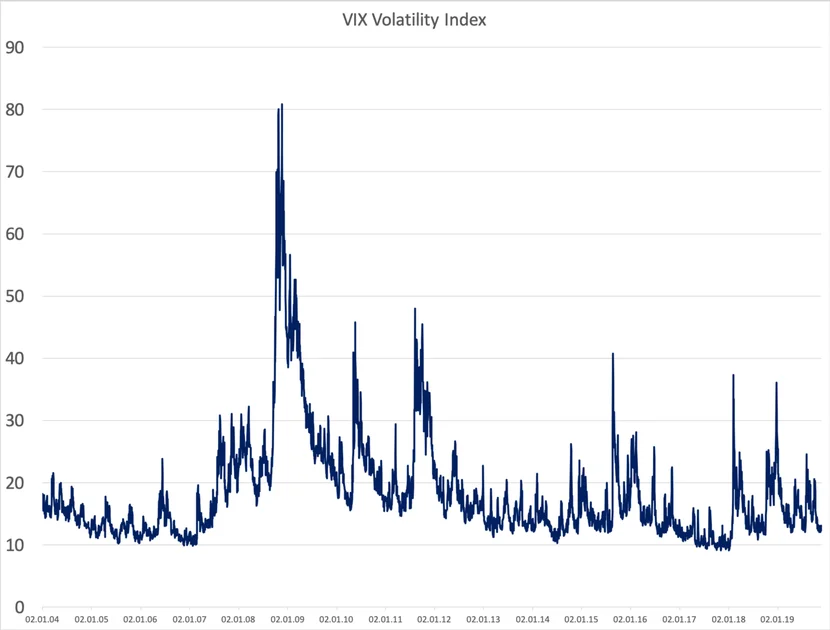
Historically, a VIX reading below 20 is considered relatively calm, while readings above 30 signal significant fear or uncertainty. A VIX above 40 has been associated with crisis-level events — such as the 2008 financial collapse or the early days of the COVID-19 pandemic in 2020. The current spike, while not yet reaching those historic extremes, has nonetheless rattled confidence across equity markets and triggered a visible rotation into defensive assets including Treasuries and gold.
Options volume has increased substantially as traders seek to hedge their portfolios. This hedging activity itself feeds back into the VIX calculation, creating a self-reinforcing dynamic that can amplify short-term volatility readings even further.
Why the VIX Is Rising: The Forces Driving Fear
Several interconnected factors are contributing to the current volatility spike, and understanding them is critical to interpreting what the VIX is signaling versus what it may be overstating.
Geopolitical and Policy Uncertainty
Global geopolitical tension remains a significant driver of market anxiety. Ongoing conflicts and diplomatic standoffs — particularly in the Middle East — continue to inject unpredictability into energy markets and global supply chains. Rising oil price instability, for instance, has historically correlated with increased VIX readings, as it threatens to reignite inflationary pressures at a time when central banks are trying to carefully manage a soft economic landing.
On the domestic policy front, uncertainty around trade tariffs, fiscal spending, and regulatory shifts has added another layer of concern for institutional investors. Markets dislike uncertainty above almost anything else, and policy ambiguity — whether from Washington or major trading partners — tends to be priced in through elevated volatility.
Federal Reserve and Interest Rate Jitters
Perhaps no single factor has been more consistently linked to VIX movements in recent years than Federal Reserve policy expectations. As the Fed navigates the difficult terrain between controlling inflation and avoiding recession, every economic data release — from jobs reports to CPI figures — becomes a potential market-moving event. The uncertainty around the timing and magnitude of future rate cuts has kept options traders on edge, contributing to persistently elevated implied volatility readings.
For equity investors, this matters enormously. Higher interest rates reduce the present value of future corporate earnings, making stock valuations more sensitive to any negative surprise. In this environment, sectors like technology — which depend heavily on growth expectations — tend to see amplified swings, further inflating volatility measures. Investors following stocks like Micron Technology amid AI memory demand are navigating exactly this kind of rate-sensitive terrain.
Historical Context: The VIX as a Market Barometer
The VIX was introduced by the CBOE in 1993 and has since become one of the most widely watched indicators in global finance. Its design captures the implied volatility of S&P 500 index options over a 30-day window, making it a real-time reflection of collective market sentiment rather than a lagging indicator.
Over its three-decade history, the VIX has served as a reliable contrarian signal. Extreme spikes have often — though not always — preceded market recoveries, as panic selling eventually gives way to bargain hunting. The 2020 COVID crash, for example, saw the VIX briefly top 80 before markets staged one of their most dramatic recoveries on record within months.
Conversely, prolonged periods of low VIX readings — such as those seen in 2017 or parts of 2021 — can signal complacency, which often precedes sharp corrections. This dual nature makes the VIX a tool that demands careful interpretation rather than reflexive reaction.
What the VIX Spike Means for Investors Going Forward
The current elevation in the VIX carries meaningful implications for market participants across the spectrum — from retail investors managing retirement accounts to institutional funds overseeing billions in assets.
For long-term investors, elevated VIX readings are often a reminder to revisit portfolio diversification. Volatility, while uncomfortable, is a normal feature of functioning markets. The key distinction is between short-term noise and structural deterioration in economic fundamentals. At present, while the VIX is elevated, many analysts argue that underlying corporate earnings remain resilient enough to justify staying invested — albeit with appropriate caution.
For active traders, a high VIX environment opens opportunities in volatility-linked instruments, options strategies such as straddles, and defensive sector rotation into utilities, healthcare, and consumer staples. However, trading elevated volatility carries its own risks, as sharp reversals can be just as sudden as the initial spikes.
Broader market trends suggest that volatility itself is becoming a more permanent feature of the investment landscape. The combination of algorithmic trading, 24-hour news cycles, geopolitical fragmentation, and post-pandemic economic reshuffling has made markets structurally more reactive than they were a generation ago. The VIX, in this sense, is not merely a fear gauge — it is increasingly a measure of a world operating with less predictability and more interconnected risk than ever before.
Comments