
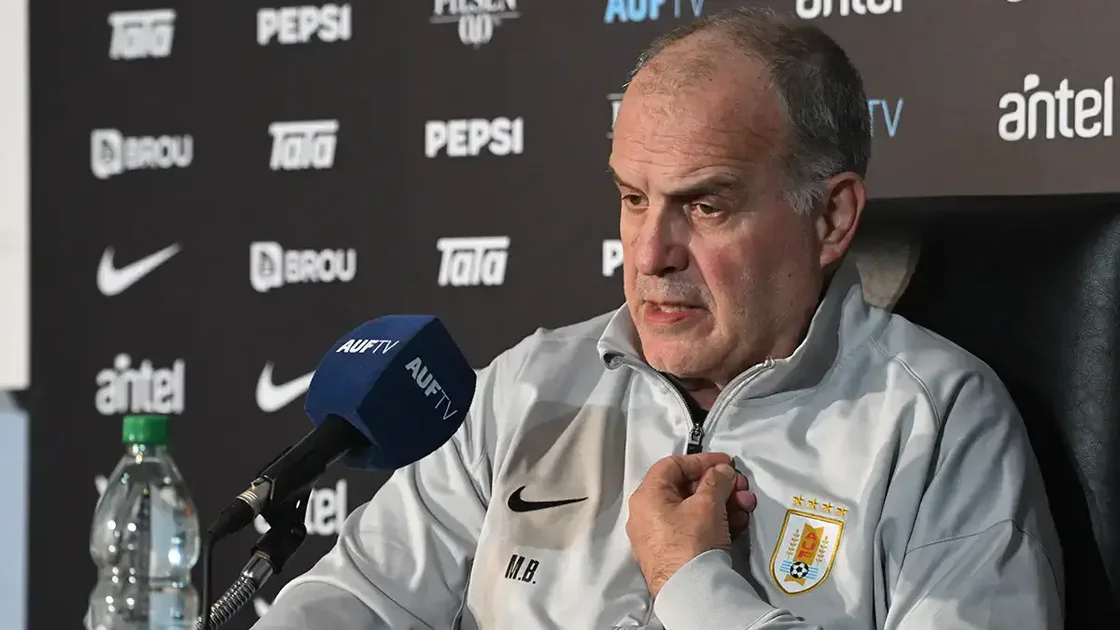
Uruguay's World Cup Campaign Hangs by a Thread Amid Internal Rebellion
As the clock ticks down to a pivotal Group H clash at the Estadio Akron in Guadalajara, the Uruguayan national team is engulfed in an unprecedented internal crisis. According to multiple reports, a group of senior players—including the influential quartet of Sergio Rochet, Manuel Ugarte, Rodrigo Bentancur, and Federico Valverde—has openly challenged head coach Marcelo Bielsa's tactics and training methods just hours before the must-win match against Spain.
The confrontation, first reported by Uruguayan outlet El Espectador and corroborated by Diario AS, centers on the players' discontent with Bielsa's demanding training intensity, which they claim has led to injuries among teammates. More critically, the players have expressed a fundamental disagreement with Bielsa's tactical approach for the Spain game. They are pushing for a low-block, counter-attacking strategy, while Bielsa insists on a high-pressing, possession-based system that mirrors Spain's own style—"como si fuesen un espejo" (as if they were a mirror).
In response, Bielsa called a full team meeting where he reportedly confronted the dissenting players, accusing them of trying to force him out after he excluded star forwards Luis Suárez and Nahitan Nández from the squad. The meeting, described as tense, ended with Bielsa claiming that the players who were injured—but still brought to the World Cup—are his strongest supporters.
Confirmed Lineups: Changes and Continuity
Despite the chaos, Bielsa has named his starting XI, with a single change from the draw against Cabo Verde. Darwin Núñez replaces Fede Viñas, offering a more mobile attacking threat. The lineup still features the highly questioned Fernando Muslera in goal, while Ronald Araújo remains an injury doubt and José María Giménez starts on the bench.
Spain, meanwhile, has named a strong side under Luis de la Fuente. Marcos Llorente replaces Pedro Porro at right-back, and Mikel Merino comes into midfield for Fabián Ruiz. Lamine Yamal continues as the focal point of the attack, with Álex Baena and Mikel Oyarzabal alongside him.
Uruguay XI: Muslera; Varela, Cáceres, Olivera, Sanabria; Ugarte, Valverde, Bentancur; Canobbio, M. Araújo, Núñez.
Spain XI: Simón; Llorente, Cubarsí, Laporte, Cucurella; Rodri, Pedri, Merino; Yamal, Baena, Oyarzabal.
The Stakes: A Group H Chess Match with Elimination on the Line
The mathematical realities of Group H make this match a high-stakes thriller. Spain currently leads the group with 4 points, followed by Uruguay and Cabo Verde with 2 points each, and Saudi Arabia with 3. While Spain can afford a draw, a loss could see them slip to second or even third place, depending on the result of the simultaneous match between Cabo Verde and Saudi Arabia.
For Uruguay, anything less than a win likely means elimination. Their inability to break down Cabo Verde and Saudi Arabia has left them on the brink. The internal discord only amplifies the pressure. As one source noted, "Uruguay nunca ha ganado a España en los diez encuentros en los que se han enfrentado" (Uruguay has never beaten Spain in ten meetings), with five Spanish wins and five draws.
Spain's recent form offers a stark contrast. After a slow start against Cabo Verde—a 2-2 draw—La Roja rediscovered its attacking verve in a 4-1 thrashing of Saudi Arabia. Lamine Yamal's emergence as a consistent star has given de la Fuente's side a cutting edge they lacked in their opening game. As commentator Manu Carreño put it, Spain needs to win to "evitar sustos" (avoid scares) and secure top spot, thereby avoiding a potential knockout clash with Argentina.
A Historical Dominance Under Siege
The historical record heavily favors Spain. But this Uruguay team, despite its turmoil, possesses individual quality that can trouble any defense. Federico Valverde, the sole España-based player in the Uruguayan lineup (Real Madrid), is a threat from midfield, while Darwin Núñez's pace can exploit any high line. The question is whether a fractured dressing room can channel that talent into a coherent performance.
Where to Watch: Global Broadcast Details
For fans in Spain and across the globe, the match kicks off at 02:00 CEST (Spanish peninsular time) on Saturday, June 27, 2026—the early hours of Friday night into Saturday morning. The game will be broadcast live on La 1, La 2 Cat, RTVE Play, DAZN Mundial, and Bar TV Mundial on Movistar Plus+ (channel 300). In other territories, local broadcasters will carry the feed.
Viewers can also follow live updates, lineups, and post-match analysis via AS.com, which will offer minute-by-minute coverage starting one hour before kickoff.
The Bielsa Betrayal: A Manager's Philosophy vs. Player Power
Beyond the immediate result, this match represents a broader conflict in modern football: the clash between a manager's uncompromising tactical vision and the growing agency of superstar players. Marcelo Bielsa, known globally as "El Loco" for his obsessive, high-intensity style, has always demanded total commitment. His methods brought success at Leeds United and a brief renaissance for Uruguay, but they have also worn thin.
The players' request for a low block against Spain is a direct repudiation of Bielsa's core philosophy. He has never been a defensive coach; his teams press, attack, and dominate possession. A low block would be a tactical surrender that Bielsa likely views as an admission of inferiority. Yet, the players see it as pragmatism: survival first, style second.
This fracture has been brewing since Bielsa dropped Luis Suárez and Nández—two veterans who commanded immense respect in the squad. The current crop of leaders, particularly those playing in Europe's top leagues, feel emboldened to speak out. The question now is whether Bielsa can rally his troops or whether the mutiny will be fatal.
What This Means for Uruguay's Future
If Uruguay loses or draws and is eliminated, Bielsa's tenure will almost certainly end. His reputation as a tactical genius, already dented by recent results, might not survive a player revolt. This would also signal a shift in Uruguayan football's power dynamics, where the players' union holds more sway than ever before.
If Uruguay wins and somehow advances, Bielsa will be hailed as a master psychologist who channeled dissent into motivation. But the underlying issues—injuries, trust, tactical alignment—will not simply disappear.
Spain's Opportunity: Calm in the Chaos
For Luis de la Fuente's Spain, the Uruguayan crisis is a double-edged sword. A fractured opponent can be easier to beat, but it can also be unpredictable—a wounded animal fights hardest. Spain's focus will be on their own performance.
De la Fuente has built a side that is flexible yet stable. His decision to start Mikel Merino alongside Rodri and Pedri suggests he wants both defensive solidity and creative passing from deep. The wide threat of Lamine Yamal and Álex Baena will test Uruguay's full-backs, who have been inconsistent.
Spain's own history in World Cup group stages is strong; they have not lost a group match since 2014. Avoiding Argentina in the round of 16 is the obvious carrot. Beyond that, this game offers a chance to send a message to the tournament: La Roja can handle pressure, adapt to adversity, and win ugly if needed.
The Broader Implications for Group H and the Knockout Stage
The Group H winner will face the Group I runner-up, likely a strong team like Argentina or Senegal. The runner-up gets the Group I winner, also daunting. For Spain, topping the group is non-negotiable. For Uruguay, beating Spain would not only guarantee advancement but also set up a path that avoids the tournament favorites until later rounds.
Conclusion: The World Cup's Most Volatile Match
As the sun sets over Guadalajara, the atmosphere inside the Estadio Akron will be electric. But the real drama is happening behind closed doors. Uruguay's players have drawn a line in the sand. Marcelo Bielsa has planted his flag. And the world will watch to see which side breaks first.
For fans of the beautiful game, this match is more than a group-stage decider. It is a referendum on authority, rebellion, and the fine line between genius and madness. Whether Bielsa can pull off one more miracle or whether the players' mutiny succeeds will define not just this match, but the future of Uruguayan football.
As the legendary commentator Andrés Cantor might say: "¡GOOOOOOL!"—or perhaps, "¡CAOS!". We find out soon.
Comments