
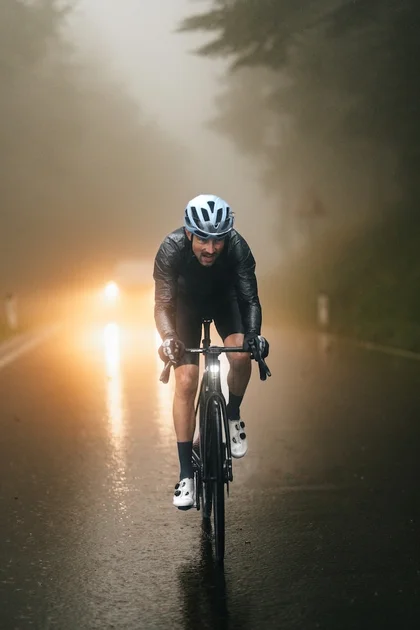
Death of a Champion: Max Riese Killed in Training Accident
The international ultra-cycling community is in mourning following the death of Max Riese, one of its most accomplished and beloved figures. The 36-year-old Austrian rider died on Tuesday evening after colliding with a wild animal—reportedly a deer—during a training ride on the Roßfeld Panoramic Road near his home in Elsbethen, in the Flachgau region outside Salzburg.
According to Salzburg24, a passing motorist discovered Riese seriously injured in the middle of the road and immediately called emergency services. Firefighters from Au and Berchtesgaden responded alongside a rescue helicopter, but Riese succumbed to his severe injuries at the scene. Police believe the impact with the animal caused the crash, which shattered his bicycle completely. A search for the injured deer, conducted with a local hunter, proved unsuccessful. Authorities have asked anyone who witnessed the incident on Tuesday evening to contact the Berchtesgaden police.
The news was confirmed across the cycling world on September 17. Bikepacking.com published a memorial tribute, while German outlet bike-x noted the cruel irony that the accident occurred on Riese's home training loop—a route he had ridden hundreds of times.
A Giant of Ultra-Endurance Racing
Riese was not merely a participant in the ultra-cycling scene; he was one of its defining athletes. His 2026 season alone cemented his legacy: in May, he won the Hellenic Mountain Race in Greece, and in late August he claimed second place at the legendary Silk Road Mountain Race in Kyrgyzstan, a 2,000-kilometer odyssey featuring 30,000 meters of elevation gain through remote and unforgiving terrain.
His exploits extended far beyond organized events. Just over a year ago, Riese made global headlines when he completed a "triple Everesting" on the Gaisberg near Salzburg—climbing the mountain 95 consecutive times for a total of 26,553 vertical meters in just over 37 hours. The feat, which pushed the boundaries of human endurance, was widely covered in cycling media.
Beyond his athletic achievements, Riese was a community builder. Through his gravgrav Collective, he developed bikepacking routes and organized events, helping to grow the discipline in Austria and beyond. Those who knew him consistently described him not only as a powerful rider but as an open, positive, and joyful person.
Tributes Pour In as Community Mourns
The response to Riese's death has been immediate and heartfelt. In a statement shared on social media, the gravel and ultra-cycling community wrote: "With infinitely heavy hearts, we must share that Max Riese has passed away. He leaves behind an irreplaceable gap."
His friend Matouš Podroužek, who had recently spoken with Riese about his plans for the new Taurus Mountain Race in Turkey this October, paid tribute to him in bike-x: "In my thoughts, I'm with the beautiful rides I was lucky enough to experience with him. Unfortunately, there were far too few, because something always comes up—and next year it would surely have worked out. My condolences, our condolences, go to his family and his girlfriend."
The road.cc live blog summarized the mood with a quote from a community member: "You did everything with a big smile. Thank you for the inspiration, support, and for the privilege of knowing you."
A Sobering Reminder of Cycling's Inherent Risks
Riese's death has reignited conversations about the dangers that accompany cycling, even for the most experienced riders. The bike-x editorial noted that risk travels with every rider regardless of preparation or equipment quality: "An inattentive person behind the wheel, a stone on the ideal line, a tire defect—or even an innocent animal that jumps out of the bushes. It doesn't take more than that."
His death also highlights the specific hazards faced by ultra-cyclists, who often train alone on remote roads at dusk—conditions that increase the likelihood of wildlife encounters. While cycling infrastructure and safety advocacy typically focus on urban environments and driver behavior, the risks of rural training routes remain less discussed.
For a sport that celebrates pushing limits and embracing self-reliance, Riese embodied both the beauty and the peril of that ethos. He had just completed one of the most demanding race seasons of his career and was looking forward to an extended offseason—a break he never got to take.
His loss leaves a void not only in the results sheets of the world's hardest races but in the community he helped build. As the tributes continue to accumulate, one message echoes across them all: Max Riese will be deeply missed—as a formidable athlete, and above all, as a friend and a remarkable human being.
Comments