
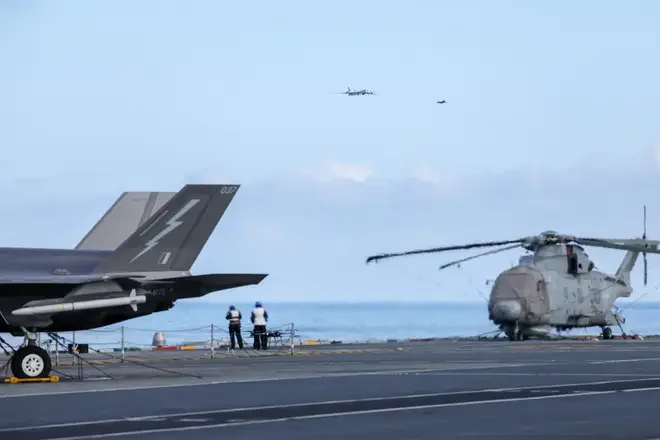
UK F-35s Intercept Russian Plane Shadowing HMS Prince of Wales in the Arctic
The Ministry of Defence has confirmed that Royal Air Force F-35B fighter jets intercepted a Russian Tupolev Tu-142 maritime patrol aircraft, designated by NATO as a 'Bear-F', after it engaged in what the MoD described as 'unsafe and unprofessional' behaviour near the UK Carrier Strike Group in the Norwegian Sea.
The incident occurred on July 2, 2026, while HMS Prince of Wales was operating under NATO command as part of Operation Firecrest. The Russian aircraft flew at low altitude and at an unnecessarily close range to the 65,000-tonne aircraft carrier before dropping a significant number of sonobuoys—devices designed to detect and track submarines—in close proximity to the UK warship.
According to the MoD, the Russian aircrew failed to respond to multiple attempts by British forces to establish communication on international aviation frequencies. In response, two F-35B Lightning jets were scrambled from the flight deck of HMS Prince of Wales to intercept and escort the Russian aircraft until it departed the area.
The UK Carrier Strike Group currently deployed includes HMS Prince of Wales, the Type 45 destroyer HMS Duncan, several Merlin and Wildcat helicopters, and the Royal Fleet Auxiliary tanker RFA Tidespring. The group is operating alongside NATO allies as part of Arctic Sentry, a mission reinforcing security in the Arctic and North Atlantic.
A Deliberate Provocation or Routine Surveillance?
The Russian Tu-142 is a long-range maritime reconnaissance and anti-submarine warfare aircraft, a Cold War-era platform still in active service. The dropping of sonobuoys so close to a NATO carrier is considered by defence analysts to be a tactical move aimed at locating allied submarines that may be operating in the vicinity of the task group.
Defence Secretary Dan Jarvis, who visited HMS Prince of Wales over the weekend, addressed the interception during a media interview. 'We should be clear-eyed about the fact that the threat from Russia exists in every domain—under the water, on the water, on the land, in the sky, in space and in cyberspace as well,' he said.
The response from the UK was measured but firm. Rather than firing warning shots or conducting aggressive manoeuvres, the F-35s performed a professional escort, underscoring NATO's commitment to de-escalation while maintaining a visible deterrent.
Why This Incident Matters
The interception of the Russian Bear-F is not an isolated event but part of a broader pattern of increased military activity in the High North. The Arctic and the Norwegian Sea have become a focal point for NATO-Russia tension as melting ice caps open new shipping lanes and strategic resources become more accessible.
HMS Prince of Wales is the first European aircraft carrier to conduct NATO air defence operations with F-35 jets, marking a significant milestone for the alliance's capability in the region. The carrier's presence near Iceland, as part of Arctic Sentry, sends a clear signal that NATO is prepared to defend its northern flank.
The Strategic Shift of the UK Carrier Strike Group
The deployment comes at a time when the UK has assumed command of NATO's Special Forces headquarters, described by the Ministry of Defence as 'the spearhead' of the alliance's rapid deployment teams, capable of deploying anywhere in the world within days. This dual demonstration of naval and special forces readiness underscores London's commitment to European security.
It also follows a series of incidents that have heightened tensions between Russia and the West. Just weeks before the interception, Royal Marines boarded a Russian shadow fleet oil tanker in the English Channel. The head of the UK armed forces has warned that the risks and threats facing Britain are greater now than at any time since the Cold War.
Putin's Superyacht and the Arctic Chessboard
Adding a layer of intrigue to the current deployment, it was reported last week that a £100 million superyacht belonging to Russian President Vladimir Putin was traversing the coast of Norway, apparently returning to Russian waters. Asked whether HMS Prince of Wales was tracking the vessel, Defence Secretary Jarvis declined to comment specifically but stated: 'We know where it is.' He added that the movement of the yacht was 'another combat indicator' that Putin is 'increasingly under pressure.'
While the MoD has not linked the superyacht's movement directly to the Bear-F interception, the proximity of the two events highlights the complex, multi-layered nature of the current standoff. The Arctic is no longer a peripheral theatre; it has become a central arena for great-power competition.
Broader Implications for NATO and Global Security
The interception of the Russian maritime patrol aircraft is a textbook example of the new normal in NATO-Russia relations. Such encounters, once rare, are now occurring with increasing frequency. The MoD's decision to publicise the incident is itself a departure from past practice, when such intercepts were often kept classified to avoid inflaming tensions.
By going public, the British government appears to be pursuing a dual strategy: transparency to deter future Russian aggression, and messaging to demonstrate that NATO is vigilant and capable.
The Escalation Risk
Some analysts warn that close encounters at sea and in the air carry inherent risks of miscalculation. In 2022 and 2023, several similar incidents were reported involving Russian aircraft approaching US and allied warships in the Mediterranean and the Baltic. While no shots have been fired, the potential for an accident—a mid-air collision, a misread signal, or a mechanical failure during an intercept—remains a constant concern.
The dropping of sonobuoys is particularly sensitive because it directly targets the submarine fleet, a key component of NATO's nuclear deterrent. If a Russian submarine were to be located and trailed, it could compromise patrol routes and undermine the credibility of second-strike capabilities.
A Wider Pattern of Russian Activity
The Bear-F interception is part of a wider pattern of Russian military assertiveness that has intensified since the invasion of Ukraine. From GPS jamming in the Baltic to the deployment of hypersonic missiles in Kaliningrad, Moscow is testing NATO's response in multiple domains simultaneously.
The UK's response—deploying F-35s from a carrier to intercept and shadow the Russian aircraft—signals that the Royal Navy and RAF are integrated and ready. The F-35B, with its advanced sensors and stealth capabilities, is well suited for such missions, providing a technological edge over the ageing Tu-142.
The Human Factor
For the 1,500 British personnel aboard the Carrier Strike Group, the interception was a real-world validation of months of training. Unlike simulated intercepts or tabletop exercises, this was a live encounter with a potentially hostile aircraft, operating under rules of engagement that required restraint and professionalism.
Speaking to defence journalists, military sources described the atmosphere on board as calm but focused. The F-35 pilots, who had been conducting routine air defence patrols, transitioned seamlessly to the interception mission, demonstrating the flexibility of the carrier air wing.
What This Changes
The incident marks a significant moment in the UK's post-Brexit defence posture. By taking command of NATO's special forces rapid reaction unit and leading the Arctic Sentry mission with its carrier group, Britain is asserting a role as a leading European military power outside the European Union but central to NATO strategy.
In parallel, the UK faces a number of other challenges that stretch its defence resources. The interception of a possible Russian shadow fleet tanker in the English Channel, the ongoing support to Ukraine, and the constant requirement to protect the UK mainland from potential air and sea threats all demand attention.
Domestic Pressures and Defence Spending
Defence Secretary Dan Jarvis has been an advocate for increased defence spending, arguing that the threats faced by the UK require sustained investment. While the F-35 interception was a success, the broader defence budget is under pressure, with inflation and procurement delays affecting all three services.
Earlier this year, an independent review highlighted gaps in the Royal Navy's surface fleet, particularly in destroyer numbers and anti-submarine warfare capabilities. The decision to deploy HMS Prince of Wales, rather than its sister ship HMS Queen Elizabeth, was driven partly by the need to keep one carrier in a higher state of readiness while the other undergoes maintenance.
The Geopolitical Landscape
The Arctic is becoming a stage for a new geopolitical competition. Russia has invested heavily in its Northern Fleet, reopening Soviet-era bases and deploying advanced air defence systems along its Arctic coastline. NATO, in response, has increased the frequency and complexity of its exercises in the region.
Norway, a key NATO member with a long border with Russia in the Arctic, has been a crucial partner in this effort. The decision by the UK Carrier Strike Group to operate in the Norwegian Sea is a direct result of this closer cooperation.
The Bear-F interception also comes amid a period of global instability. The war in Ukraine grinds on, tensions in the Indo-Pacific are rising, and the United States is increasingly focused on competition with China. European nations, led by the UK and France, are being asked to shoulder more of the burden for the defence of Europe's northern and eastern flanks.
Looking Ahead
For the crew of HMS Prince of Wales, the interception is unlikely to be the last such event. As long as the Carrier Strike Group remains on station in the Arctic, further interactions with Russian aircraft and ships are almost certain. The MoD has made clear that the UK will continue to operate in international waters and airspace, and that any unsafe or unprofessional behaviour by Russian forces will be met with an appropriate response.
In the short term, the incident is likely to dominate headlines in the UK and across Europe. It provides a dramatic example of the new realities of great-power competition, where Cold War-era tactics like sonobuoy dropping are combined with 21st-century technology like the F-35.
The message from London is clear: the UK is back in the business of high-end naval operations, and it is prepared to defend its interests and those of its allies in the most challenging environments on earth.
Comments