
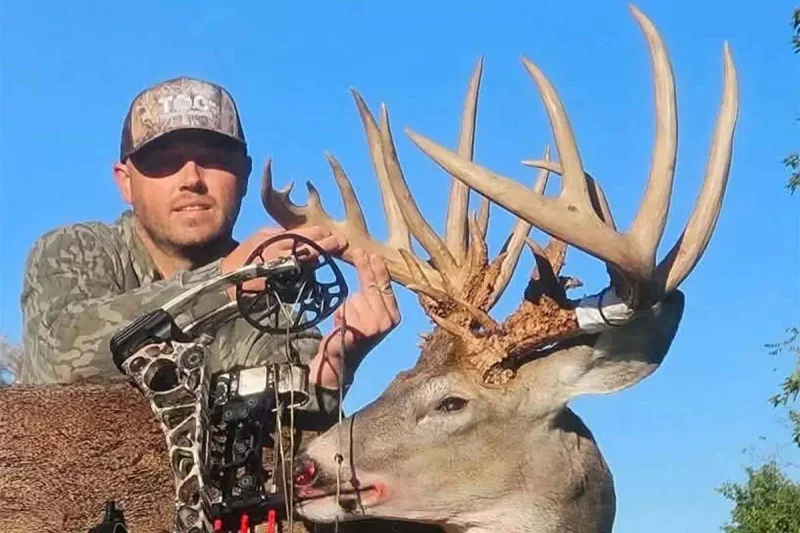
Stephen Crowell Indiana Bowhunt Ends with 266-Inch Non-Typical Buck
An Ohio bowhunter's months-long pursuit of a mysterious giant buck in eastern Indiana ended in dramatic fashion on October 2, when Stephen Crowell arrowed a 266-inch non-typical whitetail that had been eluding him since late last year. The harvest, which occurred on a small farm in east-central Indiana, is being celebrated by deer hunting outlets as one of the most remarkable archery trophies of the 2026 season.
Crowell, a 35-year-old manufacturing project manager from New Paris, Ohio, who also guides walleye anglers on Lake Erie, had secured permission to hunt the property only recently. According to Outdoor Life, he had been on the farm just once or twice before but had heard rumors of a giant buck in the area. He nicknamed the deer "Rumor" because he had never actually seen it.
That changed in late September, when Crowell spotted the buck near the edge of a still-green soybean field while putting out trail cameras. The encounter gave him a reference point—a lone tree in the bean field—that would prove critical. On October 2, with bow season open in Indiana since October 1, a canceled fishing charter due to rain freed Crowell to hunt. He arrived at the farm around 3:30 p.m., hung a lock-on stand in the lone tree despite heavy poison ivy, and settled in by 4:30 p.m.
Just before 7 p.m., after several does and a small buck had passed through, the target deer stepped out. Crowell ranged him at 51 yards and decided he had to shoot. The arrow hit high—Crowell believes the buck dropped as he released—but the deer went down immediately. When he approached, he was stunned by the size of the rack. "It looked like he had a brush pile of antler tines," Crowell told Outdoor Life. The buck was later measured at 266 inches as a non-typical.
A Hunt Defined by Persistence, Not Luck
The road to the 266-inch buck was anything but straightforward. Crowell first became aware of the deer in late November 2025, when he heard rumors of a giant in the area. He drove around eastern Indiana in the cold last December and eventually saw the deer feeding in a picked agricultural field. But as the months wore on, the trail went cold. Throughout the spring and summer, Crowell ran trail cameras but never captured a single photo of the buck. He began to suspect the deer was avoiding the cameras altogether.
The challenge was compounded by the deer's sheer size. Crowell had previously taken his best buck in Ohio the year before—a gross 215 4/8-inch deer—but this Indiana whitetail was operating in another class. The 266-inch non-typical is a rare animal by any measure, and the difficulty of patterning a specific mature buck in open agricultural country is well known among bowhunters.
A critical moment came on September 21, when Crowell jumped the deer in a brushy draw leading to a standing soybean field. According to El-Balad.com, Crowell had only one reference point—the lone tree in a trail camera photo—to work with. The buck bounded from its bed but then slowed and stopped a little over 100 yards away, looking back for about two minutes. That stare-down gave Crowell a clean look at the rack and confirmed he was dealing with the deer he had been chasing all summer.
Even then, the hunt was not assured. With two children under the age of seven and a full-time job in manufacturing project management, plus his side work as a fishing guide, Crowell's time afield was limited. The rain on October 2 that canceled his charter provided a window he might not have otherwise had. His father watched his children so he could hunt. "With the cold weather coming in that afternoon I figured it would be a good time to check a small farm I'd just secured permission to hunt," Crowell told Outdoor Life.
The Shot and Its Aftermath
Crowell's setup on October 2 was far from elaborate. He hung a lock-on stand in the lone tree, trimmed only a few limbs for cover, and relied on the bean field as the primary food source. "The tree was covered in poison ivy, and it took time for me to get my stand set," he said. "I was settled in for hunting about 4:30, and I was about a hundred yards from where I'd seen the buck two weeks prior."
As the evening progressed, three does entered the field, fed, and wandered off. An hour later, a small buck appeared, vanished into a thicket, and then reappeared—this time with the giant behind him. The big deer was slow and cautious, feeding on beans as he worked closer. When he stopped broadside at 51 yards, Crowell realized the buck was not going to come any closer and would soon head away.
"I knew I had to shoot then or maybe never again," he said. Despite shaking with adrenaline, he steadied himself and drew. The arrow hit high, and the buck went down right there. Crowell believes the deer dropped to turn and run at the sound of the release, causing the high hit. "I'm not complaining, though," he said.
After the shot, Crowell stayed in the stand for a time, collecting his thoughts and thanking God. When he climbed down and approached the buck, the reality of its size hit him. "I knew he was big, but I had no idea how big until I got to him," he said. He used a heavy-duty carry tote to move the deer, which was later officially measured at 266 inches non-typical.
Why This Buck Matters
Trophies of this caliber are exceptional in any whitetail state, but they carry particular weight in Indiana, which has a strong reputation for producing large-bodied, heavy-antlered deer. A 266-inch non-typical is the kind of animal that draws attention from record books and hunting media alike. For context, the previous best buck for Crowell was a 215 4/8-inch gross typical from Ohio—a trophy in its own right, but nearly 50 inches smaller than the Indiana giant.
The hunt also underscores a broader trend in modern deer hunting: the rise of the do-it-yourself, public- and permission-based hunter who leverages trail cameras, scouting, and persistence to target specific mature bucks. Crowell did not rely on a high-fence operation or a guided outfitter. He secured permission on a small farm, ran cameras, and made the most of limited time. His story resonates because it reflects the reality of most hunters—working people with families and jobs who nonetheless find ways to pursue their passion.
Moreover, the role of chance—a canceled fishing trip due to rain—adds a layer of unpredictability that is familiar to anyone who spends time in the field. The weather window, combined with the cold front moving in, likely had deer on their feet. Crowell's decision to hunt that afternoon, even without recent camera evidence, proved decisive.
A Record-Class Animal and the Community Response
The 266-inch non-typical has quickly become a topic of conversation among whitetail enthusiasts. North American Whitetail, which first reported the story, noted that the buck was taken in Indiana and described it as a massive 266-inch trophy. Social media and hunting forums have buzzed with speculation about where the deer will rank among Indiana's all-time archery non-typicals. While official record-book entries can take months to verify, the raw number alone places the buck in elite company.
Crowell's story also highlights the importance of land access and relationships with landowners. He had only recently secured permission to hunt the small farm, and his willingness to scout even when cameras were not producing paid off. The lone tree that provided his ambush point became the linchpin of the entire hunt.
For Crowell, the experience was spiritual. "I hope every bowhunter can feel the same way I did then with that buck," he told Outdoor Life. That sentiment—a mix of awe, gratitude, and relief—is one that many hunters chase for a lifetime. -- For those following other outdoor and conservation news, stories like the RSPCA investigation into cats found in Birmingham remind us of the broader animal welfare landscape, though Crowell's hunt was a legal and ethical pursuit.
Broader Implications for Deer Hunting
The Crowell buck arrives at a time when deer hunting participation is facing challenges in some regions, but trophy potential remains a powerful motivator. States like Indiana, Ohio, and Kentucky have become destinations for hunters seeking mature bucks, thanks to a combination of genetics, nutrition, and age structure. The 266-inch non-typical will undoubtedly fuel interest in Indiana's archery season.
It also serves as a case study in the value of persistence. Crowell did not capture a single photo of the buck during the spring and summer. He relied on a single visual encounter and a hunch. In an era of camera-driven hunting, his success is a reminder that woodsmanship and intuition still matter.
As news of the buck spreads, Crowell will likely face questions about whether he plans to enter it into record books. For now, he seems content to savor the moment. The deer known as "Rumor" is no longer a rumor—it is a reality, and a remarkable one at that.
Comments