
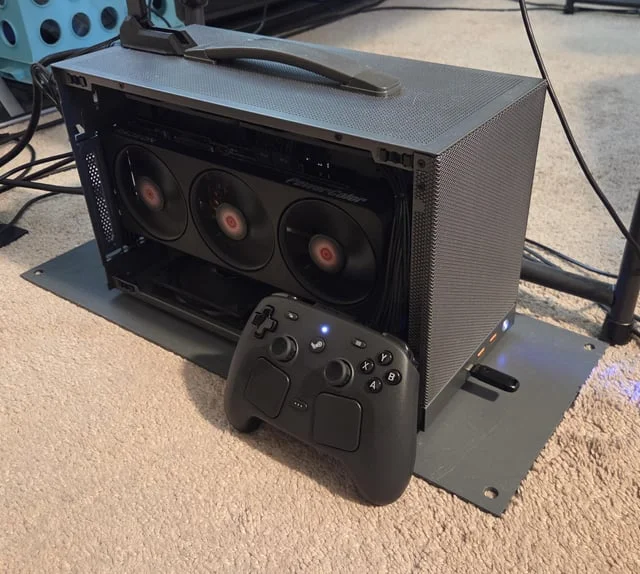
SteamOS 3.8 Goes Desktop: Valve Opens the Gates for Custom Steam Machines
Valve has officially released SteamOS 3.8.10, a landmark update that transforms the operating system from a Steam Deck exclusive into a fully functional desktop Linux distribution. The release, which went live last week, introduces initial support for the upcoming Steam Machine hardware, a new BIOS for both Steam Deck LCD and OLED models, and significantly improved compatibility with Intel and AMD platforms.
In a conversation with The Verge, Valve's Pierre-Loup Griffais confirmed that his team is now "collaborating with Nvidia very closely" to bring full SteamOS support to Nvidia graphics cards. While he cautioned that Nvidia driver support may not arrive before the end of 2026, Griffais emphasized that a dedicated team is working on the integration. For years, running SteamOS on custom hardware was a hacky affair—requiring a Steam Deck recovery image and largely limited to AMD systems. SteamOS 3.8 changes that by offering a streamlined installation process and broader hardware compatibility.
The update also improves screen casting support for apps like OBS and Discord, fixes issues with USB racing wheels and non-standard USB devices, and adds the ability to wake the Steam Deck from sleep via a connected Steam Controller. These refinements signal that Valve is preparing for a broader ecosystem where Steam Machines—both pre-built and DIY—can compete with traditional Windows gaming rigs.
Steam Machine Revival: From Companion Cube Cases to Community Wishlists
The Steam Machine's return is not just a software story. Hardware accessories are already flooding the market. dBrand today launched its Companion Cube case for the upcoming Steam Machine, priced at $130 for a full set that includes a Test Chamber diorama, red button stand, and an Orange and Blue Steam Controller skin inspired by Portal. A stripped-down "Poverty Cube" version costs $100 and ships later. The case, which dBrand provided to Steam Deck HQ for review, uses polycarbonate and polyurethane construction with magnetic front panels for easy cleaning and vents for airflow.
Meanwhile, the Steam Deck community is buzzing ahead of the 2026 Steam Summer Sale. According to Notebookcheck, Reddit users are already curating wishlists that emphasize value and performance on the handheld. Older AAA titles like The Witcher 3, Cyberpunk 2077, and the Batman Arkham Collection dominate discussions, alongside indie gems such as Hades, Hollow Knight, and Balatro. Strategy games—from Command & Conquer to Age of Wonders IV—are surfacing as surprisingly comfortable Deck experiences. Many users are advocating for restraint, advising fellow gamers to set budgets and avoid impulse buys on already massive libraries.
Valve's broader strategy appears to be twofold: support its own hardware (Steam Deck and Steam Machine) while simultaneously enabling a PC ecosystem where users can build their own SteamOS rigs. This mirrors the original Steam Machine vision from 2015, but with a decade of Linux gaming maturity and Proton compatibility behind it.
Why This Matters: The End of Windows Exclusivity in PC Gaming?
The implications of SteamOS going fully desktop with Nvidia support are massive. For years, the PC gaming market has been dominated by Windows, with Linux relegated to a niche for enthusiasts and developers. Valve's push for SteamOS as a mainstream gaming OS could break that monopoly, offering gamers a free, high-performance alternative that doesn't require a Windows license.
For Steam Deck owners, the tie-in is clear: games that run well on the handheld will now run natively on a desktop Steam Machine. For builders, the ability to install SteamOS on an Nvidia-powered rig means they can enjoy the console-like Game Mode experience without sacrificing GPU performance. This could accelerate the adoption of Linux for gaming, especially as AAA titles increasingly support the platform.
The timing coincides with a broader cultural shift. As gamers seek to avoid subscription fees and proprietary storefronts, an open-source OS like SteamOS—backed by Valve's deep pockets—offers a compelling middle ground between console simplicity and PC flexibility. The Summer Sale wishlists on Reddit show that the community is already thinking in terms of platform-agnostic value, prioritizing games that run well across devices.
Valve's collaboration with Nvidia also suggests that the company is serious about competing with Windows on high-end hardware, not just mid-range handhelds. If successful, SteamOS could become the third major gaming platform alongside Windows and macOS, fundamentally reshaping how consumers think about PC gaming.
Looking Ahead: What the Steam Machine Launch Means for Gamers
With SteamOS 3.8 now stable, dBrand cases in pre-order, and the Summer Sale imminent, the pieces are falling into place for Valve's most ambitious hardware ecosystem push in a decade. The reservation system for the official Steam Machine may be limited, but the DIY route is now viable—and for many enthusiasts, more appealing.
As the community debates whether to splurge on deep discounts or wait for new hardware, one thing is clear: Valve is betting that gamers want an open, customizable alternative to the walled gardens of console and Windows. Whether that bet pays off will depend on how smoothly Nvidia support arrives and how many developers optimize for the platform. For now, the early signs are promising.
Keyword-rich internal link suggestion: For those planning to build their own Steam Machine on a budget, even extreme storage solutions like the PS5 Pro Storage Costs More Than Console: SanDisk 8TB SSD Hits $2,960 remind us that cutting-edge PC hardware can get pricey. And if you need a break from gaming, check out how Jersey Mike's Ends Chick-fil-A's 11-Year Reign as America's Favorite Restaurant—a perfect snack for a long gaming session.
Comments