
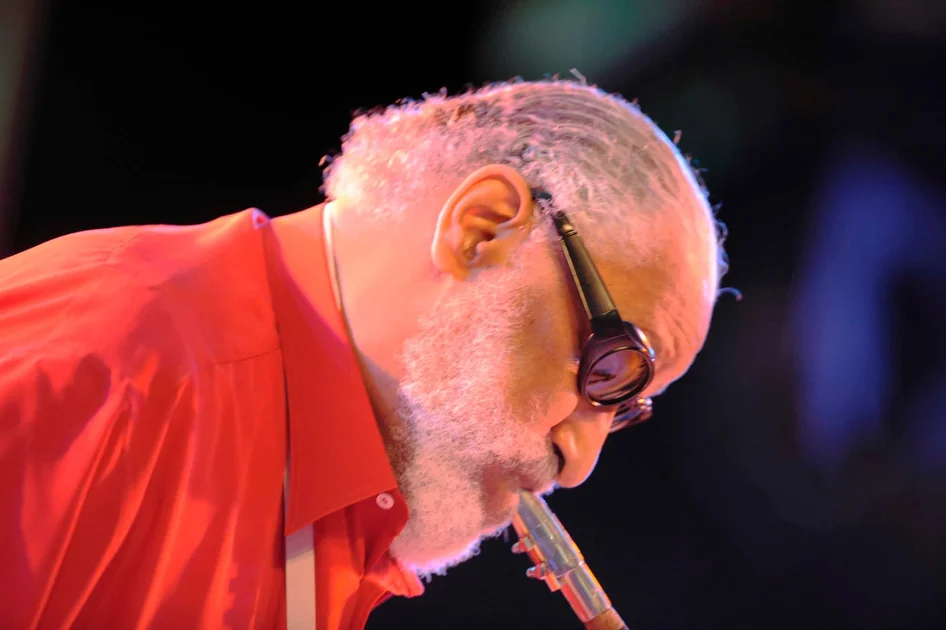
Sonny Rollins, the ‘Saxophone Colossus,’ Dies at 95; A Titan of Jazz Improvisation
Sonny Rollins, the towering tenor saxophonist who reshaped the language of jazz with his fearless improvisations and melodic genius, died Monday at his home in Woodstock, New York. He was 95.
Rollins’s death was announced on his website and confirmed by his publicist, Terri Hinte. The statement did not provide a cause of death, though Rollins had been diagnosed with pulmonary fibrosis years earlier. It quoted a 2009 reflection from the musician: “I think when the creative person ends, he continues in the next existence. I’m a person who believes this life isn’t the be-all and end-all of everything.”
With a career spanning more than six decades and over 60 albums, Rollins was one of the last living giants of the bebop generation. He worked alongside Miles Davis, Thelonious Monk, John Coltrane, and Dizzy Gillespie, and his influence is woven into the very fabric of modern jazz. Known as the “Saxophone Colossus” — a nickname drawn from his landmark 1956 album Saxophone Colossus — he was celebrated for his ability to spin unexpected, labyrinthine solos from simple melodies, often stretching a single improvisation to startling lengths.
A Life Immersed in Music
Born Walter Theodore Rollins on September 7, 1930, in New York’s Harlem district, Rollins was surrounded by music from childhood. His siblings played violin and piano; Fats Waller lived in the neighborhood; and his idol, saxophonist Coleman Hawkins, was a local presence. “I was just immersed in it from the beginning really,” Rollins told PBS NewsHour.
His mother gave him an alto saxophone at age seven. “I got the saxophone and I went into the bedroom and I started playing — that was it,” he recalled to Jazz Times. “I was in seventh heaven.” By high school, he was jamming with future stars Jackie McLean and Art Taylor, and after graduation he joined bands led by bebop pioneers Bud Powell and Fats Navarro. His first major recorded appearance came on 1949’s The Amazing Bud Powell, a cornerstone of the hard bop genre that Rollins would help pioneer.
The Bridge: A Crucible of Genius
For all his early success — Saxophone Colossus was already a classic by 1956 — Rollins remained plagued by self-doubt. In the summer of 1959, seeking to reinvent his playing, he began practicing on the pedestrian walkway of New York’s Williamsburg Bridge. What started as a way to avoid disturbing a pregnant neighbor became a two-year retreat in which he played for 14 or 15 hours a day, sometimes retreating only to grab a cognac at a nearby bar.
“What made me withdraw and go to the bridge was how I felt about my own playing,” Rollins told The Guardian in 2022. “I knew I was dissatisfied.”
The result was the album The Bridge (1962), a landmark work that did not break entirely from his past but pushed his soloing and improvisation into new territory. A contemporary review in Jazz Journal noted that Rollins could “extract the last ounce of meaning from a particular phrase taken from the melody.” The album set him on a course to become one of the most acclaimed performers of his generation, alongside Coltrane and Wayne Shorter.
A Legacy of Innovation and Melody
Rollins’s improvisational approach was both disciplined and reckless. He hated clichés and refused to play signature “licks.” Critic Stanley Crouch once wrote in The New Yorker that when Rollins was on — which was most of the time — he seemed “capable of blowing a hole through a wall.” His affection for standard tunes brought startling new life to songs like “The Surrey With the Fringe on Top,” and his self-penned compositions, including “Oleo” and “St. Thomas” (the latter inspired by the calypso music of his parents’ Virgin Islands heritage), became jazz standards.
Rollins survived virtually all of his peers from the 1950s and ’60s, the period that established the fundamental elements of contemporary jazz. He performed into his 80s, finally retiring in 2014. In 2011, President Barack Obama awarded him the National Medal of the Arts, saying Rollins had inspired Obama himself to “take risks that I might not otherwise have taken.”
A Spiritual View of Art and Life
Throughout his career, Rollins spoke often of music as a spiritual practice. In a 2009 interview quoted after his death, he said: “I think when the creative person ends, he continues in the next existence. … A spiritual person doesn’t feel like that.” His publicist’s statement reflected that outlook, noting that Rollins died peacefully at home.
The End of an Era, But Not the Music
Rollins’s death closes the book on a generation of jazz titans who transformed a dance form into an art of profound expression. Yet his influence remains immediate. From the ecstatic solos of contemporary saxophonists to the harmonic curiosity of modern improvisers, Rollins’s DNA is everywhere.
For listeners discovering his work for the first time, the catalog is vast and rewarding: the early Prestige sessions, the classic Blue Note albums, the epic live performances. Albums like Saxophone Colossus, The Bridge, and Freedom Suite are not just historical documents — they are live wires, still crackling with the energy of a man who insisted on finding new ideas well beyond the limits of most players.
In the end, Sonny Rollins leaves behind a sound and a standard that will outlast any bridge. As he once said, “The story begins with the music — and it never really ends.”
This article was updated on May 26, 2026, following the announcement of Sonny Rollins’s death.
Comments