
Scotland’s World Cup Hopes Hinge on Brazil After Morocco Defeat
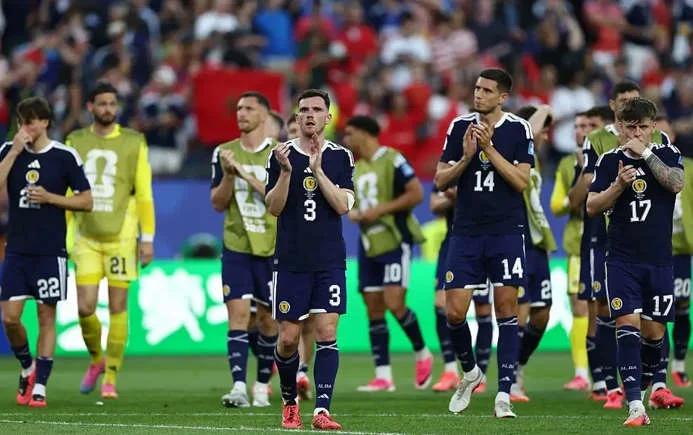
Scotland’s dream of reaching the knockout stage of the FIFA World Cup for the first time in their history suffered a severe blow on Friday night as they lost 1-0 to Morocco at Gillette Stadium in Foxborough, Massachusetts. The defeat, decided by Ismael Saibari’s stunning strike just 71 seconds into the match, leaves Steve Clarke’s side needing a result against five-time world champions Brazil in their final Group C fixture on Wednesday in Miami to advance.
The result sent Morocco to the top of the group with four points from two games, while Scotland sit third with three points, one behind Brazil, who defeated Haiti 1-0 in their opener. A draw against Brazil would likely be enough to secure Scotland’s passage to the round of 16, but a loss would leave them dependent on other results — and painfully close to another early exit.
The fastest goal of the tournament
Morocco’s opening salvo was breathtaking. A floated pass from Brahim Diaz split the Scottish defence, catching Grant Hanley deeper than the rest of the back four. Saibari, who had already scored a sublime chip against Brazil in the opening match, collected the ball with a deft touch and smashed a raking finish past goalkeeper Angus Gunn. The goal, timed at exactly 71 seconds, was the fastest of the 2026 finals.
“It isn’t often that a World Cup game has part of the crowd chanting ‘ole!’ by minute five,” noted Phil Hay of The Athletic. The early strike set the tone: Morocco dominated possession and created several other chances, with Gunn forced into a sharp save to deny Bilal El Khannouss. Saibari also hit the crossbar on a counterattack before half-time.
Scotland grew into the game in the second half. They twice appealed for penalties — the first a pull on Che Adams by Issa Diop, the second a handball from a Moroccan defender — but both shouts were waved away by the referee. Former Scotland players Neil McCann and James McFadden were adamant the Adams incident should have resulted in a red card and a penalty. “Che Adams is goal-side and he’s clearly pulled back. For me, it is a red card,” McCann said.
Despite rallying, Scotland failed to register a single shot on target. The performance was spirited but lacked the cutting edge needed to unlock a well-organized Moroccan defense.
Why it matters: the historic stakes
For a nation that has waited 28 years to return to the men’s World Cup after last qualifying in 1998, this tournament was always about more than just participation. Captain Andy Robertson had spoken before the Morocco game about the team’s ambition to “achieve history” and become the first Scottish side to reach the knockout rounds. The team’s Euro 2024 campaign, where they reached the last 16, had raised expectations.
“I believe we can get what we want and hopefully be the ones to achieve history,” Robertson said in the pre-match press conference. He also revealed that Liverpool’s owners, Fenway Sports Group, had messaged him after Scotland fans famously attended a Boston Red Sox game, wearing their tartan and decorating the city’s statues with traffic cones — a tradition imported from Glasgow’s Duke of Wellington statue.
That passion was on full display in Boston. Thousands of Scotland fans descended on the city, taking over school buses, singing in bars, and even winning over locals with their antics. The Tartan Army, as always, brought color and noise. But on the pitch, the team has work to do.
Group C standings and permutations
| Team | P | W | D | L | GD | Pts |
|---|---|---|---|---|---|---|
| Morocco | 2 | 1 | 1 | 0 | +1 | 4 |
| Brazil | 1 | 1 | 0 | 0 | +1 | 3 |
| Scotland | 2 | 1 | 0 | 1 | -1 | 3 |
| Haiti | 1 | 0 | 0 | 1 | -1 | 0 |
Brazil and Haiti will play their second group match on Sunday. If Brazil win, they will top the group with six points and Morocco would be second on four. If Scotland then beat Brazil, they could leapfrog them. If Scotland draw with Brazil, they would need Morocco to lose to Haiti — or for points difference to fall in their favor. A loss to Brazil would almost certainly eliminate Scotland unless other matches produce a miracle.
The equation is simple, if daunting: something from the game against Brazil. And as Steve Clarke acknowledged after the Morocco defeat, his team is “under no illusions about the size of the task.”
The Saibari factor: Morocco’s rising star
Ismael Saibari’s two goals in this tournament have been among the best of the finals. The PSV Eindhoven midfielder, who is reportedly being scouted by Bayern Munich, has emerged as a key figure for Morocco. His chipped finish against Brazil and the thumping drive against Scotland have showcased a player growing in confidence.
“Saibari and Diaz clearly understand exactly where they are in each other’s orbit,” Hay wrote. “It’s all the explanation you need for why Bayern Munich are in the process of buying Saibari from PSV.”
Morocco, semi-finalists in 2022, look well equipped to make another deep run. Their organization, speed on the break, and individual quality make them dangerous. For Scotland, the challenge was always going to be matching that level — and for much of Friday night, they struggled to do so.
Scotland’s response: resilience and regret
Clarke praised his players’ character after the game. “We gave it everything tonight,” he said. “We had opportunities, we didn’t take them, but the spirit is strong.” Midfielder Ryan Christie echoed that sentiment, reflecting on the journey that brought him from first cap to a World Cup. “I never envisioned playing at a Euros, never mind a World Cup,” he said. “It’s been an incredible ride.”
There is a sense of what might have been. Had the penalty appeals gone Scotland’s way, the narrative might be different. Instead, the team must now summon a performance for the ages against Brazil. The conditions in Miami — intense humidity, a partisan crowd — will test both sides.
Broader implications: A changing World Cup landscape
This match highlighted a persistent gap in international football. While Scotland have made significant strides under Clarke — qualifying for consecutive European Championships and now a World Cup — they remain behind the top-tier nations in squad depth and tournament experience. Morocco, despite being ranked outside the top 10, operate at a higher technical level and showed it when it mattered.
The 2026 World Cup has already showcased emerging trends: fast starts (the fastest goal of the tournament), tactical fluidity (false nines are in vogue), and the growing influence of club-form partnerships at international level. The Diaz-Saibari connection, forged at club level? Actually, Diaz plays for Real Madrid and Saibari for PSV, but their telepathy on the pitch suggests a growing chemistry that could carry Morocco far.
For Scotland, the future remains bright. The core of the squad — Robertson, John McGinn, Scott McTominay, Christie, and emerging talents like young striker — has an average age in its prime. If they can navigate the Brazil hurdle, the experience gained will be invaluable. If not, they will leave Boston with heads held high, having done things their own way — including decorating statues with traffic cones and singing through the rain.
What next: the Brazil exam
Scotland’s final group game against Brazil on Wednesday night in Miami will be the biggest match for the men’s national team in a generation. The five-time champions are not invincible — they drew with Morocco 1-1 and only beat Haiti 1-0. But they possess the individual quality of Vinicius Jr, Rodrygo, and a new generation of stars.
“A point against Brazil on Wednesday is likely to be enough to earn first ever knockout stage place for Scots,” wrote the BBC’s Colin Moffat. “If Scotland finish on three points, then there will be a long wait for the other groups to finish.”
For the Tartan Army, the party in Boston continues. For the players, the focus shifts to the Hard Rock Stadium. History awaits, if they can find one more moment of magic.
For more on Scotland’s journey, read our preview Scotland vs Morocco: Tartan Army Braces for Crucial World Cup Test in Boston. And for a look at how England are faring under Thomas Tuchel, see Tuchel begs FIFA to fix photographers blocking England anthem view.
Comments