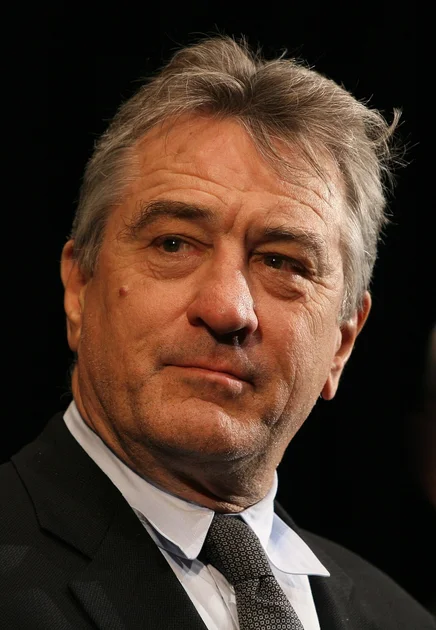
Early Life and Background
Robert De Niro was born on August 17, 1943, in Manhattan, New York City. Raised in the Greenwich Village neighborhood, he grew up in a culturally rich environment that would later influence his artistic sensibilities. His father, Robert De Niro Sr., was an expressionist painter and sculptor, while his mother, Virginia Admiral, was also a painter. Although his parents divorced when he was just two years old, De Niro maintained relationships with both.
Formative Years in Acting
De Niro showed an early interest in performance and began studying acting as a teenager. He trained at the Stella Adler Conservatory and later at the HB Studio under Lee Strasberg, where he was immersed in the Method acting technique — an approach that would become central to his craft throughout his entire career. His dedication to transforming himself physically and psychologically for roles became one of his most recognized professional traits.
Breakthrough Roles and Rise to Stardom
Robert De Niro's career gained significant momentum in the early 1970s through his collaborations with director Martin Scorsese. Their professional relationship became one of the most celebrated partnerships in cinema history.
Collaborations with Martin Scorsese
De Niro first worked with Scorsese on Mean Streets (1973), a gritty portrayal of life in New York's Little Italy. The film established both men as rising forces in American cinema. Their collaboration continued with Taxi Driver (1976), in which De Niro played Travis Bickle, a mentally unstable Vietnam War veteran navigating the dark streets of New York. The role earned him an Academy Award nomination and is widely regarded as one of the greatest performances in film history.
The duo reunited for Raging Bull (1980), where De Niro portrayed boxer Jake LaMotta. For this role, he famously gained over 60 pounds to depict the fighter in his later years. The performance earned him his second Academy Award for Best Actor.
Academy Award Wins
De Niro's first Oscar came in 1975, when he won Best Supporting Actor for his portrayal of the young Vito Corleone in The Godfather Part II (1974), directed by Francis Ford Coppola. This recognition, combined with his later win for Raging Bull, cemented his place among the most accomplished actors of his generation.
Versatility and Career Longevity
Throughout the 1980s and 1990s, Robert De Niro demonstrated a remarkable range across a variety of genres. He appeared in dramatic thrillers such as Cape Fear (1991) and Heat (1995), as well as comedies like Midnight Run (1988) and Analyze This (1999). This versatility helped sustain his relevance in an industry known for short careers.
Transition to Comedy and Producer Roles
In the late 1990s and into the 2000s, De Niro expanded into comedic territory and also took on roles as a producer. He co-founded TriBeCa Productions and later the Tribeca Film Festival in 2002, alongside producer Jane Rosenthal. The festival was established in response to the September 11 attacks, with the goal of revitalizing Lower Manhattan's cultural and economic life.
Recent Work and Continued Recognition
In his later career, De Niro has continued to take on ambitious roles. His performance in Silver Linings Playbook (2012) earned him an Academy Award nomination for Best Supporting Actor. More recently, he starred in Martin Scorsese's The Irishman (2019), a crime epic that received widespread critical acclaim and further demonstrated his enduring capabilities as a performer.
Personal Life and Cultural Impact
Robert De Niro has been married twice. His first marriage was to actress Diahnne Abbott from 1976 to 1988. He later married actress Grace Hightower in 1997, and the couple separated in 2018. De Niro is the father of seven children.
Philanthropy and Entrepreneurship
Beyond acting, De Niro has engaged in several entrepreneurial ventures, including co-owning the Nobu restaurant chain and the Greenwich Hotel in New York City. He has also been involved in various charitable initiatives, including support for arts education and community development programs.
Legacy in American Cinema
Robert De Niro's impact on American cinema is considered profound and lasting. He has appeared in more than 100 films over a career spanning six decades. His approach to character preparation and physical transformation has influenced generations of actors. In 2009, he received the Kennedy Center Honor, and in 2016 he was awarded the Presidential Medal of Freedom, the highest civilian honor in the United States.
His body of work remains a benchmark for dramatic acting, and his name continues to be synonymous with commitment, craft, and cinematic excellence.
Comments