
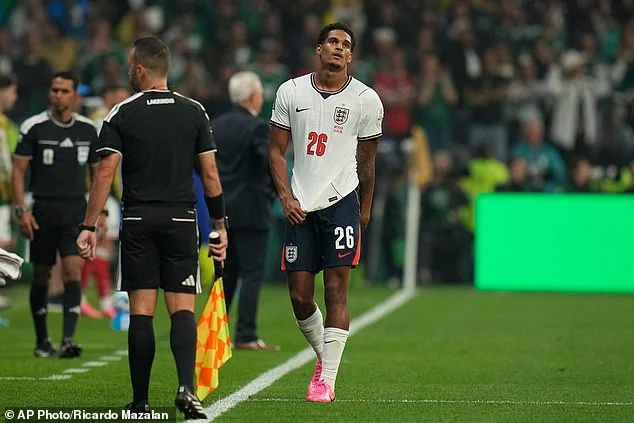
England's World Cup Hopes Dealt Major Blow as Quansah Receives Two-Match Ban
FIFA has officially confirmed that England defender Jarell Quansah will serve a two-match suspension following his red card in the round-of-16 victory over Mexico, a decision that rules the Bayer Leverkusen star out of Saturday's quarter-final against Norway and any potential semi-final appearance. The ban, announced on Thursday, July 9, 2026, has intensified the selection crisis for England head coach Thomas Tuchel, who now faces the prospect of entering the knockout stages without a fully fit natural right-back.
Quansah, 23, was sent off in the 54th minute of England's thrilling 3-2 win over Mexico after a VAR review deemed his challenge on Jesus Gallardo as serious foul play. The independent disciplinary panel, acting under Article 14 of FIFA's code of conduct, imposed an additional match on top of the automatic one-game suspension that accompanies any World Cup sending-off. The ruling means Quansah will miss both the quarter-final clash with Norway and, should England advance, the semi-final against either Argentina or Switzerland. The only scenario in which the defender could feature again in this tournament is if England reach the final in New Jersey on July 19.
FIFA's statement cited Article 10.5 of the tournament regulations and Article 69 of the FIFA Disciplinary Code, confirming that the suspension applies to England's next matches in the competition. The Football Association had been considering an appeal, but under the current rules for the 2026 World Cup, there is no mechanism for teams to contest red card decisions. This has left England with no formal avenue to challenge the severity of the punishment.
Why It Matters: England's Right-Back Crisis Deepens at a Critical Moment
Quansah's absence creates a significant tactical problem for Tuchel, who has relied on the defender as a makeshift right-back throughout the tournament. With first-choice Reece James sidelined since the group stage due to a hamstring injury, Quansah had started two games in that position and had become an integral part of England's defensive structure. His physicality and ability to contribute to both defensive solidity and attacking transitions had made him a key figure in the squad's progression to the quarter-finals.
Now, Djed Spence stands as the only fully fit natural right-back remaining in England's squad. The Tottenham defender has seen limited minutes so far in the tournament and will be thrust into a high-pressure knockout environment against a Norway side that has impressed with their attacking flair. The situation echoes a broader concern about squad depth in critical positions, a weakness that could be exposed as the competition intensifies.
The timing could hardly be worse. England are seeking their first World Cup final appearance since 1966, and the momentum built during the tournament—including a gritty win over Mexico—has galvanized both the squad and the nation. However, the right-back dilemma is not the only headache for Tuchel. The ban also disrupts the team's defensive chemistry, which had been improving after a shaky start to the group stage.
The Balogun Controversy: A Shadow Over FIFA's Consistency
The Quansah ban has reignited a fierce debate about FIFA's disciplinary consistency, particularly in light of the controversial decision to allow United States forward Folarin Balogun to play in the round of 16 against Belgium. Balogun had been sent off for serious foul play against Bosnia and Herzegovina and, under normal circumstances, would have faced a two-match ban identical to Quansah's. However, FIFA took the extraordinary step of suspending Balogun's one-match ban for 12 months, citing a little-known clause that allows for a suspension of disciplinary action under "specific circumstances."
The decision came after U.S. President Donald Trump personally called FIFA president Gianni Infantino to request a review. Trump later publicly admitted to the intervention, and the Belgian FA formally challenged Balogun's eligibility, arguing the move undermined the integrity of the competition. The United States went on to lose 4-1 to Belgium, but the damage to FIFA's credibility had already been done.
England boss Thomas Tuchel did not hide his frustration, criticizing FIFA's inconsistent approach. "Who overturns a red card for one nation but not another?" he asked in the aftermath of the Mexico match. "We have to accept the rules, but the rules should be applied equally." The German coach's comments reflect a growing sense of unease among participating nations about the influence of political pressure on sporting governance.
France also felt the sting of FIFA's inconsistency. The French Football Federation had appealed to have Michael Olise's yellow card overturned, fearing it would rule the star winger out of a potential semi-final, but that request was firmly rejected. The optics of allowing a U.S. player to escape suspension while punishing England and France have fueled accusations of preferential treatment toward the host nation.
No Appeal, No Mercy: The Rigid Framework of FIFA's Disciplinary Code
One of the most striking aspects of the Quansah case is the absence of any formal appeals process for red cards at the World Cup. Article 10.5 of the tournament regulations states that a sending-off automatically triggers a suspension, and the disciplinary committee's decision on the length of the ban is final. This rigidity has drawn criticism from multiple quarters, particularly after the Balogun situation demonstrated that FIFA does have the flexibility to alter punishments when it chooses to.
England had explored the possibility of appealing the two-game ban, arguing that the challenge might have been over-punished. TV replays showed Quansah's studs catching Gallardo's shin, but some pundits suggested the contact was not malicious and that the player had attempted to pull out of the tackle. However, without a formal appeals mechanism, the FA's hands were tied.
The lack of transparency around how FIFA reached its decision has only added to the controversy. In Balogun's case, the organization issued an 871-word statement claiming it had considered "all of the specific circumstances surrounding the incident and evidence available," but offered no concrete details about what those circumstances were. No such statement has been issued for Quansah, leaving many to wonder why one player received leniency while another faces the full force of the rules.
Broader Implications: Integrity, Politics, and the Future of World Cup Governance
The Quansah ban, set against the backdrop of the Balogun affair, raises fundamental questions about the integrity of World Cup disciplinary procedures. Football has long prided itself on being a meritocracy, where results on the pitch determine success. But when political interventions can alter the course of player availability, the line between sport and diplomacy becomes dangerously blurred.
Infantino, already under fire for his close relationship with Trump and his extensive travel during the tournament—clocking nearly 50,000 miles—now faces calls for his resignation from several European federations. The Belgian FA has been particularly vocal, accusing FIFA of "defending football in general — its integrity and credibility" by allowing external pressure to dictate internal rules. The fact that Balogun's ban was suspended only after a presidential phone call has created an unsavory precedent that could undermine confidence in future tournaments.
For England, the immediate concern is pragmatic: how to replace Quansah and maintain momentum. But the broader implications extend beyond this World Cup. If FIFA continues to apply its disciplinary code unevenly, it risks eroding the trust that players, coaches, and fans place in the institution. The game's governing body must find a way to restore consistency, whether through a transparent appeals process or by publishing detailed reasoning for all disciplinary decisions.
What Comes Next: England's Path Without Quansah
As England prepare for the Norway quarter-final, Tuchel must urgently reconfigure his defense. Spence is the natural replacement, but the manager could also consider shifting to a back three, using wing-backs to provide cover. Midfielders like Trent Alexander-Arnold, though not in the squad, have been suggested as potential alternatives, but the current pool is limited.
The quarter-final against Norway, who knocked out Denmark in the round of 16, will be a stern test. Norway's attacking threat, led by Erling Haaland and Martin Ødegaard, will target England's right flank. Without Quansah's athleticism and defensive awareness, the backline will need exceptional organization and communication.
Should England advance, they would face either Argentina or Switzerland in the semi-final—both formidable opponents. The possibility of reaching the final without a specialist right-back is daunting, but Tuchel's tactical acumen and the squad's resilience have already been proven during this campaign.
A Tournament Marred by Controversy
The 2026 World Cup, co-hosted by the United States, Canada, and Mexico, was supposed to be a celebration of football's global reach. Instead, it has been overshadowed by off-field disputes that have damaged the sport's reputation. From the Balogun saga to the Quansah ban, the narrative has shifted from athletic achievement to administrative chaos.
Football fans around the world are left wondering: is the playing field truly level? Or are the rules applied differently depending on who is asking? For England, the focus remains on winning matches, but the questions raised by this controversy will linger long after the final whistle.
For further reading on how political influence has shaped major sporting events, see Chris Packham on Evolution: New BBC Series Aims to Rewrite Natural History TV, which explores the intersection of media, politics, and public perception.
In other football news, Celtic Go All Out for Kieron Bowie as Verona Slaps £13m Price Tag on Striker highlights the transfer market dynamics shaping club football.
Comments