
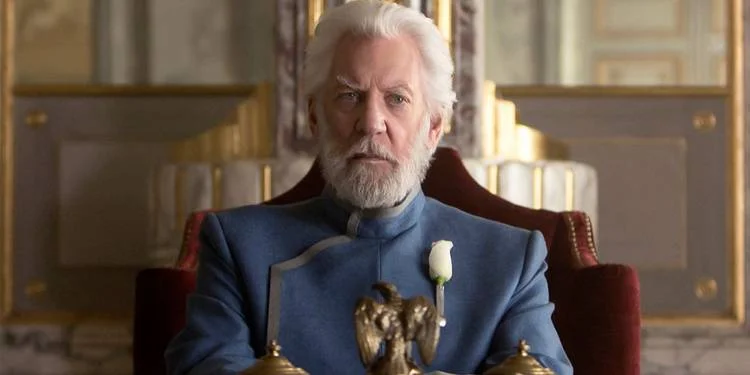
President Snow in the Spotlight as 'Sunrise on the Reaping' Hits Theaters
The character of President Snow is once again at the center of pop culture conversation as The Hunger Games: Sunrise on the Reaping continues its theatrical run. The film, which adapts Suzanne Collins's 2025 novel about Haymitch Abernathy's victory in the 50th Hunger Games, has sparked discussion over a deleted scene, a newly added character moment, and actor Glenn Close's revelations about her character's romantic history with Snow.
According to Creepy Catalog, the film adaptation leaves out a crucial sequence from the book: a celebration at Snow's mansion where the newly crowned victor is locked in a golden birdcage suspended from a chandelier. In the novel, Haymitch is displayed while party guests take pictures and offer him food through the bars. The scene underscores Snow's control over the victors and the vulnerability of Haymitch's loved ones, whom Snow can reach in District 12. The film instead moves from Haymitch's interview with Caesar Flickerman directly toward his homecoming, omitting the extended aftermath and the psychological weight of the cage. While the birdcage scene is absent, the film does add a significant moment between Snow and Haymitch that was not in the book, as director breaks down in an interview with Yahoo News Canada. In this new scene, Ralph Fiennes's Snow directly names Lucy Gray Baird while warning Haymitch about Covey girls, asking if people still speak of her and concluding, "She could have had everything." This explicit reference to the protagonist of The Ballad of Songbirds and Snakes deepens the connection between Snow's past and his present cruelty, a link that was only oblique in Collins's novel, per SlashFilm.
Glenn Close Reveals Drusilla Sickle's Romantic Past with Snow
Adding to the Snow-centric news cycle, Glenn Close—who plays Capitol chaperone Drusilla Sickle—joked with Ralph Fiennes at the New York premiere on November 16 about their characters' supposed romantic history. In a Yahoo Entertainment report, Close asked Fiennes what his character thinks of Drusilla, and Fiennes replied, "Do you think they've had a thing? They had a thing." Close agreed, saying she was too old for him and moved on, while Fiennes joked he couldn't keep up. Close described Drusilla as "vile" and "corrupt," a drunk who has been doing her job for 25 years and hates the tributes. This improvised backstory, though not canon, adds a new layer to Snow's personal history and the Capitol's decadence.
Why President Snow Remains Central to the Franchise
President Snow has been the defining antagonist of the Hunger Games series since the original trilogy, and the recent prequels have only expanded his role. The Ballad of Songbirds and Snakes (2023) explored his origins as a young man, while Sunrise on the Reaping shows him in middle age, already the ruthless leader who will later terrorize Katniss Everdeen. The decision to cut the birdcage scene removes a visceral metaphor for his control, but the added Lucy Gray reference compensates by tying his personal loss to his political paranoia. The film's box office performance and fan reactions suggest that audiences remain fascinated by Snow's evolution. The inclusion of Drusilla Sickle, played by Close, also introduces a new Capitol figure whose relationship with Snow, as invented by the actors, hints at the corruption and moral decay of the Capitol elite.
A Villain in the News
Beyond the film, the character's name has appeared in headlines, though not in a political context. The topic "president snow" is currently trending, driven entirely by entertainment coverage. This resurgence of interest aligns with the franchise's strategy of expanding its lore through prequels and interconnected stories. As the Hunger Games universe grows, Snow remains the connective tissue, linking the distant past of Panem to the events of the original series.
What This Means for the Franchise and Its Fans
The continued focus on President Snow underscores the franchise's shift toward exploring the villains and the systems that create them. By cutting the birdcage scene, the film may have softened the depiction of Snow's cruelty, but the added Lucy Gray moment and the actors' playful backstory keep his character complex and menacing. Fans who have followed the series since the beginning will appreciate the Easter eggs, while newcomers get a clearer picture of Snow's motivations. The debate over the deleted scene also highlights the challenges of adapting a beloved novel, where every omission can spark discussion. As Sunrise on the Reaping continues its run, President Snow's presence—both on screen and in interviews—reminds audiences why he is one of modern fiction's most enduring antagonists.
Comments