
Pete Golding's Ole Miss Era Begins With Playoff Expectations and a Complicated Past
OXFORD, Miss. — When Pete Golding leads No. 10 Ole Miss onto the field Sunday night against Louisville at Nissan Stadium, it will mark the culmination of an improbable journey — one that began with him trying to convince his predecessor not to leave.
The Rebels' season opener against the No. 24 Cardinals (6:30 p.m. CT, ABC) is the only ranked matchup of Week 1, and it sets the stage for Golding's first full season as a head coach after he spent years as a defensive coordinator under Lane Kiffin.
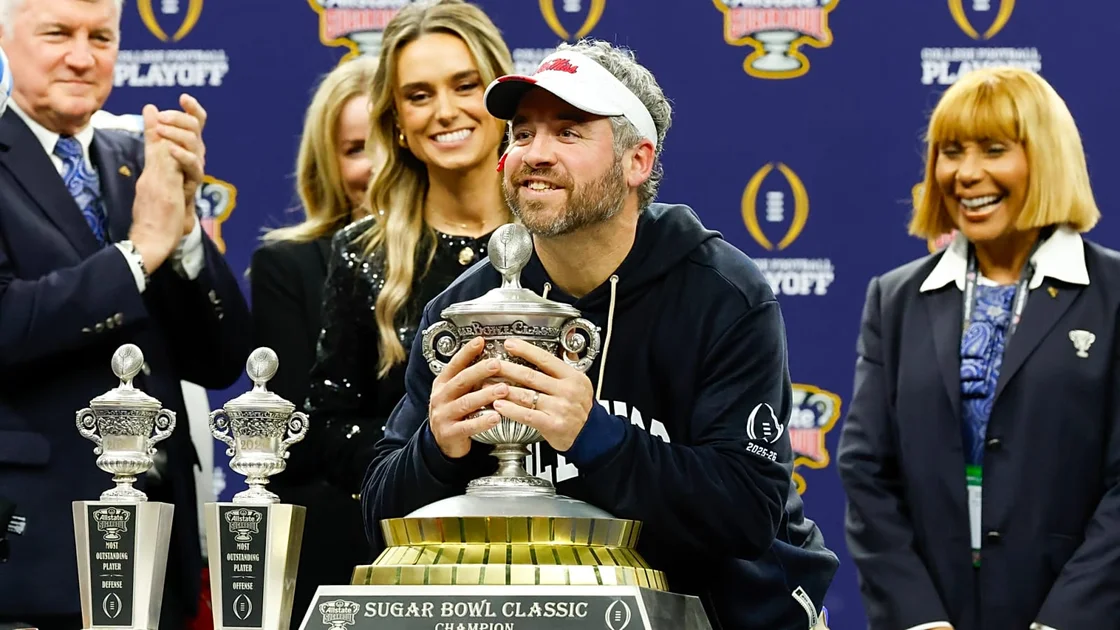
Golding was thrust into the top job on Nov. 30, 2025, when Kiffin stunned the program by departing for LSU just as Ole Miss was on the verge of a College Football Playoff berth. Yet what could have been a disruptive transition turned into an unexpected run: Golding led the Rebels to two playoff wins — a 41-10 victory over Tulane and a 39-34 Sugar Bowl triumph over Georgia — before falling 31-27 to Miami in the Fiesta Bowl semifinal.
Now, with a full offseason to implement his vision, Golding faces perhaps the defining question of his tenure: Can he keep Ole Miss out from under the massive shadow Kiffin left behind? The answer will begin to unfold in Nashville.
A Reluctant Head Coach and a Heated Plea to Kiffin
Golding's path to the head coaching role was unconventional — and, by his own admission, initially unwanted.
In the days before Kiffin's departure, Golding huddled with his boss deep into the night inside Ole Miss' football facility. He was convinced that their partnership — much like the Clemson teams of the 2010s, with a dynamic head coach and two coordinators content in their roles — had captured lightning in a bottle. And he feared Kiffin's move to LSU would shatter it.
"I was telling him, 'You're a f—ing idiot if you leave,'" Golding told ESPN. "I thought I could convince him to stay. And then it got real."
That raw, profane plea encapsulated the bond the two men had built. Golding, who cut his teeth in Division II before becoming Alabama's defensive coordinator, joined Kiffin at Ole Miss in 2023. Their collaboration produced a top-tier defense and a program that reached the cusp of national prominence.
But Kiffin chose Baton Rouge, lured by the prestige of an SEC West powerhouse. Golding, meanwhile, was suddenly the man in charge — a role he never actively sought despite his deep ties to the program.
"You can say it was a great year, but when you're that close and you didn't play well, and if you'd played well you could've played in the next one and then … who knows?" Golding reflected, acknowledging the sting of the Fiesta Bowl loss.
Sustaining Momentum: Golding's Challenge Beyond One Season
The immediate success Golding enjoyed in the playoff — winning two games after taking over on short notice — masked a larger challenge. Interim coaches often thrive on emotion, but sustaining that level demands a program-building acumen that goes beyond a single January run.
Golding has spent the offseason trying to make that clear.
"You can't lose that feeling," Golding said. "F— that. You need to feel that every morning when you get up. And are you doing what it takes to not feel that again?"
That fiery rhetoric has characterized his first full offseason, marked by a trip to SEC Media Days in Tampa and a steady drumbeat of messaging about maintaining Ole Miss' place among the sport's elite. The Rebels enter 2026 with a roster that returns several key contributors from last year's playoff squad, and they are ranked No. 9 in the preseason polls — one spot ahead of the Cardinals.
The Louisville game itself carries its own intrigue. The Cardinals feature junior quarterback Lincoln Kienholz, a transfer from Ohio State who was a top-100 recruit in the 2023 class. With limited college tape available, Golding has had to blend evaluations of Kienholz's high school film with his play at Ohio State and an assessment of Cardinals coach Jeff Brohm's tendencies with first-year starters.
"I think it's a combination of both those," Golding said Monday when asked about scouting Kienholz. "Obviously from an athletic standpoint, skill set standpoint you're looking at previous tape where you actually get to see him play the game. 'Is he a dual-threat guy?' and arm strength and all those types of things. But I think also you go back 'Okay, when Brohm's had a first-year starter at the position, what's that kind of look like early in the season? Is it the full menu for them?'"
Kiffin's Shadow Looms, but Golding Carves His Own Path
For all the attention on his relationship with Kiffin, Golding is now determined to be his own man. The two remain friendly — Kiffin's LSU debut was marred by delays and drama in Week 1, while Golding watched from Oxford — but their paths have diverged.
Golding's arrival as head coach came with a unique twist: he was elevated from defensive coordinator, not brought in as a fresh face or an offensive guru. That background has shaped his approach, emphasizing defensive discipline while trusting new offensive coordinators to handle that side of the ball.
The early returns have been promising. The Rebels won two playoff games under him, and their culture appeared stable enough to avoid a roster exodus during the transition. Yet the broader college football landscape is unforgiving: programs that flirt with the playoff one year can plummet to mediocrity the next if they fail to adapt.
What this changes is the perception of Ole Miss itself. For years, the program was synonymous with Kiffin's personality — brash, unpredictable, and occasionally controversial. Under Golding, there is a quieter intensity. He has replaced the bombast with a workmanlike demeanor, but he still swears like a coordinator who has spent decades in locker rooms.
The test Sunday night will be less about X's and O's and more about whether that intensity translates to sustained success. If Golding can guide the Rebels back to the playoff — or even merely keep them in the conversation all season — he will have answered the question that has followed him since November: Was he ready to be a head coach, or was Kiffin's shadow simply too large to escape?
As he told ESPN, the stakes are personal.
"I thought I could convince him to stay," Golding said of that fateful night. "And then it got real."
What became real now belongs to Golding alone. The shadow is still there, but on Sunday night in Nashville, he takes the first significant step toward stepping out of it.
For more on the college football landscape and potential coaching moves, check out our analysis of Shelton's Raw Talent Meets Grunt Controversy in US Open Run — a reminder that athletic excellence often comes with its own set of distractions.
Comments