
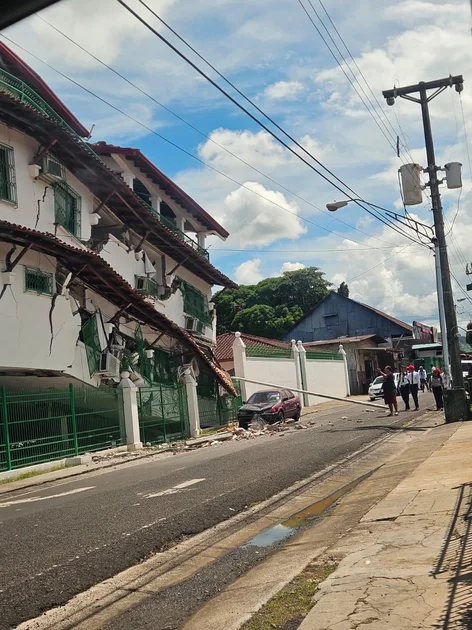
Panama Earthquake: 7.7 Magnitude Tremor Shakes Nation, Tsunami Threat Lifted
A powerful magnitude 7.7 earthquake struck southern Panama on Friday, October 9, 2026, sending thousands into the streets, damaging buildings, and briefly triggering tsunami warnings across the region. The quake, which occurred shortly before 1 p.m. local time, was centered 12 km west-southwest of Pitaloza Arriba, according to the U.S. Geological Survey (USGS). It struck at a depth of 12.6 km and lasted about a minute.
Key Facts
- Magnitude: Initially reported as 8.0, later revised to 7.7 by USGS; some sources cited 7.6.
- Epicenter: Near Pitaloza Arriba, in sparsely populated southern Panama, about 200 km from Panama City.
- Aftershocks: More than 45 aftershocks recorded, including a 6.6 near Rio Grande and a 5.8 near El Cacao.
- Casualties: No immediate reports of deaths, but damage was widespread.
- Government response: All administrative offices and schools suspended operations; President Jose Raul Mulino called it a "major disaster."
- International aid: U.S. Secretary of State Marco Rubio said the U.S. is mobilizing resources at Panama's request.
Context: Damage and Disruption Across Panama
The earthquake caused significant damage in several provinces, particularly Cocle, where the town of Penonome saw a collapsed cathedral and damaged government buildings. In Panama City, skyscrapers swayed, and residents evacuated in panic. Videos on social media showed water cascading from a rooftop pool of a high-rise and a bridge over the Panama Canal shaking violently.
"We are facing a major disaster," President Mulino said, adding that some roads had "completely collapsed." Local reports described scenes of chaos, with traffic snarls as office workers struggled to get home. Juana Alveo, a cashier in Penonome, recounted, "It was horrible, like nothing we ever experienced. My daughter was trapped in school."
Tsunami Threat and Aftershocks
Initially, the U.S. Tsunami Warning System issued a potential tsunami threat for nine countries: Costa Rica, El Salvador, Peru, Mexico, Guatemala, Panama, Nicaragua, Colombia, and Ecuador. The threat was later narrowed to Panama and Ecuador before being lifted entirely. No tsunami waves were reported.
The constant aftershocks—more than 45 by Saturday morning—kept residents on edge. Seismologists at the University of Panama recorded several strong tremors, including magnitudes 5.8, 5.5, and 5.2. The Panamanian government urged caution as authorities assessed the damage.
Perspective: A Nation on Edge
While Panama is no stranger to seismic activity, this earthquake is among the strongest in recent memory. The country sits near the boundary of the Caribbean and South American plates, making it vulnerable to quakes. The 7.7 magnitude event is comparable to the 1991 Limon earthquake in Costa Rica (7.7) and the 2017 Chiapas earthquake in Mexico (8.2). However, Panama's relatively sparse population in the epicentral region may have limited casualties.
The economic impact could be significant. The Panama Canal, a vital global shipping route, reported normal operations, and the Cobre Panama copper mine also continued working. Tocumen International Airport lifted a temporary flight suspension. But the damage to infrastructure, especially in Cocle province, may take weeks to repair.
Regional and International Response
U.S. Secretary of State Marco Rubio expressed solidarity: "The United States stands with the people of Panama. At the request of the Panamanian government, the State Department is rapidly mobilizing resources and personnel to assist." Panama's National Civil Protection System (SINAPROC) said it is not currently seeking international help but is evaluating the situation.
The earthquake also disrupted sports: a women's friendly football match between Panama and New Zealand was cancelled. The Football Ferns, New Zealand's team, were staying in Panama City.
What's Next?
As aftershocks continue, Panamanian authorities are working to restore normalcy. The full extent of the damage is still being assessed, but initial reports suggest that while buildings collapsed, the nation may have escaped widespread destruction and deaths. President Mulino has pledged to rebuild, and international support is on standby.
For now, residents remain cautious, with many choosing to sleep outdoors. The coming days will reveal the true toll of this powerful tremor.
This is a developing story. Check back for updates.
Comments