
Oppo's Most Ambitious Flagship Hits the Global Stage
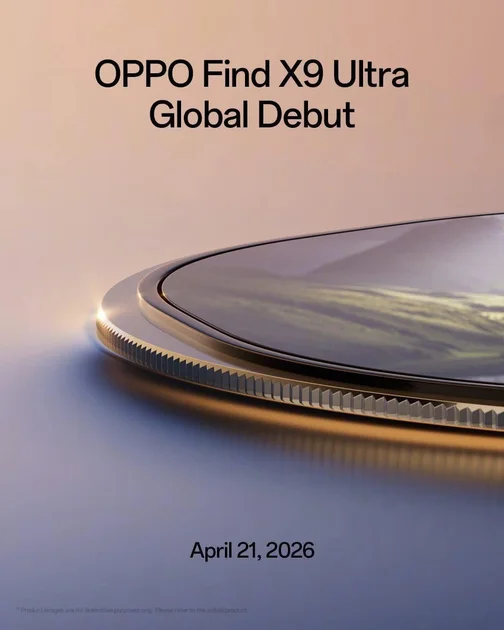
April 21, 2026 marks the official global launch of the Oppo Find X9 Ultra, the Chinese smartphone maker's most spec-heavy flagship to date. Following weeks of controlled teasers and Weibo posts confirming individual features, Oppo is pulling back the curtain completely at a dedicated launch event scheduled for 19:00 local time. The device had already stirred considerable excitement among photography enthusiasts and Android fans alike — and the confirmed specs make it clear that Oppo is swinging for the top of the ultra-premium segment.
The headline feature is undoubtedly the camera system. The Find X9 Ultra is built around a 200-megapixel Sony LYT-901 main sensor measuring 1/1.12 inches — which Oppo claims is the largest 200MP sensor ever fitted into a smartphone. That primary shooter is complemented by a dual-periscope arrangement and, in total, four physical rear cameras. Oppo and Hasselblad have co-developed what they market as an "8 Pro Lenses" system, covering focal lengths from 14mm ultrawide all the way to a 460mm equivalent using a five-reflection periscope architecture. The result is a continuous optical-quality range that includes 23mm, 47mm, 70mm (3x zoom), 139mm, 230mm (10x zoom), and 460mm (20x) focal equivalents. Software muscle comes in the form of Hasselblad Master Mode 2.0, which promises a 16EV dynamic range and RAW MAX support across every focal length.
Beyond the Lens: Core Hardware That Backs Up the Hype
The camera story is just the beginning. Oppo has confirmed that the Find X9 Ultra runs on Qualcomm's Snapdragon 8 Elite Gen 5 chipset, paired with Oppo's proprietary Tide Engine to maintain 144Hz performance in demanding mobile game genres including MOBA and tactical FPS titles. The 6.82-inch display is built from X3 luminescent material, hits a peak brightness of 3,600 nits HDR, and drops as low as 1 nit for low-light environments — a feature that has become increasingly standard at the ultra tier but is executed at a high level here.
Perhaps the most striking hardware spec outside of the camera is the battery. The Find X9 Ultra carries a 7,050mAh "Glacier Battery" built with a self-developed spherical silicon-carbon anode material and backed by a proprietary energy-concentrating chip. It supports 100W SUPERVOOC wired charging and 50W wireless charging. Oppo also touts an industry-first encapsulated thermal unit designed to manage heat during extended high-resolution video recording sessions. Rounding out the feature set are IP66, IP68, and IP69 ratings for dust and water resistance, satellite connectivity for calls and texts in areas without cellular coverage, dual symmetrical speakers, a bionic vibration motor, and crystal shield glass — all of which have cleared a Swiss SGS five-star drop and shock resistance certification.
Why the Find X9 Ultra Matters in a Crowded Market
The ultra-premium Android smartphone segment in early 2026 is fiercely contested. Samsung's Galaxy S26 Ultra, Xiaomi's 17 Ultra with optional Leica branding, and Vivo's X300 Ultra have all arrived in the same crowded window. Oppo's Find X9 Pro — the previous generation — was already regarded as a capable, camera-first device, but it relied on a MediaTek Dimensity 9500 chipset. The jump to Snapdragon 8 Elite Gen 5 in the Ultra signals a deliberate move to compete directly with the most powerful Android hardware available.
The Hasselblad Partnership and the "8 Lenses" Marketing Debate
Oppo's co-branding with Hasselblad continues to be a differentiating card in a market where Sony partnerships (Xperia) and Leica tie-ups (Xiaomi) have become common currency. The design language reinforces the collaboration: the hexagonal camera module housing is a nod to Hasselblad's camera history, with knurled metal edges that improve grip during handheld shooting. Oppo and Hasselblad have also introduced an "Earth Explorer Kit" — an optional camera grip accessory equipped with a zoom lever, a more restrained take on the physical controls seen on some rival flagships.
However, the "8 Pro Lenses" marketing angle has drawn scrutiny. The device physically has four camera sensors; the additional "lenses" are derived from sensor crops and software-defined focal lengths — a strategy previously used by Apple for its Pro iPhones, where Cupertino counted cropped sensor outputs as distinct "lenses" to expand its marketing numbers. That move drew considerable criticism at the time, and Oppo now faces the same debate. Whether the image quality justifies the nomenclature will ultimately be decided by reviewers and consumers. The design comes in two colorways: Canyon Orange, with a textured finish inspired by the Grand Canyon, and Tundra Umber, which channels Scandinavian minimalism and draws direct inspiration from Hasselblad's X2D camera body.
What the Find X9 Ultra Signals for Flagship Smartphone Trends
The Find X9 Ultra's arrival encapsulates several converging forces shaping the high-end smartphone market in 2026. Battery capacity has quietly become a key battleground: the 7,050mAh cell dwarfs what was considered flagship-standard just two years ago, and it reflects growing consumer demand for all-day — and potentially multi-day — endurance without sacrificing performance. Silicon-carbon battery chemistry is rapidly displacing older lithium-ion formulations across the Android ultra tier, and Oppo's implementation here is among the most advanced yet publicly detailed.
The camera arms race, meanwhile, shows no sign of slowing. Dual-periscope telephoto systems and triple-digit megapixel sensors are becoming table stakes rather than differentiators, pushing brands to layer on software innovation — AI-enhanced modes, extended dynamic range, RAW capture pipelines — to justify flagship pricing. Oppo's use of Hasselblad's color science and the Hasselblad Master Mode 2.0 processing stack represents an attempt to offer a qualitative leap, not just a quantitative one.
This dynamic has broader implications for the chip industry as well. The migration of ultra-premium Android handsets to the latest Snapdragon silicon reflects Qualcomm's deepening grip on the top end of the market — a trend explored in detail when examining Nvidia's Expanding Empire: From AI Chips to Quantum Computing and Edge Partnerships, where the appetite for more capable silicon across consumer and enterprise devices is reshaping the competitive landscape.
Pricing and regional availability details are expected to be confirmed at today's launch event. The Find X9 Ultra will launch alongside the Find X9s Pro, though global rollout timelines beyond China have not yet been formally announced.
Comments