
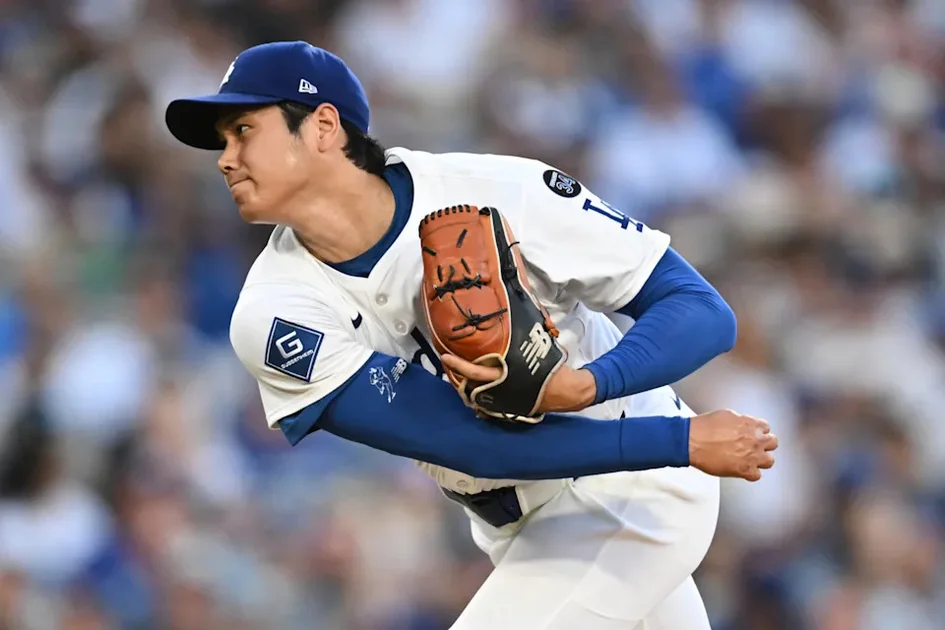
Ohtani Resumes Throwing, But a Return to the Mound Remains a Waiting Game
Shohei Ohtani took a significant step forward on Saturday, playing catch for the first time in two weeks. The session, which began with plyometric drills and progressed to throws from 90 feet, marks the beginning of a carefully managed progression aimed at getting the two-way star back on the pitcher's mound. The Los Angeles Dodgers' 2-1 victory over the Arizona Diamondbacks was secondary to the sight of their franchise player entering the next phase of his rehabilitation.
Ohtani was shut down indefinitely in late July due to continued soreness and inflammation in his left knee, an issue that also contributed to a problem in his left biceps following a bullpen session on July 22. His last game appearance as a pitcher came on July 3, when he threw 110 pitches over six innings against the San Diego Padres, allowing three runs and striking out nine. The forced layoff has been a period of careful rest, but Ohtani's return to flat-ground throwing signals that a long and methodical road back to game action has officially begun.
"It's getting pretty good day by day," Ohtani told reporters through interpreter Will Ireton. "It's hard to tell at this point what the schedule is going to look like. Rather than rush the progression of this, I would rather make sure we're headed in the right direction. But making sure we're taking the right steps."
A Season of Two Halves
Before the shutdown, Ohtani was pitching at an elite level. In 14 starts this season, he posted a 1.79 ERA with 95 strikeouts across 85 2/3 innings. Despite the injury, his offensive production has remained solid. In July, he slashed .273/.330/.557 with six home runs, seven doubles, and 17 RBIs, continuing to be a central force in the Dodgers' lineup even as his pitching workload was curtailed. The contrast between his dominant performances on the mound and the careful, methodical pace of his recovery highlights the delicate balance the team must strike with their most valuable asset.
The Dodgers, however, are not putting a timeline on his return. Manager Dave Roberts emphasized a cautious approach, noting that the team is not concerned about a specific date in the regular season but is more focused on ensuring Ohtani is healthy and effective for the postseason. "Any inning, any innings we get from him are bonuses, given he's a two-way player," Roberts said. "So I think whether it's one inning, two innings, three innings, I'm not too concerned about the timeline."
The Skubal Factor: A Trade That Changes the Calculation
The Dodgers' acquisition of left-handed ace Tarik Skubal before the trade deadline adds a new layer of context to Ohtani's recovery. With Skubal anchoring the rotation, the pressure to rush Ohtani back to the mound has theoretically lessened. However, the organization maintains that the trade has had zero impact on their plan for Ohtani.
"We're still planning on getting Shohei built up. So I think with regards to Shohei, I really don't think it has any impact," Roberts recently said. "We have a plan to build him slowly and methodically, and that would've happened if this trade happened or not. Where we're at right now, we've got to get going. So it's not a matter if he can take down innings and buy us some more time. It certainly makes us better, but I think with regard to Shohei, the plan is the plan."
This stance is echoed by the front office. Andrew Friedman, president of baseball operations, expressed strong confidence that Ohtani will pitch again this season. "We're as confident as we can be that he's going to be back and he's going to start throwing sooner to build back up," Friedman said. "Can never perfectly predict the future, but if you said, 'Hey, place a bet on it,' I would be very confident placing it that he will be back pitching."
The Luxury of Depth
The addition of Skubal provides a safety net that allows the Dodgers to be especially patient. Rather than rushing Ohtani back for a critical regular-season start, the team can afford to have him work through his progression at a glacial pace. This calculated approach gives Ohtani the time to rebuild arm strength and ensure his knee responds to the increased workload. The goal, as Roberts indicated, is to have Ohtani available in October, even if it's in a reduced role. The Dodgers' deep rotation, now bolstered by Skubal, offers a clear path to that objective without sacrificing wins in the short term.
A New Economy of Fandom: The $85 Shuttle Ride
As Ohtani works his way back physically, his cultural and economic impact on the sport has never been more pronounced. The "Shohei Ohtani Economy" has spawned an entire tourism ecosystem. Japanese travel agency JTB, the Dodgers' "official Japanese tourism partner," has launched a shuttle service that transports fans from a downtown Los Angeles hotel to Dodger Stadium for $85 for the two-mile trip. The price is a premium for the experience: a VIP ride with a bilingual guide, a direct door-to-door service for fans who have traveled thousands of miles to see Ohtani play.
"Some people go to Disneyland and Universal Studios," said Masakazu Nakafuji, JTB's general manager for their New York office. "Mainly, people want to see the Dodgers for three straight days at Dodger Stadium."
The shuttle service is an extension of JTB's larger tour packages, which include game tickets, hotels, and transportation. For Japanese fans like Tsutomu and Sayuri Ichikawa from Tokyo, who wore his and hers Roki Sasaki jerseys on a recent trip, the shuttle offered a familiar and comfortable way to get to the ballpark. The couple first visited in May on a JTB tour and came back for six more games on their own, using the shuttle as their reliable mode of transport.
This phenomenon underscores how Ohtani has transformed the Dodgers into a global destination franchise. His presence has not only filled seats at Dodger Stadium but has also created a niche economy for travel companies, hotels, and shuttle services, all catering to an international audience eager for a glimpse of one of baseball's most transcendent talents.
The Pilgrimage Factor
For many Japanese fans, seeing Ohtani and fellow countryman Roki Sasaki is a once-in-a-lifetime pilgrimage. The JTB shuttle, while expensive, is a small price for the convenience and security it offers to travelers navigating a foreign city. On the bus, a woman named Colleen and her 8-year-old son, dressed in an Ohtani jersey, were among the passengers, illustrating the draw that extends beyond Japanese borders. The shuttle is a microcosm of the broader trend: Ohtani is not just a baseball player; he is a cultural ambassador who has made the Dodgers a must-see act for tourists worldwide. This demand has created a direct economic ripple, turning a routine two-mile stadium approach into a premium, curated experience.
The NL MVP Race Suddenly Has a Door Ajar
While the Dodgers focus on October, Ohtani's injury on the pitching side has opened a fascinating narrative in the National League MVP race. Before his shutdown, Ohtani was the undeniable favorite, on pace to potentially win his third MVP award with a historic two-way campaign. However, with his pitching future for 2026 now uncertain, the race is no longer a foregone conclusion. Voters, who have historically valued Ohtani's unique two-way production, may now place more weight on his offensive numbers alone, which, while excellent, are not as historically unprecedented as they were when paired with his Cy Young-caliber pitching.
The door has swung open for other standout performers in the NL. The field is crowded with elite offensive seasons from players on contending teams, and with Ohtani's pitching workload for the remainder of the season in doubt, the award becomes a more traditional debate about hitting, fielding, and baserunning. Ohtani's ability to change the narrative with a late-season surge or a triumphant return to the mound in September will be a key storyline. His status as the reigning MVP and his standing in the court of public opinion remain high, but the argument for his candidacy has undeniably shifted. He will now need to either hit at an unprecedented pace for the rest of the year or make a highly impactful, albeit brief, return to the mound to secure his place atop the ballot once more.
The Dodgers, for their part, are less concerned with individual accolades and more focused on the team's ultimate prize. With the acquisition of Skubal and a roster built for a deep playoff run, the franchise has its sights set on a World Series title. The health of their superstar is the most significant variable in that equation, and the team's cautious approach to his rehabilitation signals that they are prioritizing long-term success over short-term gains.
The Road Ahead: Slow and Steady
Ohtani's immediate path is clear: he will continue to stretch out his throwing distance on flat ground, progress to mound work, throw bullpen sessions, and then face live batters in simulated games. Each step will be a test for his left knee, which has been the root cause of his current predicament. The plan is to incrementally increase intensity while monitoring for any signs of inflammation or discomfort.
Roberts hinted that if Ohtani does return during the regular season, his role would be greatly restricted, perhaps as an opener. "I think that's all contingent on his buildup," Roberts noted. "I think the thing is, obviously, we're not going to have that luxury of the rehab situation, so I think it's going to look a little bit like we did last year. So go from there and then once we get to a point in the middle of September, we'll have a better idea of what it looks like."
A Different Postseason Picture
The Dodgers are preparing for a version of October that may not feature Ohtani as a six-inning starter. The plan seems to be leaning towards a more strategic, bullpen-heavy approach where Ohtani could be deployed in a high-leverage role, perhaps as a multi-inning weapon out of the bullpen or an opener who gets one or two innings before the relievers take over. This is a significant shift from his typical routine as a starting pitcher, but it would provide the team with a potent weapon in a more controlled environment. As Friedman stated, the toughest decisions will be welcome ones, as they would mean a healthy and productive Ohtani is available when it matters most. The organization is betting on a slow, steady climb back to health, with the ultimate prize being a fully operational, two-way phenom leading them through the gauntlet of the postseason. The countdown to October has already begun, and every throw Ohtani makes brings the baseball world one step closer to seeing if one of its greatest talents can once again defy expectations on the biggest stage.
Comments