
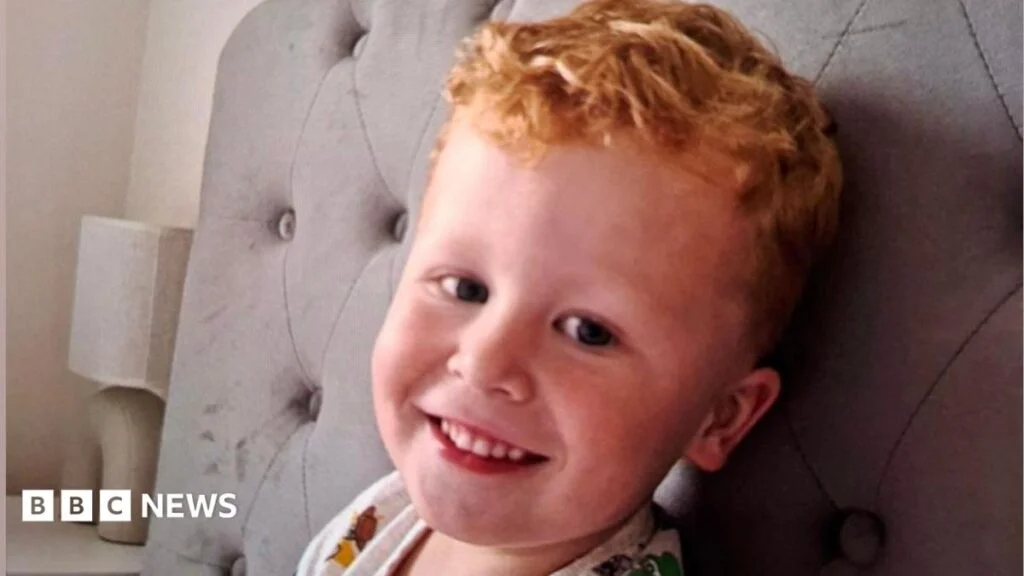
Inquest Details Final Moments of Three-Year-Old Noah Woods
An inquest into the death of three-year-old Noah Woods has revealed that the toddler left a playground through a gap in a fence before he was found dead in a nearby pond, according to testimony heard in Ipswich on Friday. Noah, from East Bergholt, Suffolk, disappeared from an under-fives play area in Merriam Close, Brantham, on the afternoon of 15 September while being looked after by relatives as part of a normal routine.
Detective Chief Inspector Matthew Connick told the hearing that CCTV footage first showed Noah playing with a relative at 2:13pm, with the last sighting of him playing at 2:37pm. The motion-activated cameras did not provide continuous footage. According to Connick, Noah "left through a gap in the fence leading to the memorial garden where he left through an open gate" before heading in the direction of Decoy Pond. A relative followed closely and called out after him, but Noah moved out of sight approximately 200 metres away, and the alarm was raised.
Search Effort and Discovery
A large-scale search operation was launched, involving Suffolk Police, helicopters, the coastguard, fire crews, and search-and-rescue volunteers, alongside about 1,300 members of the public. Many searched through the night, checking fields, gardens, sheds, and woodland. Police noted that Noah was non-verbal, partially deaf, and undergoing assessment for autism, meaning he was unlikely to respond if his name was called. Residents were asked to physically check outbuildings and gardens rather than simply shout for him.
Metropolitan Police divers recovered Noah's body from Decoy Pond on the afternoon of 16 September. Connick said the body was found about five metres from the bank, caught in submerged tree roots, where the water depth was estimated at 1.8 metres. Paramedics confirmed death at 4:31pm. Charlie Peck formally identified her son at Ipswich Hospital that evening. Suffolk Police have said the death is not being treated as suspicious, and a postmortem recorded the medical cause of death as pending further investigation.
Family Tributes and Community Response
Noah's family described him as "the centre of our world" in a statement released after the inquest opened. "Noah was a happy, cheeky, playful three-year-old boy who loved to laugh, loved to giggle and who brought joy wherever he went," they said. "He was part of a loving and caring family, living with his mummy, daddy and his little baby brother." They noted that despite facing challenges—being non-verbal, having mild hearing loss, and being assessed for autism—he was learning every day and had "only just started finding and using his little voice." His father, Rhys Woods, wrote on a community Facebook group: "There are no words to describe the pain of this loss, we are all absolutely heartbroken."
The community's response has been widespread. Ipswich Town footballers and fans paid tribute during their Premier League match against Everton on Saturday, wearing black armbands and holding a minute's applause three minutes after kick-off. A photograph of Noah was displayed on the big screen at Everton's Hill Dickinson stadium. Ipswich defender Leif Davis, who had joined the search party, donated £2,000 to a fundraising appeal set up by Good Dads Club, a group of fathers from Colchester, which had raised over £100,000 from more than 6,000 supporters by Saturday evening. Ipswich captain Dara O'Shea and goalkeeper Christian Walton laid flowers at the playground where Noah went missing. The club's match against Everton also saw fans unite in remembrance, reflecting the broader impact of the tragedy on the local area.
Assistant coroner Jyoti Gill opened the hearing by expressing condolences to Noah's family before adjourning proceedings to a later date. The inquest will examine unanswered questions, particularly why the fence had a gap and an open gate on the route from the playground to Decoy Pond.
Broader Implications for Playground Safety and Autism Awareness
The tragedy has raised pressing questions about safety measures at public play areas, especially those near bodies of water. The gap in the fence and the open gate that allowed Noah to leave the playground undetected will likely be central to the inquest's next phase. The case also highlights the particular vulnerabilities of children with autism or communication difficulties. Noah's non-verbal status and partial deafness meant that traditional search methods—calling his name—were ineffective, prompting police to adapt their approach by asking residents to physically check spaces. This underscores the need for greater awareness and tailored responses in missing child cases involving neurodiverse children.
The community mobilisation, with over 1,300 volunteers, demonstrates the power of collective action in emergencies but also raises questions about how such efforts can be better coordinated with official searches. As the inquest continues, it may lead to recommendations for improved safety protocols at playgrounds and enhanced training for caregivers and authorities. The case has already sparked conversations about the importance of inclusive play spaces and the need for timely assessments and support for children with developmental conditions.
For now, Noah's family and the Brantham community continue to mourn a life cut short. The inquest, adjourned without a set date, will resume to determine the full circumstances of his death. As the family said, they want Noah remembered as "the happy little boy that he was"—a sentiment echoed by all who followed the search and the tributes that followed.
Comments