
Newport Beach Riot: Over 400 Arrested in July 4th Chaos Fueled by TikTok
Massive Police Response as Holiday Celebration Turns Violent
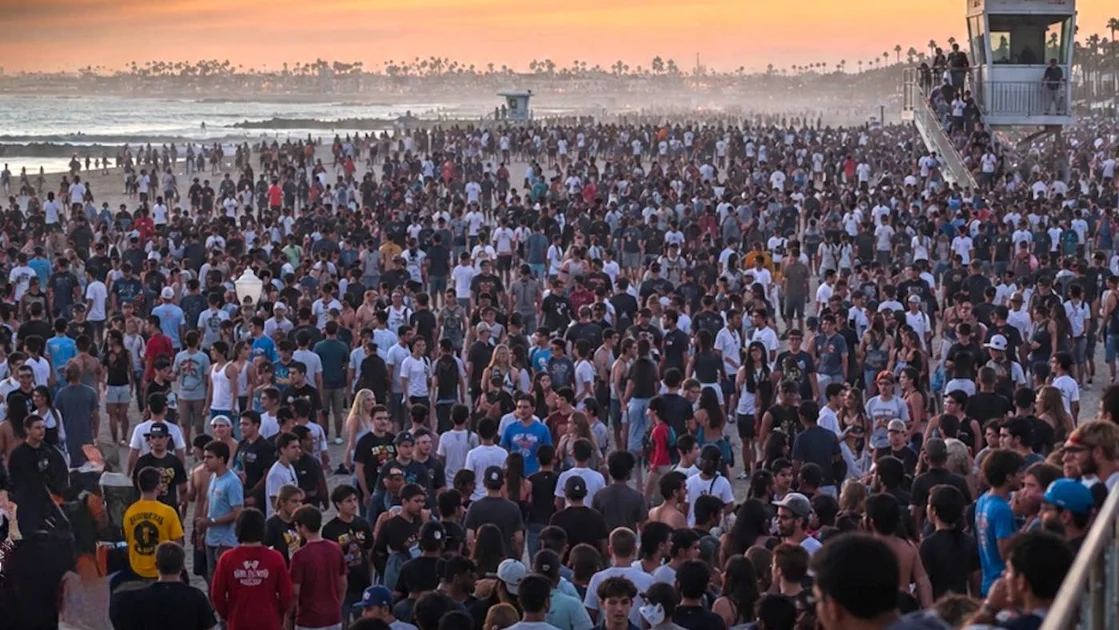
Newport Beach, California — A Fourth of July celebration spiraled into unprecedented chaos on Saturday, July 4, 2026, resulting in the arrest of 402 individuals after a crowd of thousands swarmed the Balboa Peninsula, launched fireworks at police officers, looted a grocery store, and sparked widespread disorder. Police declared an unlawful assembly around 8:30 p.m., calling in reinforcements from 17 regional law enforcement agencies to supplement 350 Newport Beach officers in what authorities described as a two-hour battle to regain control of the streets and beaches.
“We had a large unruly crowd of close to 3,000 people fighting and causing massive disruption from 29th street to 35th street,” Deputy Chief of Police Joshua Vincelet told local media. The situation escalated so rapidly that a “999” emergency call — code for an officer in distress — was issued, prompting a swarm of mutual aid from surrounding cities, including Fullerton. Police helicopters hovered overhead, warning revelers via loudspeaker to disperse or face arrest.
By the time the dust settled between midnight July 3 and 6 a.m. July 5, law enforcement had booked more than 400 people, a staggering sevenfold increase from the 60 arrests made during the same holiday window in 2025. Approximately 200 of those arrested had remained near 28th Street after repeatedly ignoring lawful orders to leave, according to police. One officer was struck by a mortar-style firework but was treated at the scene and released.
TikTok ‘Takeover’ and Social Media Frenzy
City and police officials quickly pointed to social media platforms — particularly TikTok — as the primary accelerant for the chaos. The Newport Beach Police Association posted on Facebook that “a large group of agitators invaded Newport Beach, spurred on by an alleged ‘TikTok Takeover.’ These persons came to our city with the intent on causing harm, injury, and destruction.”
Mayor Lauren Kleiman confirmed that a surge of videos showing young people lighting illegal fireworks and engaging in rowdy behavior on the peninsula began circulating Saturday afternoon. By 9 p.m., the number of people in the area had tripled, as crowds of juveniles and young adults streamed in from across Southern California and beyond. Police said social media posts drew “a large influx of juveniles and young adults to the Newport Pier area within a matter of minutes.”
Eyewitness footage captured by news outlets and bystanders showed scenes of mayhem: large aerial fireworks detonating at ground level inside packed crowds, individuals in Spider-Man masks climbing traffic lights and leading chants of “USA, USA, USA,” and fistfights erupting along the beach. One video recorded an unknown person throwing a lit firework directly into a group of people, while others showed participants tearing down street signs and using them as weapons.
Emily Alcala, an 18-year-old visiting from Las Vegas, described the scene as terrifying: “It’s very unsafe to have fireworks popped in the middle of crowds. There was a firework to your left, [then] you run to your right and there was a firework [there]. It was very chaotic. There was no way that you could go that was safe at all.”
Looting, Vandalism, and Property Damage
The unrest was not confined to the beaches and streets. Around 10 p.m., a mob descended on the Pavilions grocery store on West Balboa Boulevard, where videos show individuals smashing windows, grabbing merchandise, and ransacking shelves. The store remained closed Sunday as locals organized cleanup efforts. Stephanie Burke and her 17-year-old daughter Ashlyn were among volunteers who helped pick up trash and debris scattered by the crowd, part of an initiative by the brand “Don’t Care” to restore the beach.
In addition to the looting, numerous vehicles were vandalized, and several businesses in the area reported property damage. Police have not yet released a full estimate of the financial toll, but officials promised a thorough post-holiday safety review. The city had already instituted a “Not in Newport” zero-tolerance policy ahead of the holiday, tripling fines in designated safety zones and threatening one-strike permit revocations for short-term rentals tied to unruly gatherings. Despite those measures, the sheer size and speed of the crowd overwhelmed existing enforcement.
Why It Matters: A Wake-Up Call for Coastal Cities
From Holiday Tradition to Public Safety Crisis
The Newport Beach riot marks a dangerous escalation of a trend seen in recent years across U.S. coastal cities: large, unpermitted gatherings organized through social media that quickly spiral into violence. In 2025, similar TikTok-driven “takeovers” occurred in Huntington Beach and Santa Monica, but the scale of arrests and destruction in Newport Beach this weekend dwarfs those earlier incidents. The fact that roughly half of those detained were juveniles or young adults—and that many had traveled from out of state—raises urgent questions about how cities can anticipate and contain flash mob-style events.
“The situation escalated and police issued a 999 — an officer needs help call — prompting at least a hundred officers from surrounding agencies to converge on the location,” reported County News Service, a freelance videographer who documented the response. The reliance on mutual aid from 17 different law enforcement agencies highlights the strain that such events place on local police departments, especially during peak holiday weekends when staffing is already stretched.
Legal and Policy Fallout
In the aftermath, city leaders face intense pressure to deliver solutions. Mayor Kleiman has called for a comprehensive review of the city’s crowd-control protocols and social media monitoring capabilities. Some council members have floated the idea of implementing a temporary curfew for minors during major holidays, while others argue for stricter enforcement of existing firework bans. California state law already prohibits the sale and use of most aerial fireworks, but enforcement has historically been lax on July 4th.
Legal experts note that the sheer volume of arrests — more than 400 in a single weekend — will strain the Orange County court system and public defender resources. Many of those arrested face charges ranging from unlawful assembly and failure to disperse to assault on a police officer, looting, and possession of destructive devices. Prosecutors will likely seek enhanced penalties for those accused of throwing fireworks at officers or into crowds, as such actions can be charged as felonies.
Community Response and Cleanup
On Sunday, Newport Beach residents and business owners began the slow process of cleaning up. Volunteers swept broken glass from the streets, and store owners boarded up windows at Pavilions. The city closed all beaches from 28th to 36th streets through Monday to allow for debris removal and forensic investigation.
Local leaders have emphasized that the violence does not reflect the character of Newport Beach, a wealthy Orange County community known for its upscale waterfront homes and family-friendly tourism. “This was not a celebration,” Deputy Chief Vincelet said. “This was an invasion by a mob intent on causing destruction. We will hold every single person accountable to the fullest extent of the law.”
Perspective: What This Changes for Summer Gatherings Nationwide
The Social Media Wildfire Problem
The Newport Beach riot is a stark illustration of how quickly digital coordination can translate into real-world chaos. Unlike organized protests or permitted events, these ad-hoc “takeovers” emerge organically — often with no identifiable leader or clear demand — making them nearly impossible for authorities to preempt. Law enforcement agencies across the country are now racing to adapt: using social media monitoring tools to detect spikes in location-tagged posts, deploying mobile surveillance units, and coordinating cross-jurisdictional response plans.
In a statement Sunday, the Newport Beach Police Department acknowledged that “late in the evening, social media posts drew a large influx of juveniles and young adults to the Newport Pier area within a matter of minutes.” That velocity — going from hundreds to thousands of people in under an hour — is a nightmare scenario for public safety officials. Traditional crowd-control tactics, like establishing perimeter checkpoints, become impossible once a critical mass is reached.
Broader Implications for Tourism and Economy
For a city that heavily depends on tourism, especially during the summer season, the riot threatens to tarnish Newport Beach’s image. The Fourth of July is typically one of the busiest and most profitable weekends for local hotels, restaurants, and rental properties. In response to the chaos, short-term rental platforms like Airbnb and Vrbo may face increased pressure to enforce stricter guest screening and party bans — a policy shift that could affect travelers nationwide.
Meanwhile, similar incidents have occurred in other parts of the world. Natural disasters and civil unrest often force cities to reassess their emergency protocols. For instance, the Mount Etna Eruption in June 2026 grounded flights and disrupted transportation, underscoring how quickly unforeseen events can paralyze a region. While the causes differ — volcanic ash vs. human behavior — the need for rapid, coordinated response remains the same.
A Turning Point for Holiday Policing?
Looking ahead, the events in Newport Beach may prompt other coastal cities to adopt stricter holiday policing strategies. Already, Los Angeles County has announced it will review its July 4th deployment plans, and Huntington Beach — which experienced its own TikTok-driven riot in 2025 — is considering a ban on unaccompanied minors after dark during holiday weekends.
In contrast, the calm and orderly behavior of the majority of holiday revelers — families who attended sanctioned fireworks shows and beach barbecues — was largely overshadowed by the chaos. The challenge for officials will be to design interventions that target the bad actors without punishing the broader public. Mayor Kleiman summed up the dilemma: “We will not allow a small, violent group to ruin the Fourth of July for everyone. But we also have to be realistic about the power of social media to incite lawlessness. The rules of the game have changed, and we need to change with them.”
For now, Newport Beach remains on edge. Police have increased patrols through the rest of the summer, and residents are bracing for the possibility of copycat events. As one local business owner, who asked not to be named, put it: “We got through COVID, we got through the wildfires. Now we have to figure out how to survive a TikTok riot. It’s a new world.”
Comments