
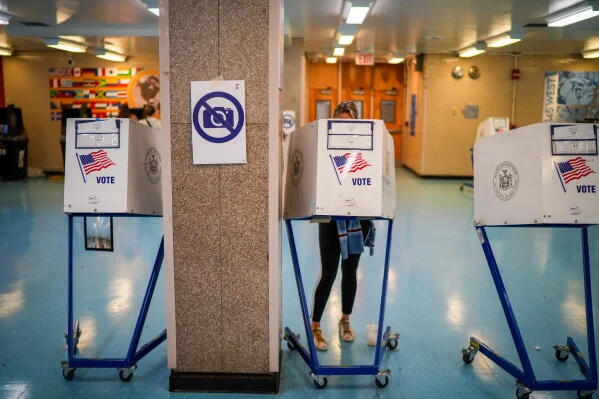
A Night of Change: Voters Reshape the Political Landscape in New York and Maryland Primaries
The 2026 primary elections delivered a series of decisive upsets and confirmations on Tuesday, reshaping the political map in key districts from New York City to Maryland. With more than 90 percent of votes counted in several hotly contested races, voters sent a clear message about the direction they want for their parties, particularly on issues of economic justice, foreign policy, and the influence of establishment endorsements.
In New York, the most watched race of the night was in the state's 10th Congressional District, where former New York City Comptroller Brad Lander unseated incumbent Congressman Dan Goldman. With 90 percent of votes in, Lander led by a commanding 65.8 percent to 34.0 percent, a margin that caught many political observers off guard. Goldman, a lead counsel in the first impeachment trial of President Donald Trump and an heir to the Levi Strauss fortune, had poured millions of dollars of his own money into the race and enjoyed endorsements from Governor Kathy Hochul and House Minority Leader Hakeem Jeffries. Yet Lander's progressive platform, including labeling Israeli actions in Gaza a genocide, resonated strongly in a district with a large Jewish population deeply divided over U.S.-Israel relations.
Further north, in New York's 7th Congressional District, State Assemblymember Claire Valdez defeated Brooklyn Borough President Antonio Reynoso. Valdez, a member of the Democratic Socialists of America and an early supporter of Mayor Zohran Mamdani, won with 56.1 percent of the vote against Reynoso's 35.8 percent. The race to replace longtime incumbent Nydia Velázquez—who backed Reynoso—became a proxy battle between the city's progressive grassroots and its establishment machine. Mayor Mamdani's backing of Valdez proved decisive, as she swept the district often called the "Commie Corridor" for its left-wing leanings.
In the 12th Congressional District, the race to succeed retiring Congressman Jerry Nadler was the most crowded of the night. State Assemblymember Micah Lasher emerged victorious with 39.1 percent of the vote, followed by Assemblymember Alex Bores at 35.0 percent. Jack Schlossberg, the grandson of President John F. Kennedy and a political influencer, finished third with 10.8 percent. Lasher's victory, while not a landslide, gives the progressive wing another reliable vote in Congress. The district's diverse electorate had closely watched the contest as a bellwether for whether celebrity status or legislative experience would prevail.
In Maryland, incumbent Governor Wes Moore easily secured the Democratic nomination for a rematch against Republican Dan Cox in November. Moore, a rising star in the national Democratic Party, faced no serious primary challenge. Cox, a far-right figure endorsed by former President Trump, won the Republican nomination again, setting up a general election battle that will test Moore's appeal in a state that is reliably blue but has pockets of conservative strength.
The most intriguing Maryland result came in the 5th Congressional District, where Adrian Boafo won the Democratic nomination to replace retiring Congressman Steny Hoyer, the longtime House Majority Leader. Boafo, a former Capitol Hill staffer and community organizer, emerged from a crowded field that included state legislators and local activists. He will face Republican Chris Chaffee in the fall. The contest signals a generational shift in a district that has been represented by Hoyer since 1981.
Why These Primaries Matter: Stakes and Background
The 2026 primaries are taking place against a backdrop of profound national anxiety. The economy, while technically stable, has left many working families struggling with the cost of living. Immigration enforcement remains a flashpoint, with recent reports like ICE's backing down from a $700 million warehouse plan underscoring the volatility of the issue. And international affairs—particularly the ongoing war in Gaza—have fractured the Democratic coalition in ways that were on full display Tuesday night.
In New York's 10th District, the race between Goldman and Lander was arguably the most potent illustration of this fracture. Goldman, who served as a lead House impeachment manager, had positioned himself as a moderate institutionalist. He argued that his experience and relationships in Washington made him the most effective representative for the district. Lander countered that Goldman was a "career politician" who spent millions of his own money to maintain a seat that should belong to the community. But it was the issue of Israel that truly divided them.
Goldman strongly defended U.S. military aid to Israel, though he criticized Prime Minister Benjamin Netanyahu's government and said he saw no evidence of genocide. Lander called Israel's actions a genocide and attacked Goldman for what he characterized as complicity. In a district that is home to one of the largest Jewish populations in the country, the debate was deeply personal for many voters. Exit polls suggested that Jewish voters split roughly evenly, while younger voters and Arab American voters overwhelmingly backed Lander.
In the 7th District, the race to replace Nydia Velázquez reflected the growing influence of organized progressive movements. Velázquez, who had served since 1993, endorsed her protégé Antonio Reynoso, a mainstream progressive. But Claire Valdez, backed by Mayor Zohran Mamdani and the DSA, ran on a platform of abolishing ICE, enacting Medicare for All, and cutting off military aid to Israel. She also tapped into voter frustration with the party establishment. With her victory, the DSA now holds a direct line to a congressional seat in one of the most left-wing districts in the nation.
Maryland's primary, while less dramatic, nonetheless matters for national politics. Governor Wes Moore is widely seen as a potential future presidential candidate. His ability to win the general election in November, especially against a divisive opponent like Dan Cox, will be closely watched by national Democrats. A strong showing could position Moore for a larger role in 2028 or beyond. Meanwhile, the open seat in Maryland's 5th District, long held by Steny Hoyer, is a chance for younger Democrats to establish themselves. Adrian Boafo's victory signals that the party's base is hungry for new faces and fresh ideas.
Another key takeaway from New York was the performance of several other races. In NY-13, Darializa Avila Chevalier narrowly defeated incumbent Adriano Espaillat, 49.4 to 45.9 percent. The race was called with 88 percent of votes in. Espaillat, the first formerly undocumented immigrant elected to Congress, had represented the district since 2017. Avila Chevalier, a former Obama administration official, ran on a platform of housing affordability and public safety, successfully appealing to working-class voters and younger families who felt left behind by the district's rising rents.
In NY-17, Cait Conley won the Democratic primary with 49.5 percent of the vote, defeating Beth Davidson and Effie Guadalupe Phillips-Staley. Conley, a former cybersecurity official, emphasized her experience in government and her ability to work across the aisle. The race had been relatively low-profile but attracted national attention as a test of whether moderate Democrats could hold their ground in an increasingly polarized environment.
Broader Implications: What This Changes
The results from Tuesday's primaries offer a clear snapshot of where the Democratic Party is headed in 2026 and beyond. The biggest story is the resurgence—and consolidation—of the progressive wing. Brad Lander's victory over an incumbent with near-universal establishment support is a warning shot to moderate Democrats who have relied on institutional backing without a strong grassroots operation. It suggests that voters, particularly in urban districts, are willing to punish incumbents they perceive as out of touch on foreign policy and economic justice.
At the same time, the results show that progressives are not a monolith. In NY-12, Micah Lasher, a more pragmatic progressive, won over the more left-wing Alex Bores and the celebrity candidacy of Jack Schlossberg. This suggests that while voters want change, they are not automatically drawn to the most extreme or the most famous candidate. Lasher's victory came on the strength of his legislative record and his ability to build a broad coalition, including support from labor unions and local elected officials.
The Maryland primary underscores a different trend: the power of incumbency and name recognition in quieter races. Governor Wes Moore's unopposed path to the general election means he can husband resources and focus on the fall campaign. The 5th District race, meanwhile, is a reminder that open seats still attract intense competition, and that the next generation of Democratic leaders is eager to step up.
One surprising subplot from the night was the relatively low turnout, despite the high-profile nature of several races. In New York, only about 18 percent of registered Democrats voted in the primary. This is typical for midterm primaries but raises questions about enthusiasm heading into November. The races that did generate excitement—especially NY-10 and NY-07—saw slightly higher turnout, but overall voter engagement remains a concern.
The 2026 primaries also have implications for national politics. The anti-incumbent sentiment that characterized the night is not unique to New York. Across the country, from Maryland to Colorado, primary voters have shown a willingness to challenge sitting representatives and to elevate candidates who advocate for more aggressive action on climate, housing, and foreign policy. This could spell trouble for establishment figures in other states as the general election approaches.
For Republicans, the night was quieter but not without significance. In New York's 21st District, Anthony Constantino won the Republican primary with 59.3 percent of the vote. The district, which covers the Adirondacks and parts of the North Country, is reliably Republican in presidential years but has shown competitive tendencies in midterms. Constantino will face Democrat Blake Gendebien, who won his primary with 64.7 percent, in what promises to be a closely watched race.
In Maryland, Dan Cox's victory in the Republican gubernatorial primary sets up a rematch with Wes Moore. Cox lost by a wide margin in 2022, but the political landscape has shifted. Moore must defend his record while Cox tries to tie him to President Biden's unpopularity. The race will be a test of whether the national mood can overcome strong state-level incumbency.
Looking ahead, the results from Tuesday suggest that 2026 will be a year of intense ideological battles within both parties. For Democrats, the tension between the progressive and moderate wings is far from resolved. For Republicans, the pull of Trump-aligned candidates remains strong, even as some voters signal a desire for more traditional conservatism.
In New York, the general election will feature several of Tuesday's winners. Brad Lander will face a Republican challenger in a district that leans heavily Democratic, making his general election victory all but certain. Claire Valdez will similarly be heavily favored. But for many of the incoming freshmen, the real work begins now: building a coalition that can survive the general election and then deliver on the promises that got them here.
As the dust settles, one thing is clear: the 2026 primaries have reshaped the Democratic caucus in the House. The question now is whether that new caucus can unite around a common agenda—and whether it can withstand the challenges of a divided government and a polarized electorate. For voters who turned out on Tuesday, the change they sought has arrived.
Comments