
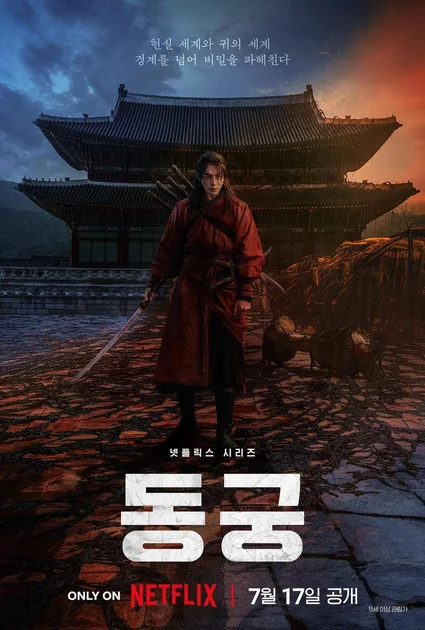
The East Palace Arrives to Mixed But Passionate Reviews
Netflix has quietly released what many are calling the first K-drama blockbuster of 2026: The East Palace. The supernatural period horror series, which dropped in full on July 17, has already ignited a fierce debate among critics. Some hail it as a spellbinding fantasy epic, while others find its mythmaking overwrought and its originality lacking.
The eight-episode series, directed by Choi Jung-kyu (The Devil Judge) and written by Kwon So-ra and Seo Jae-won (Bulgasal: Immortal Souls), stars Nam Joo-hyuk in his long-awaited return to television after a three-year hiatus. He plays Gu-cheon, a man with the ability to see spirits and travel to a hellish dimension called the Realm of Gwi. Roh Yoon-seo co-stars as Saeng-gang, a court lady with supernatural gifts, and Cho Seung-woo portrays a desperate king whose heirs are dying one by one under mysterious circumstances.
The early critical reception is sharply divided. At Collider, Kelcie Mattson awarded the series a glowing review, calling it "the most spellbinding fantasy epic of 2026" and praising its fusion of traditional Korean costume drama with supernatural horror and political intrigue. Conversely, the South China Morning Post’s Pierce Conran gave it just 2.5 out of 5 stars, arguing that while the visuals dazzle, a "lack of originality and convoluted mythmaking hold it back."
Screen Rant’s Shealyn Scott, who reviewed the first four episodes, took a middle ground, applauding the show’s "delightfully serpentine storytelling" and its seamless blending of Korean folklore and horror. ButWhyTho’s LaNeysha Campbell also praised the series, highlighting Nam Joo-hyuk’s emotional depth and the gradual revelation of Gu-cheon’s traumatic past.
Why the Stakes Are High for Netflix’s K-Drama Slate
The mixed critical reception comes at a pivotal moment for Netflix’s Korean content strategy. The platform has invested heavily in K-dramas as a global growth driver, and The East Palace represents a high-profile test of whether lavish period horror can replicate the success of hits like Kingdom and The Squid Game.
The series is a collaboration with Imaginus, the production company behind last year’s Tempest and the recent romantic hit Can This Love Be Translated?. It arrives as part of a broader July wave of Korean horror content — including Na Hong-jin’s big-budget sci-fi creature epic Hope and the horror-romcom Spooky in Love — signaling a genre resurgence in South Korea.
For Netflix, The East Palace is also a vehicle to bring back a beloved star. Nam Joo-hyuk, known for Twenty-Five Twenty-One and Weightlifting Fairy Kim Bok-joo, has been absent from the small screen since 2023. His return is a major draw for domestic and international fans alike. The show also marks a return to dark fantasy for director Choi Jung-kyu, whose previous work The Devil Judge earned a cult following.
The Story: A Royal Curse and a Spirit Slayer
At the heart of The East Palace is a classic horror setup: a royal family cursed by an unseen entity. The king’s heirs are dying under inexplicable circumstances, mirroring events that occurred 30 years earlier. Desperate, the king kidnaps Gu-cheon, a preternatural expert on spirits. Gu-cheon can see ghosts and travel to the Realm of Gwi, a crimson-tinted hellscape where vengeful souls torment the living. He is joined by Saeng-gang, a court lady with her own hidden powers.
The narrative unfolds as a mystery: who — or what — is killing the princes? The show layers court intrigue with supernatural horror, building toward a revelation that ties the present curse to the king’s own bloody past. Critics agree that the world-building is ambitious, but some argue that the mythology becomes tangled. The SCMP review noted that the series struggles to balance its exposition with character development, occasionally sacrificing emotional payoff for lore.
Performance Highlights: Nam Joo-hyuk’s Comeback
Reviewers across the spectrum have praised Nam Joo-hyuk’s performance. At ButWhyTho, Campbell noted that his portrayal of Gu-cheon lends "emotional depth through his expressions, especially in quiet moments." Initially appearing apathetic and selfish, Gu-cheon gradually reveals a traumatic past that explains his reluctance to use his powers. Screen Rant’s Scott echoed this, writing that his return is "certainly worth the wait."
Roh Yoon-seo, who gained recognition in Crash Course in Romance and 20th Century Girl, is described as an invaluable ally to Gu-cheon. Their dynamic as narrative foils — he a weary spirit slayer, she a mysterious court lady — is one of the show’s strongest elements. Cho Seung-woo, known for Stranger, delivers a restrained but menacing performance as the king, a ruler driven to extremes by grief and ambition.
What This Means for K-Drama and Streaming
The polarized reception of The East Palace reflects a broader trend in the streaming era: ambitious genre-blending projects often divide critics, even as they attract large audiences. The show’s visual splendor — the lavish palace sets, the crimson Realm of Gwi, the intricate costumes — is almost universally praised. The question is whether that polish is enough to overcome storytelling hiccups.
For Netflix, the series is a reminder that originality remains a challenge in the crowded K-drama market. The platform has found enormous success with genre hybrids like Kingdom (zombies + Joseon politics) and The Glory (revenge drama), but The East Palace may struggle to stand out if viewers find its mythology too familiar or convoluted.
Yet early social media buzz suggests strong viewer interest, particularly among international audiences drawn to historical fantasy and horror. The show’s release strategy — dropping all episodes at once — is designed to encourage binge-watching, a model that has worked well for other Netflix K-dramas such as The 8 Show and Bloodhounds.
The Horror Renaissance in Korean Content
The summer of 2026 is shaping up to be a season of Korean horror. The East Palace joins Hope and Spooky in Love in a genre resurgence that has been building since last year. This could signal a lasting shift in the K-drama landscape, where horror and dark fantasy become more mainstream, moving beyond niche audiences.
If The East Palace proves a commercial success, it may encourage Netflix to greenlight more period horror projects. If it falters, the lesson may be that audiences want tighter plotting alongside visual ambition. For now, the show is a fascinating case study in how high expectations collide with mixed execution — and a testament to the enduring appeal of ghosts, palaces, and star power.
For more on what’s streaming this month, check out our Netflix July 2026: New Movies, British Series, and 40-Title Weekly Rollout guide.
Comments