
Italy Raises Mount Etna Alert Level as Lava Flows Intensify
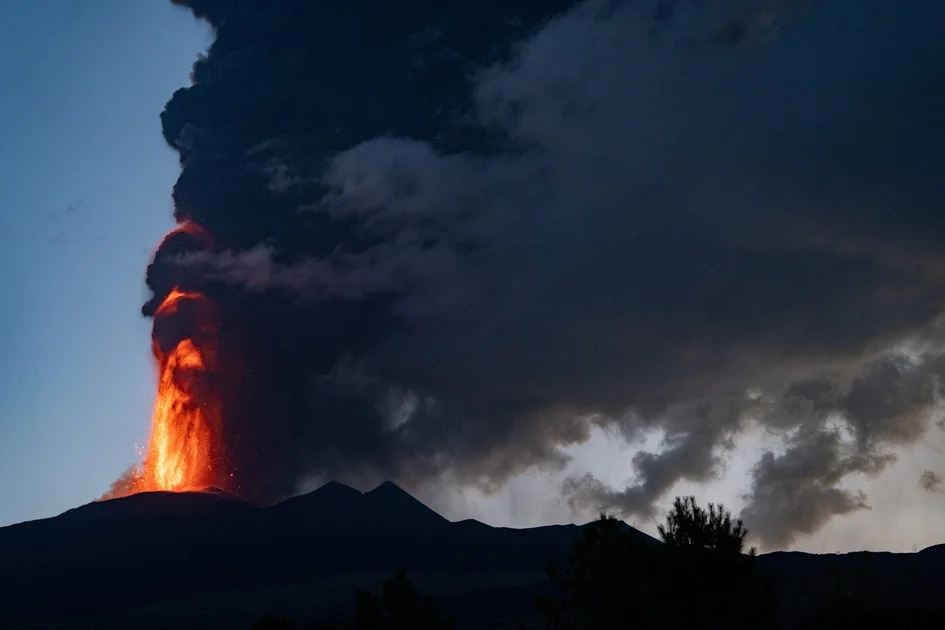
Italian authorities have raised the alert level for Mount Etna after a surge in volcanic activity sent lava cascading down the volcano's eastern slope. The Italian Civil Protection Department upgraded the status from green to yellow on June 28, following what it described as "effusive activity" linked to a sharp rise in volcanic tremor. The change signals a heightened phase of monitoring and the potential for more energetic eruptions in the days ahead.
According to Italy's National Institute of Geophysics and Volcanology (INGV), lava began flowing at an altitude of approximately 9,800 feet on Etna's eastern flank. Scientists noted that the activity reflects a shift in the volcano's internal dynamics, which can sometimes precede intensified eruptions. The Civil Protection Department warned that the current scenario could escalate, prompting authorities to strengthen observation systems and prepare for possible further developments. As of the latest reports, no evacuations have been ordered.
Footage Captures the Spectacle
Dramatic visuals have emerged from the region. A drone image captured by Reuters photographer Giuseppe Di Stefano on June 29 shows a stream of molten lava glowing against the dark slopes of the volcano, while NBC News video footage displays lava flowing from Mount Etna lighting up Sicily's night sky. The images underscore the raw power of Europe's largest and most active volcano, which has been a near-constant presence in the lives of Sicilians for millennia.
Why This Eruption Matters
Mount Etna, designated a UNESCO World Heritage Site, is among the most monitored volcanoes on Earth. Its activity is typically characterized by episodic eruptions, lava flows, and ash emissions. The current uptick in activity comes at a time when scientists are gaining new insights into the volcano's deep plumbing—insights that could reshape how eruption risks are assessed not only for Etna but for volcanoes worldwide.
The alert level change from green to yellow is a significant step. Under Italy's civil protection system, green indicates normal activity, while yellow signals the need for heightened surveillance. The next level, orange, would imply a potential for eruption, and red means an eruption is imminent or underway. The current yellow designation means that local authorities, volcanologists, and emergency services are now operating under a state of increased readiness.
A New Scientific Understanding of Etna’s Ancient Eruptions
While the current eruption captures headlines, a groundbreaking study published just days earlier in the journal Geochemistry, Geophysics, Geosystems is reshaping the scientific understanding of how Mount Etna behaves. Researchers from Cornell University have found that two of Etna’s most powerful ancient eruptions were driven by completely different underground processes, operating through separate pathways, at different depths, and on vastly different timescales.
The Role of Volcanic Gases
To understand the significance of this finding, one must first grasp what controls the explosiveness of a volcanic eruption. The key lies in gases dissolved within magma—primarily water vapor and carbon dioxide. Think of it like a bottle of fizzy soda: if opened slowly, the gas escapes gently; if shaken and opened abruptly, the result is explosive. Magma behaves similarly. The speed at which gases escape, and the depth at which they separate from the molten rock, determines whether an eruption is a gentle lava flow or a violent explosion.
For decades, scientists believed that water was the dominant driver of volcanic eruptions. But in 2023, the same Cornell-led research group demonstrated that carbon dioxide can also trigger explosive eruptions—a discovery that opened an entirely new line of inquiry. The latest study builds on that work, using a technique called Raman spectroscopy to analyze tiny pockets of gas trapped inside crystals in ancient lava deposits.
Two Eruptions, Two Different Routes
By examining these microscopic time capsules, the researchers were able to reconstruct the underground journeys of two major eruptions from Etna’s past. They discovered that the magma for each eruption rose through completely separate pathways, originating at different depths and driven by different gas cocktails. One eruption was fueled primarily by water vapor escaping at shallow depths; the other was driven by carbon dioxide released from much deeper within the Earth’s crust. The findings challenge the long-held assumption that a single volcano has a uniform magma plumbing system.
This has profound implications for hazard assessment. If volcanoes can host multiple, independent magma pathways beneath the same summit, then monitoring data—such as ground deformation or gas emissions—may need to be interpreted differently. A change in one part of the system might not signal an eruption from the same conduit, and the warning signs for one type of eruption could be completely different from another.
Broader Implications for Volcano Monitoring Worldwide
The Cornell study is part of a larger shift in volcanology toward recognizing complexity in what were once thought to be simpler systems. Etna, with its long eruptive history and extensive monitoring network, serves as an ideal natural laboratory. The techniques used in this research—especially Raman spectroscopy—could soon be applied to other active volcanoes, from Vesuvius to Kilauea, to map their hidden plumbing.
The Stakes for Sicily and Beyond
For the millions of people living on the slopes of Etna and in the city of Catania, understanding these deep processes is not an academic exercise. The volcano’s eruptions can disrupt air travel, damage infrastructure, and threaten lives. In 2002, a major eruption destroyed the tourist complex at Piano Provenzana. In 2017, ten people were injured by an explosion during a lava flow. More recently, in 2021, Etna produced a series of spectacular paroxysms that sent ash clouds across the Mediterranean.
The current lava flow, while not immediately threatening populated areas, serves as a reminder of the volcano’s restless nature. The INGV continues to monitor seismic activity, ground deformation, and gas emissions around the clock. The combination of real-time data and new scientific models could eventually allow for more precise forecasts of when and how the next major eruption will occur.
What This Changes
The convergence of an active eruption and a paradigm-shifting scientific study creates a unique moment for the field of volcanology. For the first time, researchers have shown that a single volcano can harbor multiple, independent eruption pathways that operate on different timetables and respond to different triggers. This means that the traditional model—where a volcano has one main conduit feeding from a single magma chamber—is too simplistic.
A New Era of Risk Assessment
In practical terms, this could lead to more nuanced alert systems. Instead of a single status for a volcano, authorities might need to assess risks for different sectors or depths. For example, shallow, water-driven eruptions might produce more ash and pose a greater threat to aviation, while deep, carbon-dioxide-driven events could generate faster-moving lava flows that reach populated areas more quickly.
The study also underscores the importance of investing in cutting-edge analytical tools. Raman spectroscopy, which uses laser light to identify the molecular composition of samples, is not new, but its application to volcanic gas inclusions is a relatively recent innovation. As the technique becomes more widespread, it could become a standard part of volcanic monitoring, much like seismometers and GPS stations are today.
A Window Into the Planet’s Interior
Beyond its immediate practical applications, the research offers a rare glimpse into the dynamic processes that shape our planet. Volcanoes are the surface expressions of Earth’s internal heat engine, and understanding how they work is key to understanding plate tectonics, mountain building, and even the origin of the atmosphere. Every eruption, whether ancient or ongoing, carries information about conditions deep beneath our feet that would otherwise be inaccessible.
As Etna continues to light up the Sicilian sky, the scientists who study it are reminded that every eruption is both a spectacle and a message. The current lava flow, spectacular as it is, is only the most visible part of a far larger story—one that scientists are only now beginning to read.
Conclusion
Mount Etna’s latest eruption has captured global attention, both for its dramatic visuals and for the scientific advances it accompanies. While Italian authorities maintain a vigilant watch over the volcano’s current activity, researchers are rethinking the fundamental architecture of volcanic systems. The new study from Cornell University demonstrates that Etna’s ancient eruptions were not all alike; they traveled different paths, driven by different gases, from different depths. This discovery will influence how volcanoes are monitored and how eruptions are forecast in the future.
For now, the focus remains on safety. The Civil Protection Department has advised the public to stay informed through official channels and to avoid restricted areas near the lava flows. As one of the world’s most active and best-studied volcanoes, Mount Etna continues to teach us new lessons—both about the forces that shape our planet and about how we can live alongside them.
Comments